
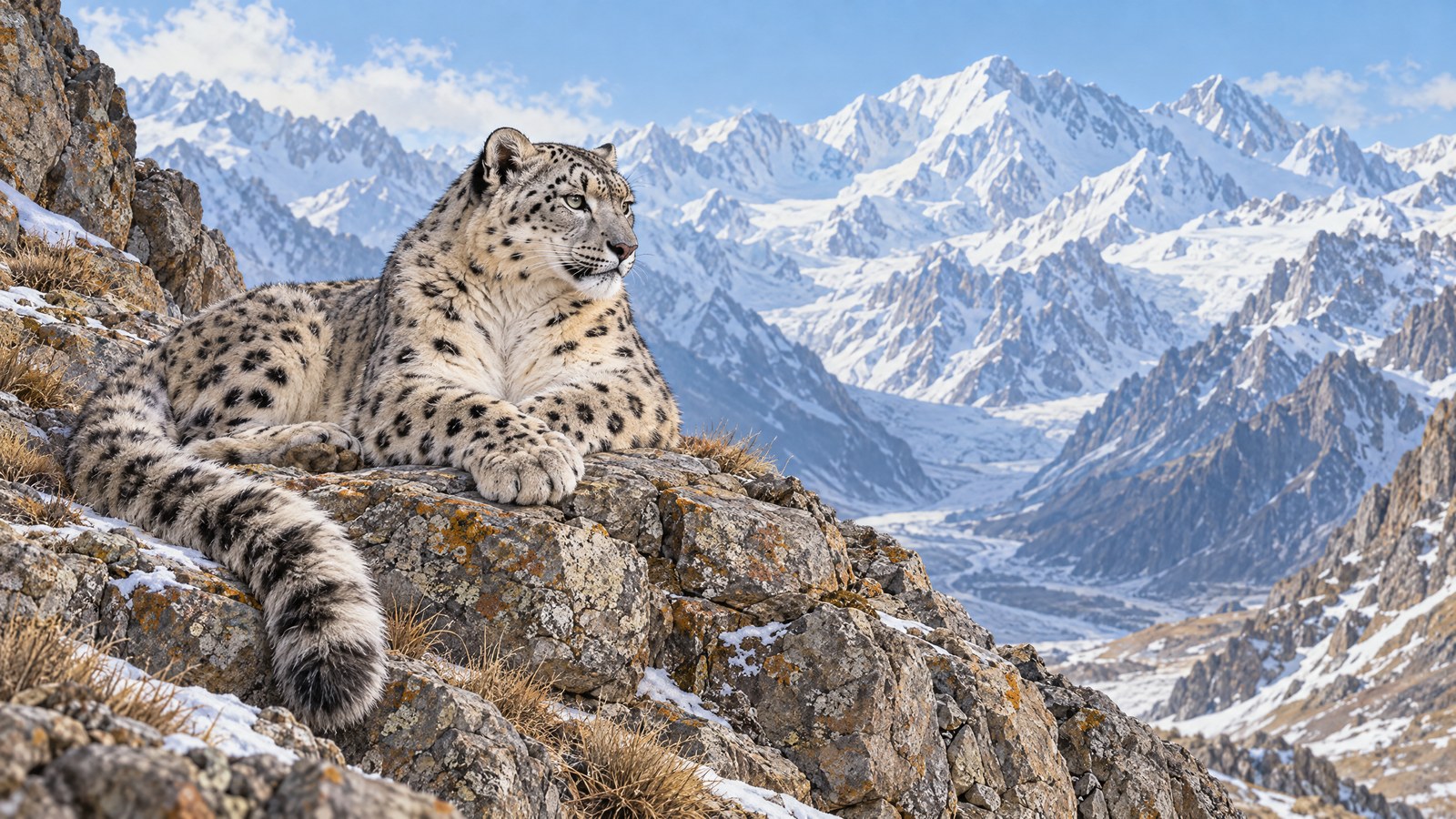

Kyrgyzstan has opened the Ak Ilbirs research and rehabilitation centre in Ananyevo village, in the Issyk-Kul Region, setting up a dedicated base for work on snow leopards and other rare wildlife. The opening ceremony took place on 23 October and was attended by the chairman of the Kyrgyz cabinet, Adylbek Kasymaliev, and Rustam Minnikhanov, the head of Tatarstan.
The centre combines scientific, veterinary and rehabilitation functions in one site. Its planned work includes monitoring snow-leopard populations, genetic research and the creation of a biobank, alongside programmes intended to support the protection and restoration of the species. The facility is also intended to study other rare wild animals and help safeguard their genetic diversity.
A base for several parts of conservation work
The new centre has a total area of 1,600 square metres. Its buildings include administrative, laboratory and veterinary blocks, as well as a museum and conference section and residential accommodation. Bringing those facilities together is intended to give research and animal-care work a permanent home in the region.
Veterinary care and rehabilitation are part of the centre’s stated role, rather than additions to a research-only project. That could allow animals requiring treatment to be cared for while the wider programme develops evidence on the species and its habitat. The plans also include work on measures for restoring populations and supporting their eventual return to natural habitats.
Snow leopards hold particular national significance in Kyrgyzstan, where they are widely seen as a symbol of the country’s mountainous landscape. The government has presented the centre as a long-term conservation initiative focused on biodiversity as well as the protection of a species regarded as rare and at risk of extinction.
Monitoring, genetic work and training
Population monitoring is among the centre’s core planned activities. The programme is expected to gather information that can guide future protection work, while genetic studies and the biobank are intended to preserve material for research and conservation. The government has also set out plans to develop programmes specifically focused on conserving snow leopards.
Specialists from Kyrgyzstan and Russia are expected to work at the site. The project also includes an exchange of experience for students and early-career researchers, adding a training element to the scientific programme. Its conference facilities could provide a setting for that work and for discussions between specialists.
The opening does not itself establish a restoration outcome or a timetable for returning animals to the wild. It does, however, mark the completion of the physical facility and the start of a programme designed to link research, veterinary treatment, rehabilitation and conservation planning. The next measure of its impact will be how those planned functions are put into operation in Issyk-Kul.
Why the opening matters
Conservation projects can require different kinds of expertise at the same time: field monitoring to understand populations, laboratory work to examine genetic diversity, and veterinary capacity when individual animals need care. Ak Ilbirs has been designed around those connected needs. Its establishment gives those strands a shared base rather than treating them as separate tasks.
For the Issyk-Kul Region, the centre creates a new location for wildlife science and rehabilitation. For the national programme, it provides infrastructure intended to support continuing rather than one-off work on snow leopards. The centre’s value will depend on its future research, care and conservation activity, but its opening is a concrete step in putting that capacity in place.







