
Local restaurant aggregator app vs. big brands: Who wins?
In today’s busy world, food delivery apps are our best choice for convenience and variety. The meal delivery business is still changing quickly in 2025. Big meal delivery services like Uber Eats and DoorDash are the most popular, as they have a large customer base and utilise the latest technology. However, small restaurant aggregator apps are proliferating because they enable people to have unique experiences and connect with others in their community. This blog examines the key differences, pricing plans, technology, and future vision of meal delivery companies to help you determine who will emerge as the winner in this year’s competition.
Let’s examine the delicious battle between corporate convenience and local charm to see who wins your heart.
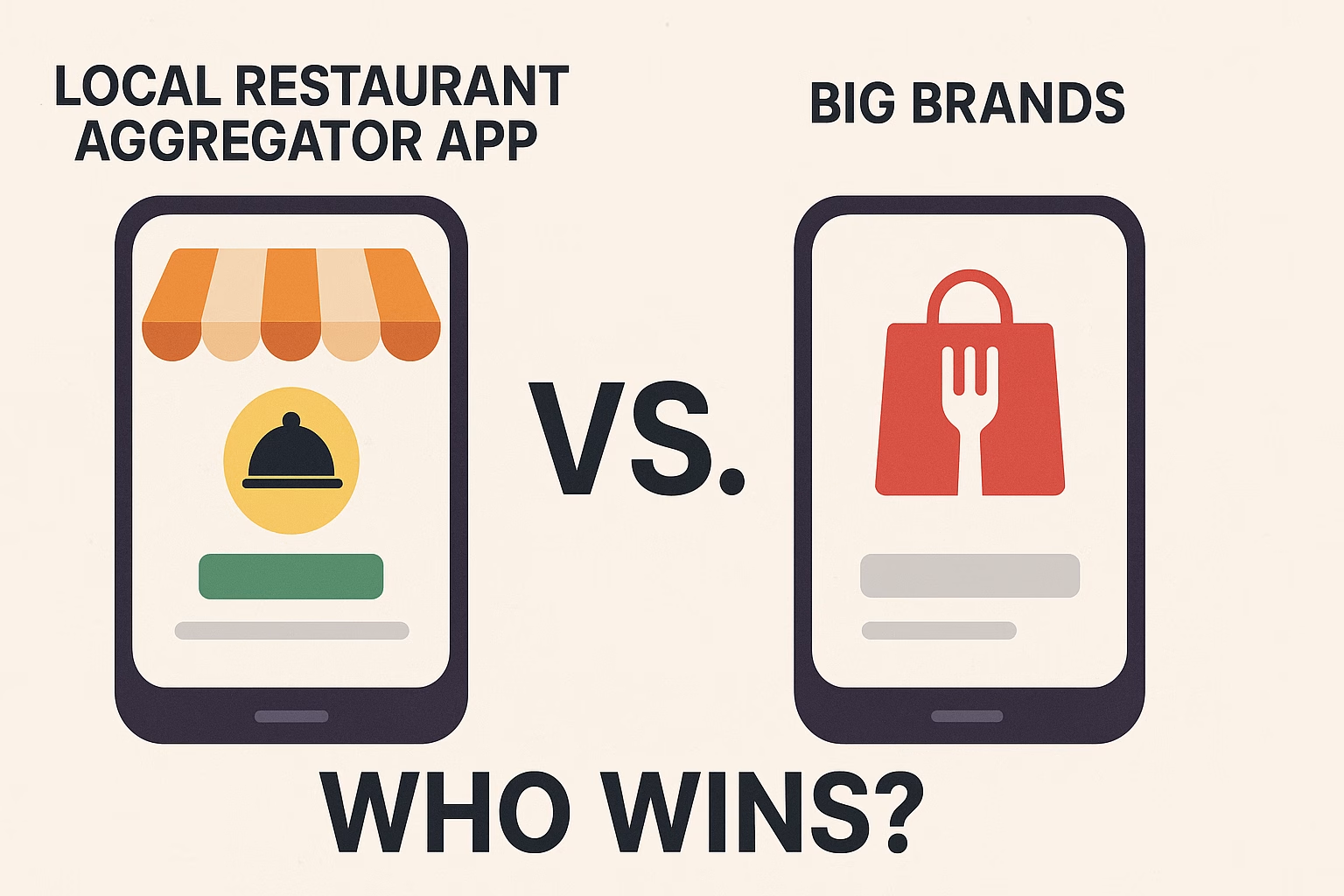
Local flavour rising: Why local restaurant aggregator apps are gaining popularity?
Local food delivery aggregator apps offer users genuine, community-driven options by showcasing carefully selected local restaurants. Personalised customer service fosters confidence, and their reduced commission costs support the success of small eateries. These platforms are gaining popularity as consumers seek to support local economies.
What makes them unique is as follows:
- Better commission rates and more flexible arrangements result from closer relationships with neighbourhood eateries.
- They frequently highlight undiscovered treasures—small, family-run businesses that aren’t accessible on large platforms.
- Faster problem-solving and increased confidence are two benefits of local customer service.
- Instead of appealing to multinational firms, they appeal to users who wish to support their local economy.
Examples of how local-first applications establish a strong connection with their customers include local food delivery apps like ChowNow and Slice, as well as region-specific platforms like Takeout Central in Raleigh or Zomato in India (in its early years).
Big food delivery brands: Powerhouses of convenience and scale
Big brands offer a wide range of dining options, sophisticated AI-powered recommendations, and efficient delivery systems. Ordering is made simple by their user-friendly apps and smooth payment integrations, particularly in cities where choice and quickness are crucial. Millions of people are guaranteed to remember them thanks to significant marketing expenditures.
Why people adore them:
- Big brands of restaurants serving a variety of cuisines.
- Big brands’ app functions include in-app promotions, loyalty plans, and real-time order tracking.
- On-time delivery are guaranteed by a robust logistics infrastructure.
Big brands’ budgets enable them to maintain their prominence through influencer, TV, and social media campaigns.
These apps offer the pinnacle of convenience for many users, particularly in cities where speed and variety are unavoidable.
Tech & user experience showdown: Comparing features of local apps and big brands
Big Brands set the trend with features such as being able to access their services from multiple platforms, offering dynamic pricing, and tracking GPS in real-time. Local apps excel in features such as localised incentive systems, straightforward user interfaces that prioritise transparency, and direct communication with restaurants. Both have unique benefits that appeal to different types of users. The food delivery app comparison table below compares the meal delivery applications side by side, allowing us to learn more.
| Feature/aspect | Local restaurant aggregator apps | Big brand aggregator apps |
| User Interface | Simple, easy-to-use with local focus | Advanced, polished, feature-rich |
| Real-Time Tracking | Limited or basic | Advanced GPS tracking with live updates |
| Personalization | Personalised recommendations, menu customisation | AI-driven recommendations and dynamic offers |
| Payment Options | Basic payment methods, some local integrations | Multiple payment options including BNPL, wallets |
| Customer Support | Localised, personalised support | 24/7 global support with AI chatbots |
| Restaurant Communication | Direct messaging between customer and the restaurant | Mostly app-mediated, limited direct contact |
| Security & Fraud Protection | Basic security measures | Robust security and fraud prevention systems |
| Loyalty Programs | Often integrated with local loyalty initiatives | Sophisticated, app-wide rewards and loyalty programs |
| Delivery Logistics | Smaller fleet, localised delivery | Large-scale, optimised logistics networks |
Key challenges facing local aggregators and big food delivery giants
Big companies are receiving a lot of negative press for charging exorbitant prices and facing problems that affect gig workers. Local apps, on the other hand, struggle because they can’t deliver to many places and have limited marketing reach. Both must continually come up with new ideas to stay competitive and meet the evolving needs of their clients in a crowded market.
Big brand challenges
- Criticism over high commission rates and treatment of gig workers.
- Increasing legal regulations and antitrust investigations in multiple countries.
- Loss of customer trust in oversaturated, ad-heavy apps.
Local app challenges
- Limited delivery fleets and service areas.
- Smaller marketing budgets make customer acquisition harder.
- Slower to roll out advanced features like AI or integrated rewards programs.
For both models, staying innovative while meeting evolving customer expectations is a balancing act.
Pricing models & restaurant profits: Which platform is more restaurant-friendly?
Local restaurant apps charge less and generate more revenue; therefore, they are better suited for small restaurants than large ones.
| Feature/criteria | Local restaurant aggregator apps | Big brand aggregator apps |
| Commission Fees | 5% – 15% | 25% – 35% |
| Subscription Model Availability | Often available (flat monthly fees) | Rare |
| Menu Price Control | Restaurants keep consistent pricing | Often increased to cover high commissions |
| Payout Speed | Faster, sometimes same-day | Slower, weekly or bi-weekly |
| Revenue Retention for Restaurants | High | Moderate to Low |
| Support for Promotions | Local and custom deals | Platform-wide, may cost extra |
| Transparency in Fees | High – clear and simple fee structures | Medium – often hidden or complex |
| Overall Profitability | Higher margins for restaurants | Lower margins due to higher platform fees |
The future of food delivery: Coexistence or competition?
Increasingly, customers prioritise transparency, environmental sustainability, and supporting local businesses. As mobile technology improves and hybrid delivery models combine convenience with community impact, they change the way people purchase food. These trends provide both small and large brands with opportunities to adapt and succeed.
- Big brands will continue to dominate cities and markets with large audiences, where variety and speed are crucial.
- Local aggregator apps will thrive in niche or community-driven areas, as they enable personalisation, offer reduced prices, and foster stronger business ties.
Instead of a winner-takes-all situation, expect people to live and work together. Big brands will perform well in crowded cities, while local aggregators will do well in smaller, more targeted locations. Partnerships and hybrid models will likely lead to a future that is more diverse and customer-centric.
Conclusion
In the food delivery market competition is fierce, with local restaurant aggregator apps and major brands competing. However, it’s not about who wins; it’s about meeting different needs. Both huge meal delivery companies and applications that collect information about local restaurants have their own benefits. You need to work with a food ordering app development company to make a successful meal delivery app. Platforms that strike a good balance between technology, trust, and value, while prioritising consumer happiness and building solid connections with restaurants, will be more successful. This healthy rivalry is beneficial for both customers and restaurants, as it leads to greater options, more competitive prices, and enhanced experiences in 2025 and beyond.