
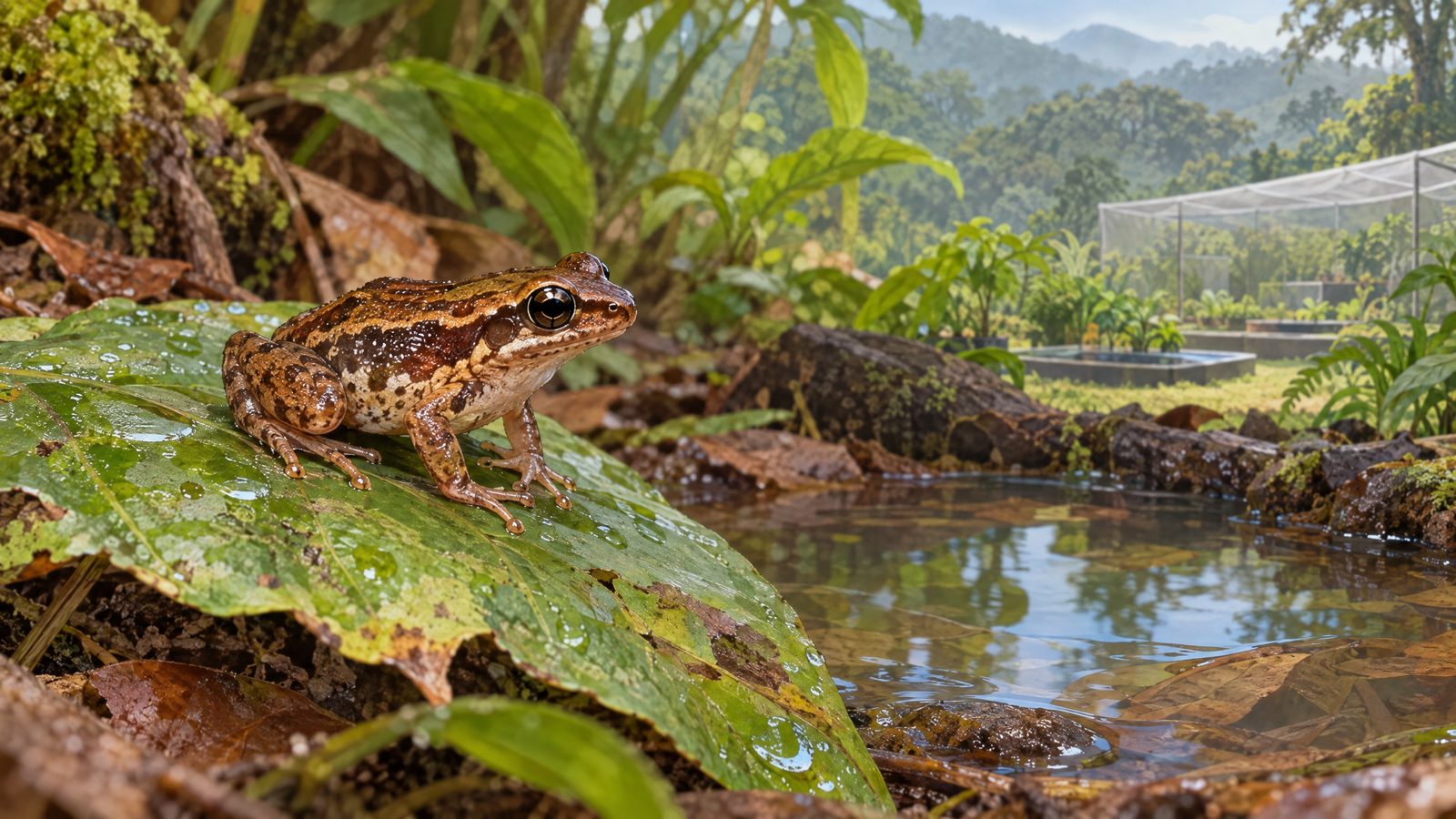

Fifteen Afia Birago’s puddle froglets have been born at London Zoo in what conservationists describe as the first successful breeding of the species under human care. The tiny amphibians, currently about 5mm long, mark a significant step in work to protect a frog known from only two pools in Ghana.
The froglets are the first of their species to hatch under human care anywhere in the world. Their birth follows the arrival of 20 adult frogs from Ghana in 2025, as part of a collaboration involving London Zoo, Herp Conservation Ghana and the CSIR-Forestry Research Institute of Ghana.
The species, Phrynobatrachus afiabirago, was described by scientists in 2018. It is endemic to Ghana and has been found in two perennial pools in the Atewa Hills Forest Reserve. The habitat is threatened by mining, placing pressure on a species with a highly restricted known range.
Breeding knowledge to be shared
When the adult frogs arrived in London, relatively little was known about their care in captivity. Keepers have since developed husbandry techniques and breeding protocols, which are being shared with colleagues at a conservation breeding centre in Kumasi. The work is intended to help Ghanaian partners establish a sustainable conservation population in the country.
That distinction matters: the 15 births are a first breeding success, not evidence that the species has been secured from extinction. The planned population in Ghana has not yet been established, and any future return of captive-bred frogs to the wild would depend on further work.
The collaboration began in response to the species’ vulnerability and practical challenges in Ghana, including limited experience with amphibian care and difficulty obtaining specialist equipment locally. A facility dedicated to amphibian conservation was established in Kumasi, while specialists in London developed knowledge that could be passed on to the in-country team.
Alongside breeding work, a conservation researcher connected with the Ghanaian partnership is investigating potential habitat on private land around Atewa Hills. The aim is to identify places that could support future releases of frogs bred in Ghana. Identifying possible habitat is an early planning step, not a confirmation that a release site has been approved or that the animals are ready to be released.
A small species with a narrow range
Adult Afia Birago’s puddle frogs weigh less than 1.75g, and the new froglets are small enough to sit on a fingertip. Their name honours Afia Birago, the mother of the Ghanaian conservationist who helped describe the species. Despite their size, the frogs have become the focus of an international effort linking specialist animal care with conservation work in their native country.
The project’s immediate value is the new practical knowledge gained through keeping and breeding the frogs. That information can inform work in Ghana, where conservationists are seeking to build local capacity and a population that could contribute to recovery in the wild. The outcome will depend on whether the approach can be sustained in-country and whether suitable habitat can be protected.
The froglets are being cared for by London Zoo’s amphibian team, where visitors can see the conservation work. The births do not remove the pressures facing wild populations, but they provide the first demonstrated breeding result for a species whose survival is closely tied to a small area of forest in Ghana.







