
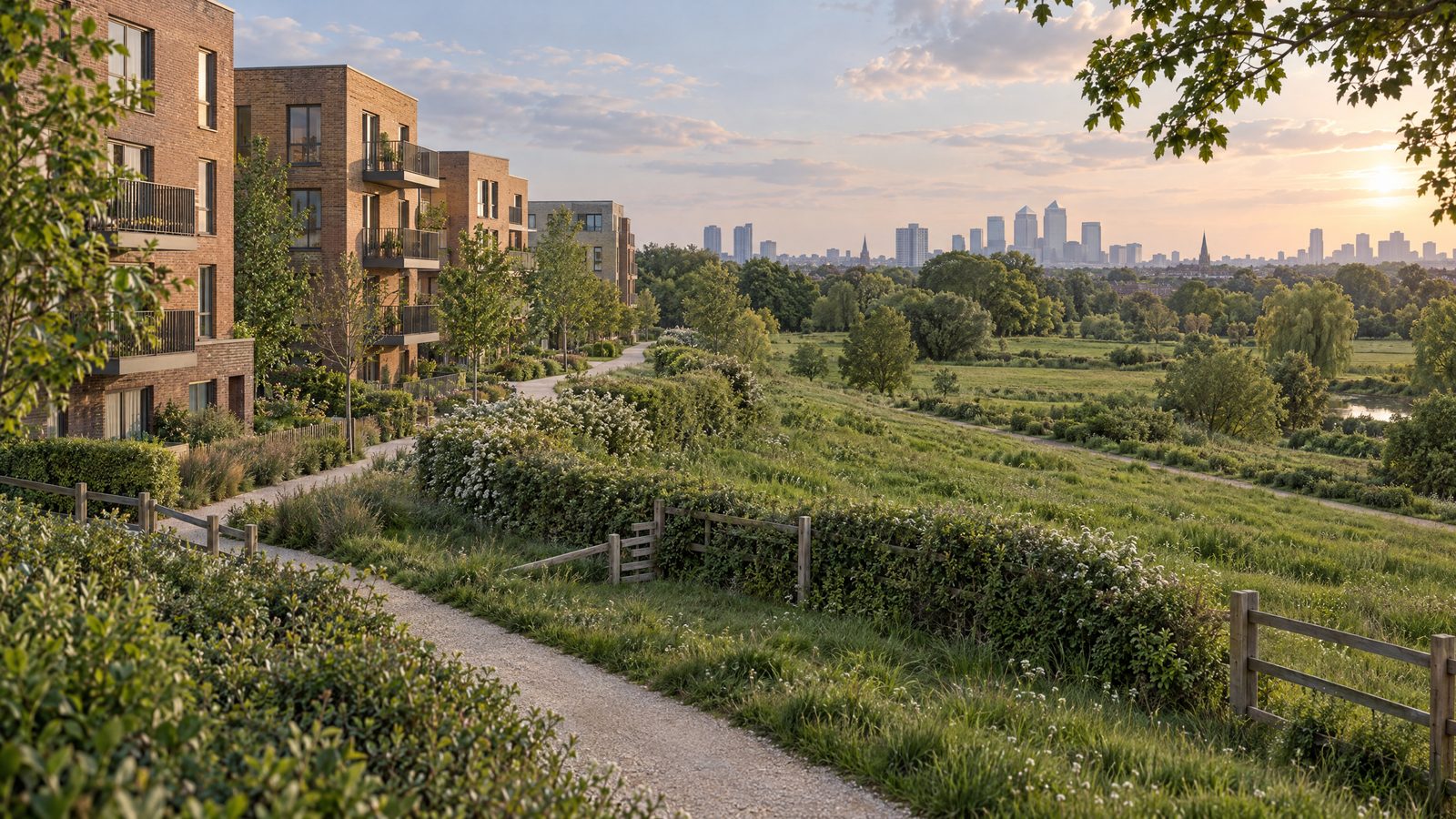

Barking and Dagenham councillors have voted to approve the borough’s part of a proposed 1,298-home development at Crowlands Heath Golf Course, but the decision does not yet clear the way for construction. The committee’s resolution covers 300 homes on the Dagenham side of the site and remains subject to a legal agreement. The larger scheme also needs a separate decision in Havering, where the other 998 homes are planned.
The 22.5-hectare site straddles the boundary between the two boroughs. The application proposes replacing the existing golf course and driving range with flats of up to six storeys, community and retail space, sports facilities, play areas, landscaping and publicly accessible open space. It also includes a new junction from Crow Lane and changes to the Wood Lane junction.
The formal committee meeting took place on 14 October. Barking and Dagenham’s planning committee voted by a majority to approve the portion within its boundary, subject to completion of a Section 106 legal agreement. Such an agreement sets out obligations connected with a permission. Until that agreement is completed, the committee’s resolution is not the same as an issued planning permission.
Affordable homes and Green Belt questions
The applicant’s plans describe all 1,298 homes as affordable. The proposed tenure mix is 763 social-rent homes and 535 key-worker rental homes. Those figures cover the whole cross-borough scheme, not just the 300 homes covered by the Dagenham committee vote. The plans identify NHS staff as a main group among the intended key-worker tenants.
The proposal would build on land designated as Metropolitan Green Belt. Planning officers treated the site as potentially qualifying as “grey belt”, a category in national planning policy for some previously developed Green Belt land. The site’s history as a quarry and later landfill was cited in that assessment. The application’s case also rests on the scale of affordable housing proposed. Neither the debate nor the committee vote removes the need for the planning authorities to assess the policy and environmental issues attached to the development.
The Greater London Authority’s stage-one assessment supported the principle of housing on the site subject to conditions, while raising concerns about relatively weak public transport access and calling for transport improvements. The scheme proposes walking and cycling links and changes to nearby roads. A separate decision by the Mayor of London is also expected in the wider planning process.
Infrastructure and local concerns
Committee discussion included concerns about parking and the effect of a large new population on local services and streets. Plans provide 70 parking spaces, including 60 for residents and 13 accessible bays. Transport for London had sought to keep parking low to encourage walking, cycling and public transport use.
The proposed legal obligations include more than £1 million towards health infrastructure in Romford, alongside contributions towards transport improvements and a review of controlled parking zones. The amounts are proposed planning contributions, not completed investment. Their delivery depends on the legal agreement and the development proceeding.
The plans also include around 4.6 hectares of public green space. The golf course is largely accessible only to paying club members at present, while the proposed layout would provide public access to open space. The design includes improvements to Wantz Boating Lake, sports courts and children’s play areas. These are elements of the application rather than facilities already built or open.
Barking and Dagenham Council bought the golf course in March and agreed to sell its freehold interest to the developer, subject to the necessary planning approvals. The council’s planning committee has now taken one step in that process. Havering’s decision on the larger share of the development remains outstanding, as does completion of the legal agreement for the Dagenham section.
As a result, the vote advances a substantial housing proposal but is not final approval for all 1,298 homes. The separate borough process and remaining planning requirements will determine whether, and on what terms, the wider redevelopment can move forward.







