
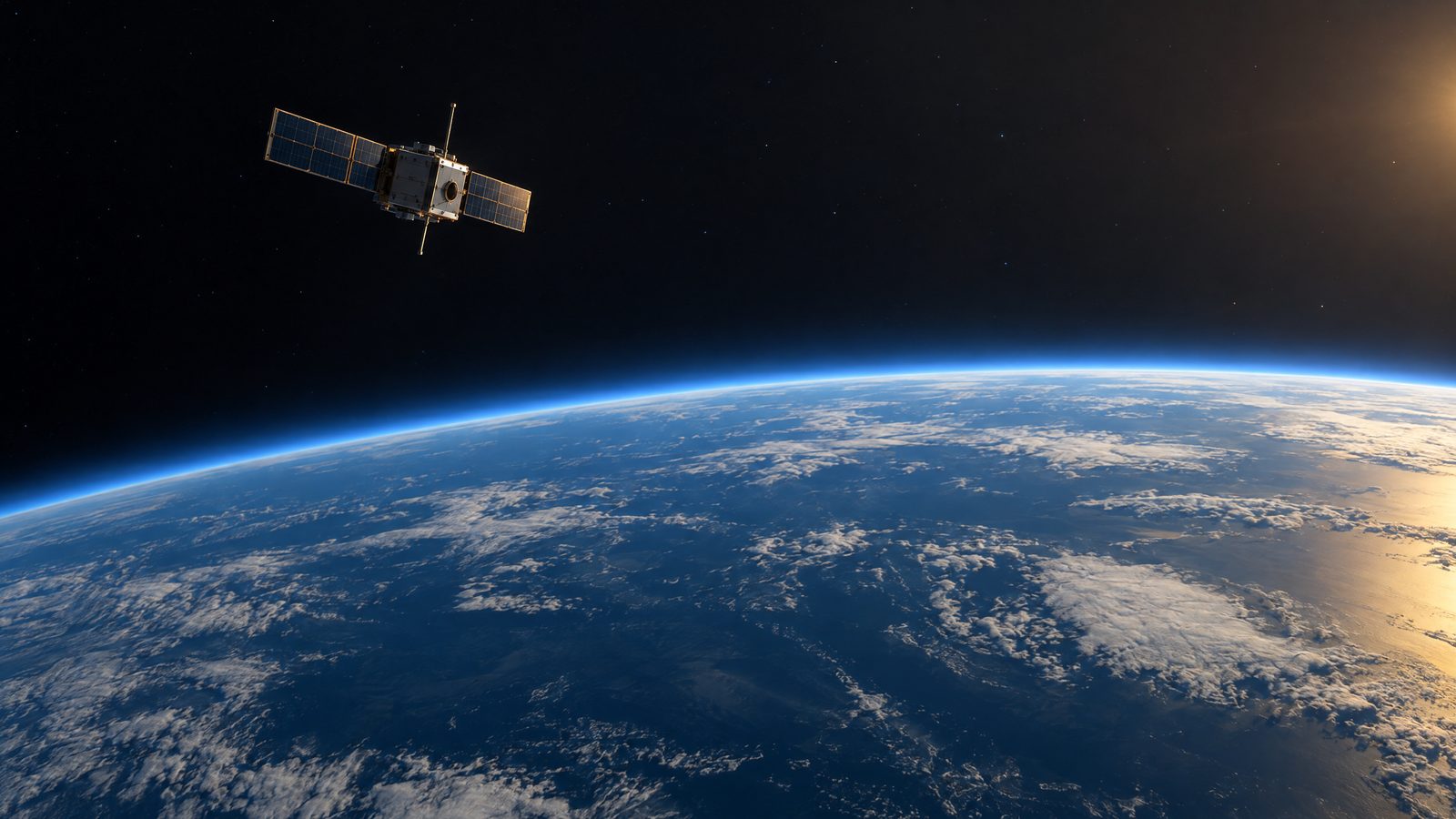

NASA’s Neil Gehrels Swift Observatory is now expected to re-enter Earth’s atmosphere on Wednesday, 4 November, after more than 22 years in orbit. The latest forecast places the return at about 3.30am Eastern Standard Time, but the estimate carries an uncertainty of 11 hours. That wide window means the stated time is a prediction, not a confirmed moment of re-entry.
The US Space Force forecast cited by NASA is based on an object whose orbit is steadily losing altitude. Swift weighs about 3,200 pounds, or roughly 1,450 kilograms. As it encounters the upper atmosphere, drag slows it and its path decays until it descends into denser air. The exact timing can shift as conditions and the spacecraft’s orbit change, so the agencies say they will continue monitoring it and updating their predictions.
What may reach the ground
Most of Swift is expected to burn up during its passage through the atmosphere. NASA says some components could survive, however, and any surviving debris would follow a corridor shaped by the spacecraft’s orbit. The agency gives that band as between 20.6 degrees south and 20.6 degrees north latitude. This describes a broad range of possible locations, not a prediction that debris will strike a particular place.
The probability of harm to any person on Earth is estimated at approximately one in 2,100. That is a small but non-zero risk calculated for the event as a whole; it is not a measure of the likelihood that any named community will be hit. The estimate also does not mean that an impact is expected. NASA says most of the observatory should be destroyed by atmospheric heating, while a limited number of denser parts may persist.
Because the corridor spans low latitudes around the equator, it crosses both land and ocean. A corridor alone cannot establish where surviving material will come down. With the forecast still carrying an 11-hour range, location and timing remain uncertain until the descent is much closer and observations refine the orbital estimate.
A long-running observatory
Swift launched in 2004 with a planned prime mission of two years. Its purpose was to study gamma-ray bursts, brief, powerful flashes associated with some of the most energetic events in the universe. Three telescopes let it observe across gamma-ray, X-ray, ultraviolet and visible wavelengths. Its ability to turn rapidly towards a burst and alert other observatories helped scientists follow events that fade quickly.
The spacecraft’s working life extended far beyond its original design period. Over more than two decades, it also observed a wide range of other targets, including active galaxies, stellar explosions, comets and asteroids. Ending operations and returning to Earth are separate milestones: NASA said the observatory had already stopped science work as its declining orbit made it unable to compensate for atmospheric drag.
Solar activity has increased the drag affecting objects in low Earth orbit, hastening Swift’s descent. NASA had attempted to extend the mission through a commercial servicing effort intended to raise the telescope into a higher orbit, but that effort ended without a boost. The agency’s 23 October update said only that re-entry was expected within the next few weeks. The 2 November notice narrows that broad outlook to a Wednesday estimate and provides the current time window and risk figure.
Those figures remain provisional. Swift is not being guided to a controlled landing, and the agencies have not identified a precise impact point. The forecast will be most useful as a changing estimate rather than a fixed appointment. NASA and the Space Force are continuing to track the spacecraft, with further updates expected as its final orbit becomes clearer.







