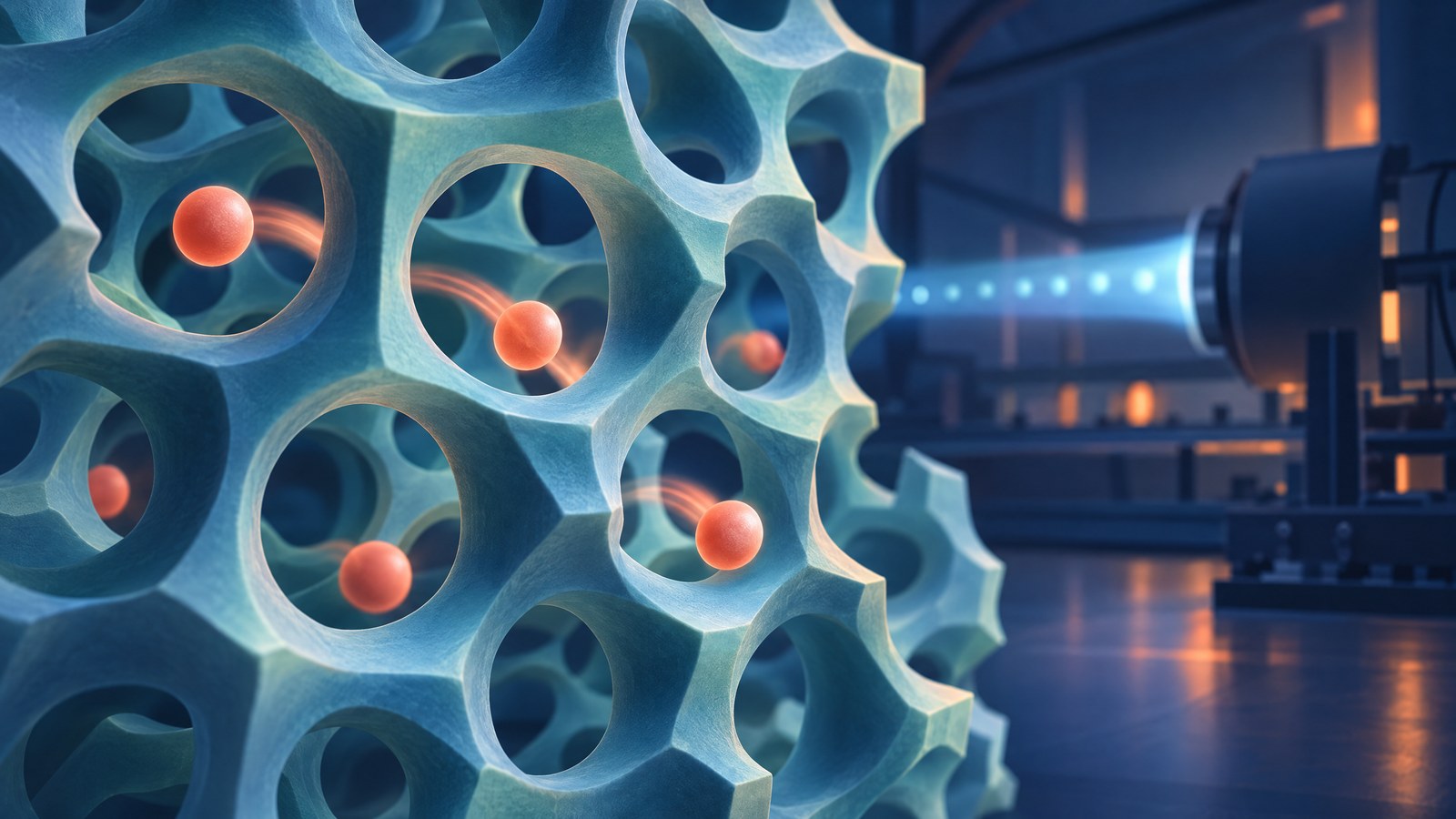

Researchers in Japan have used calorimetry and neutron scattering to examine how acetonitrile molecules move inside a magnesium-containing metal–organic framework, finding evidence that their coordination with magnesium ions is linked to the material’s high magnesium-ion conductivity.
The study focuses on MIL-101, a porous framework into which the researchers introduced magnesium bis(trifluoromethanesulfonyl)imide and acetonitrile. The material had previously been reported to conduct magnesium ions at room temperature. The latest work investigates the molecular behaviour associated with that conductivity; it does not report a commercial battery or a finished electrolyte product.
Neutron measurements reveal molecular hopping
The team combined heat-capacity measurements with quasielastic neutron scattering, a technique that can probe molecular motion over very short distances and times. Measurements at two neutron instruments covered motion from picoseconds to nanoseconds. Calorimetry was used to establish how the samples behaved as temperature changed, helping researchers interpret the scattering results.
In samples containing magnesium salt, the neutron data were best described by jump diffusion: acetonitrile molecules moved between sites rather than diffusing continuously. The analysis gave an average jump distance of about 1.6 ångströms. In comparison, samples without the magnesium salt were described by a continuous-diffusion model.
The researchers interpret the short hops as consistent with acetonitrile repeatedly forming and breaking coordination bonds with magnesium ions. The scattering experiment tracks the motion of the acetonitrile molecules, not magnesium ions directly. Its results therefore provide evidence relevant to the proposed mechanism rather than a direct observation of magnesium-ion transport.
How molecular motion relates to conductivity
The measured diffusion of acetonitrile became progressively slower across bulk acetonitrile, a bulk acetonitrile–magnesium-salt mixture, acetonitrile in MIL-101 without magnesium salt, and the magnesium-containing framework. The researchers attribute the slowing to interactions with the framework’s pore walls and with magnesium ions.
That interaction is central to the proposed explanation. When acetonitrile coordinates to magnesium, it can shield electrostatic interactions between the magnesium ion and nearby ions. Reducing those interactions is thought to make magnesium-ion movement easier. The observed changes in acetonitrile motion, including the hopping behaviour and its temperature dependence, are consistent with this coordination-mediated account.
Heat-capacity data also showed broad temperature-dependent changes in the acetonitrile-containing samples. The team associated these with disordering of molecules inside the pores. In the magnesium-containing material, the measurements additionally indicated a glass transition, which the researchers interpret as the freezing of motion in the confined acetonitrile–salt mixture at lower temperatures.
A mechanistic result, not a battery breakthrough
The work adds experimental detail to a mechanism proposed for a porous magnesium-ion conductor. It does not establish that the material is ready for use in batteries, demonstrate a complete cell, or show that a device has been built or tested. The researchers say the findings may help guide the design of solid conductors for multivalent ions, a wider class that includes ions carrying more than one positive charge.
The collaboration involved researchers from RIKEN, Tokyo University of Science, Shimane University, the Comprehensive Research Organization for Science and Society, and neutron-science facilities in Japan. The measurements used the AGNES instrument at the Japan Research Reactor 3 and the DNA instrument at the Japan Proton Accelerator Research Complex. The paper was published online in the Journal of the American Chemical Society on 29 September; the research institutions issued their public announcement on 21 October.
For now, the significance is scientific: experiments on heat capacity and molecular movement support the view that acetonitrile’s coordination dynamics are involved in the material’s magnesium-ion conduction. Further work would be needed to translate that understanding into practical energy-storage technology.