
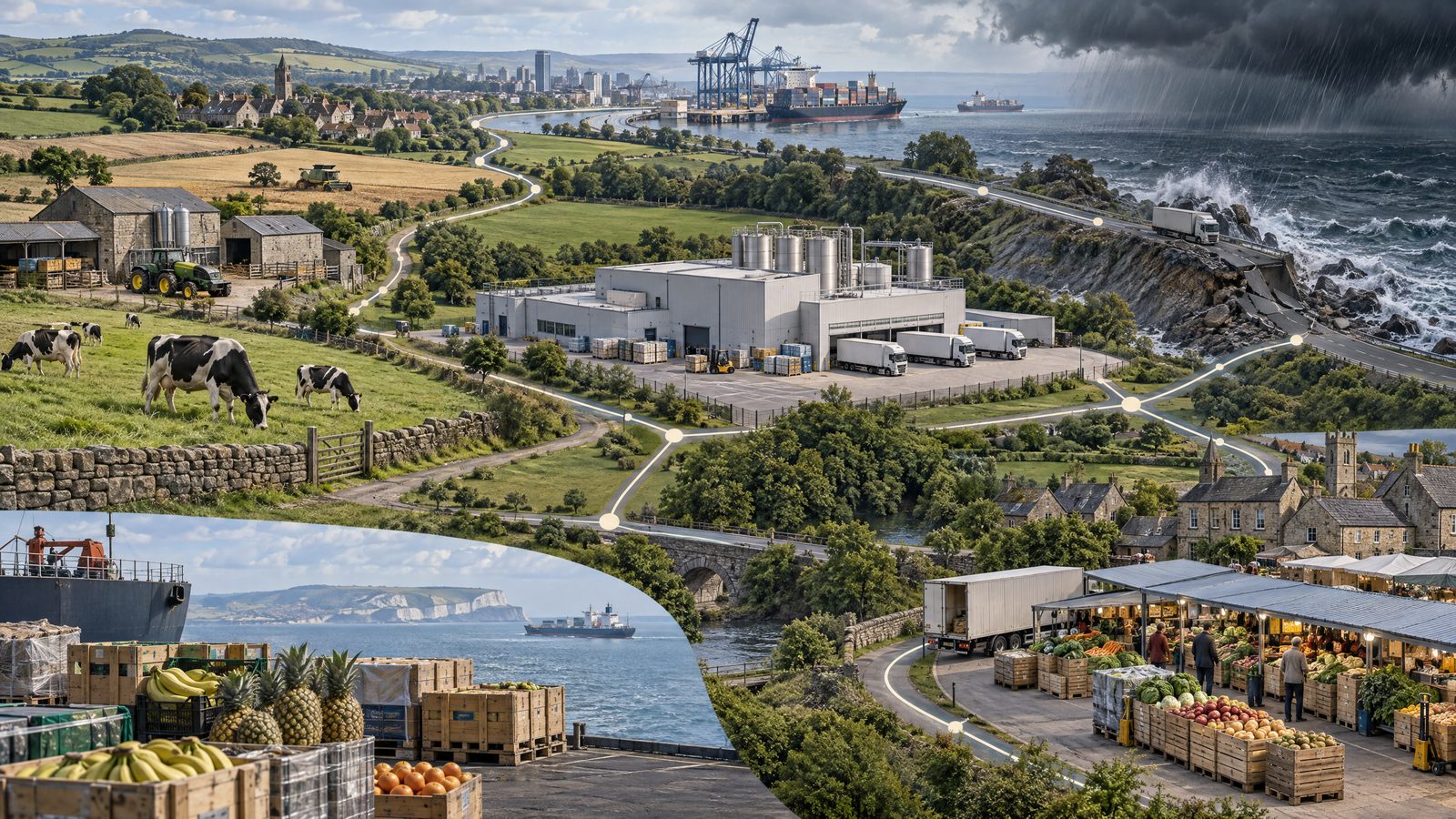

Parliament has begun examining whether the UK could keep food moving through a severe disruption, with evidence from retailers, manufacturers, a farmer and academics exposing the tension between affordable everyday shopping and a supply chain able to withstand shocks. The first Public Accounts Committee evidence session took place on 12 October; it was scrutiny, not a new food-security law or a government commitment.
Preparedness under examination
The inquiry focuses on the resilience of the UK’s food supply to disruptions. The committee’s published briefing identifies extreme weather and cyber-attacks among risks that may become more likely, and points to a 2023 exercise testing a catastrophic food-supply event. That exercise largely excluded businesses in the chain. It also records concerns that local resilience forums lacked clarity about what central government expected if supplies were disrupted.
Those gaps matter because food does not move through one organisation. Production, processing, storage, distribution, wholesale, retail and catering are interconnected. The National Audit Office describes the system as primarily industry-led: companies manage their own operations, while government has designated food as critical national infrastructure. A shock can therefore travel from farms or energy systems through manufacturers and logistics to shop availability, prices and access for households.
The audit office’s September assessment provides a sobering baseline. Commercial incentives and international sourcing have helped the system manage past disruption, but the sector’s capacity to withstand catastrophic events has not been tested. It concluded that the department’s actions had not yet been sufficient to ensure resilience against such events. The report called for clearer planning assumptions and testing with local government and industry, while recognising that stronger resilience can involve costs for public bodies, businesses and households.
Domestic capacity and multiple sources
Evidence on 12 October did not reduce resilience to a choice between British production and imports. Retail and manufacturing representatives described both domestic capacity and overseas sourcing as important. The retail representative said supermarkets were focused on supporting British farmers, while noting that fresh fruit and vegetables unavailable from UK growers in December must be imported, potentially at a premium. Seasonal availability, consumer choice and price are connected: a supply strategy cannot assume every product can be grown at home all year.
The manufacturing federation’s representative said some member businesses have long-term contracts with the same farms, in some cases for decades. He argued that more domestic production could be economically sound for businesses, but also that resilience is strongest when supply comes from multiple sources, including abroad. That distinction is significant: diversified imports can reduce dependence on one source, while productive domestic farms can provide capacity closer to home. The evidence pointed to a portfolio of supply relationships, not a simple self-sufficiency target.
Farmer Harry Metcalfe questioned whether growers always receive a fair return from supermarket relationships. He described the position as difficult to judge because growers may not sell directly to supermarkets and can sit within long chains of suppliers. He also raised the influence of price-led purchasing and processed food, where the origin of ingredients may be less visible. These were witness views, not findings by the committee.
His warning about farm profitability connects resilience to investment. If producing food is uneconomic, businesses may defer infrastructure, technology or productivity improvements, or reconsider what they grow. The farmers’ union, in a separate intervention on 13 October, said global volatility, rising costs, extreme weather and disease were weakening confidence and investment. It urged the Chancellor to use the forthcoming Budget to reduce production costs and support farm businesses. Those are the union’s requests, not announced Budget measures.
What the inquiry must resolve
The committee’s questions extend beyond whether shelves are stocked in normal conditions. Its stated themes include possible failure points, fuel disruption, drought and flooding, affordability, the department’s 2025 food strategy and preparedness among local communities. A later scrutiny session is intended to question department officials about planning and engagement with industry. The inquiry’s value will depend on whether it turns broad risk recognition into clear responsibilities, tested scenarios and practical coordination.
For consumers, resilience need not mean eliminating imports or accepting any price in the name of preparedness. It means understanding the trade-offs: multiple suppliers can provide alternatives, reliable contracts can support farm investment, and contingency plans can help identify what happens when transport, energy or production is interrupted. The hearing has opened that examination; it has not yet settled how costs should be shared or what changes government will make.







