


A Polish technology firm with a London office has published a case study of its own AI journey. The journey lasted 15 months.
In the first survey, 81% of staff said they used AI tools. Respondents rated team level AI practice at 34 out of 100. Team level AI practice reached 52.7 by the second survey in April 2026. The case study reports no return on investment figure.
TL;DR
- Future Processing, headquartered in Gliwice with an office in London, published an account of 15 months of its own AI work.
- 81% of staff used AI tools in the first survey, yet team level AI practice scored 34 out of 100.
- Team level AI practice rose to 52.7 by April 2026, the fastest rise of any measure in the study.
- The report gives no company wide return on investment or time saving figure.
What does the case study cover?
The case study covers what the company changed, in what order and how it measured progress, from a board decision to delivery standards on client work. The AI Transformation Case Study comes from Future Processing, a technology strategy and delivery partner with more than 25 years of experience. The company has its headquarters in Gliwice, Poland, and an office in London.
The starting point
The programme began when the board concluded that AI would change how software is built. Individual use of AI tools was already spreading, but the knowledge of the people furthest ahead was hard to repeat or share. The company therefore chose a programme for the whole organisation, with a plan, a budget and regular checkpoints.
Michał Sztanga, CEO of Future Processing, describes the decision: “AI is changing what every one of us does at work. At Future Processing we decided to meet that change as a whole company and to treat it as a chance to grow: to learn the new way of working ourselves, together, so that our people and our clients can rely on it.”
How progress was measured
The company ran an employee survey in two waves. Wave one took place in summer 2025 and drew 446 respondents, a 66% response rate. Wave two followed in April 2026 with 480 respondents, of whom 293 also answered wave one.
A quarterly AI Maturity Assessment covers nine competence centres in delivery, with a baseline in January 2026. Mike Zamarski, AI Strategy Advisor, designed wave one. Remigiusz Tunowski, Business Intelligence Consultant, ran wave two and the analysis.
Zamarski explains why the baseline came first: “Once the decision to transform had been taken, we knew we had to ground it in business reality, in hard numbers. A baseline works best at the very beginning, so we captured ours before any systemic change took place.”
Adoption, maturity and transformation
Adoption describes who uses AI and how often, and the survey measures it. Maturity describes the quality of skills and practices, scored on a five level scale. Transformation means the company does its work differently because of AI. Tunowski proposed this distinction.
Why does high AI usage not prove that a company has changed?
High usage describes individual habits, and only team level practice shows that a company works differently. Team level practice means a team uses AI together, in a repeatable way.
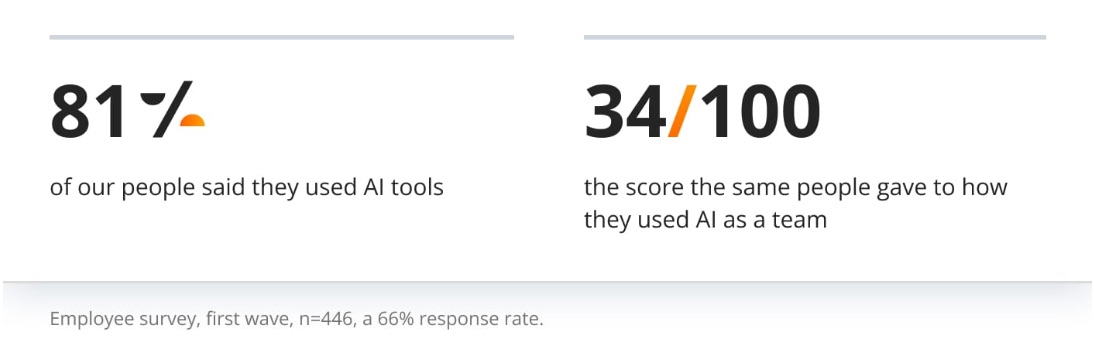
In the first survey, 81% of staff said they used AI tools and the same people gave team level use 34 out of 100.
The usage ladder
The report reads survey results on a ladder with four steps. People know about AI, try it now and then, use it regularly on their own work, and finally use it together as a team in a repeatable way.
The 81% sits on the middle steps. The 34 out of 100 describes the top step. Both figures come from the first survey and are self reported.
What the correlation shows
Teams that practise AI together rate AI’s contribution to project success higher. The correlation is r = 0.42 and it holds after allowing for each person’s own use. Individual use on its own does not predict that rating.
Konrad Bałys, Head of Engineering, explains why the company measures teams: “One person being faster gives us nothing. The whole team has to be faster, in every phase.”
How did the company move from adoption to transformation?
The company moved through four stages: point adoption, wide adoption, shared AI competence and organisational resilience. Zamarski designed the four stage AI Organisational Resilience Framework. The first two stages are adoption and the last two are transformation. The model has no separate technology layer, because technology changes faster than any plan can follow.
| Stage | Duration | What the company did |
| Point adoption | A few months | Board decision, company wide baseline survey, goals and budget fixed, route left open |
| Wide adoption | One quarter | One funded route to tools, a one page policy with a review date, an open invitation to experiment |
| Shared AI competence | Half a year | AI skills in every role, an AI Champion in every project, a quarterly maturity assessment |
| Organisational resilience | No end date | New standards for key processes, a library of proven methods, replaceable tools |
Fixed goals and an open route
Daria Polończyk, Head of Delivery, describes the planning approach: “When we started the AI transformation, we fixed the goals and the budget, and left the route to them open. The tools were changing from month to month, so we corrected the route as we learned, every quarter.”
Rules that kept control
The company approves a requested tool within two working days at most and pays for licences centrally. Compliance Assistant classifies about 150 everyday uses of AI in advance. Low risk goes ahead, medium risk is logged and high risk goes to a person with the mandate to accept it. Dominik Samociuk, Head of Security & Compliance, says: “AI is like a hammer: a fine tool, as long as you know how and when to use it.”
The client contract comes first. A client’s stricter AI rules apply on that client’s project, and the company does not use client code or data to train or ground its agents. Future Processing has held ISO 27001 certification for its information security management system since 2017, so these rules build on a system that already existed.
What do the measurements show?
Team level AI practice rose from 34 to 52.7 out of 100 between the two waves, the fastest rise of any measure in the study. The survey figures come from two waves and the maturity scores from three quarterly readings.
Survey results
Daily use of AI across the company doubled. In every delivery role it rose by a factor of 1.7 to 2.5.
The gap between what people wanted from the company and what it gave them narrowed from 26 to 15. Desire to learn rose from 69 to 75 out of 100, and the rating of the company’s readiness to support people rose from 43 to 60. The share of self described sceptics fell by more than half.
Maturity scores in delivery
On the five level scale, people rose from 2.56 to 2.89 and governance from 2.44 to 2.89. Practices and methods stayed the weakest area in every reading and moved from 2.11 to 2.56. Scores for tooling, data and compliance fell in the third reading, after teams worked through that area in depth.
Methods and experiments
The library of delivery methods approved for reuse grew from 6 to 18. Each method has been proven in more than one client project. The experiment register holds more than 250 entries from across the company.
Before and after
| Method | Before | After |
| Technical documentation generated from code | 2 to 3 days per subproject | Under 30 minutes |
| Discovery run in a Git repository | 120 hours | About 55 hours |
| First contact with a sales enquiry | 20 working hours | 6 working hours |
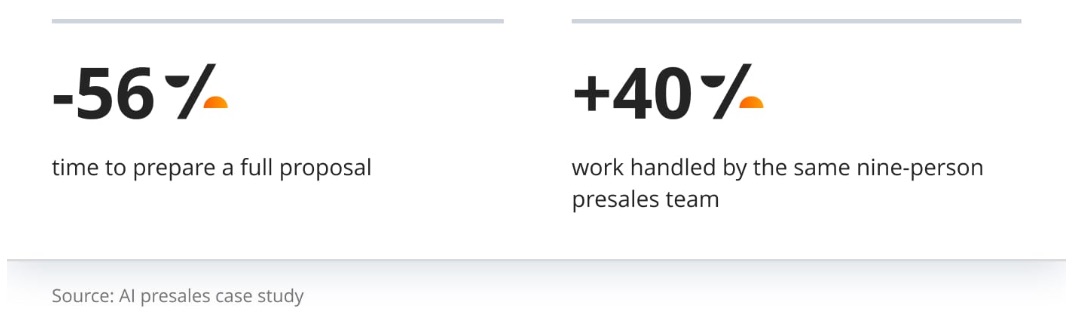
Proposal preparation now takes 56% less time. The nine person presales team handles 40% more work.
What does the report not claim?
The report publishes no company wide return on investment and no company wide time saving figure. The company set skill targets only.
Limits of the data
Survey figures are self reported, and delivery figures are measured in client projects. The report does not mix the two. Both survey waves came before shared delivery standards were in place, so their effect is not yet visible.
The study covers one company and has no controlled comparison. The company will publish a return figure after the new way of working covers most projects and has run for a full year. All figures describe the situation as of October 2026.
Where can readers download the full report?
The full report is available from the case study page. It suits technology and business leaders who want to compare their own route with a documented example. The company says the report can be shared with a leadership team. The report closes with a playbook in which Future Processing matches each of the four stages to practical recommendations.
FAQ
What is the difference between AI adoption and AI transformation?
Adoption measures who uses AI and how often, while transformation means a company does its work differently because of it. A survey measures adoption, and transformation shows in methods proven on more than one client project and in changed roles and processes.
How long does an AI transformation take?
In this case, 15 months passed between the baseline survey and a delivery standard used on client work. The last stage has no end date, because tools and regulation keep changing.
How can a company prevent shadow AI?
Make the approved route the fastest route, because shadow AI usually grows where the official route is slower than the unofficial one. Shadow AI means AI tools used for work without the company’s knowledge, such as personal accounts, free versions and browser extensions.
What should a buyer ask an AI delivery partner?
Ask which level of AI the project will use, what AI may write in the code, what happens to the data and who owns the results. Also ask who on your side decides and accepts work, and how the price changes when work gets faster.
Does the report prove a return on investment?
No, the report sets skill targets, and efficiency and return are expected after the new way of working covers most projects. Ask for the frequency behind any percentage, because a 96% saving on a task done twice a month changes little.







