
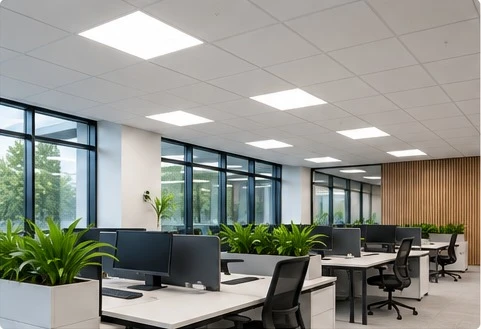

An office ceiling can look perfectly straightforward until somebody tries to replace the lights. A facilities manager orders a set of new panels, the electrician arrives, and the first fitting reveals the problem: the existing grid is an unusual size, the emergency provision has been overlooked, or the new light is uncomfortable for people working beneath it.
None of these issues is especially dramatic. They are, however, expensive ways to discover that a ceiling light is part of a building system rather than an isolated product. For small businesses refurbishing an office, clinic or retail unit, a short survey before ordering can prevent a surprising amount of rework.
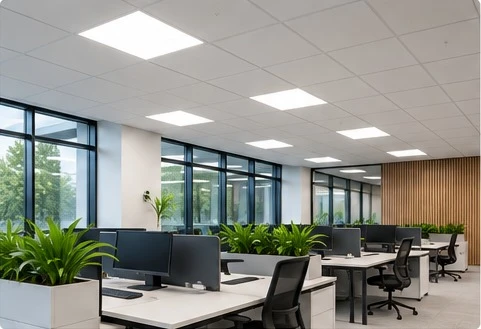
In a suspended ceiling, the existing grid and working layout should shape the replacement specification.
1. Measure the opening, not just the old fitting
A 600 × 600 mm panel is a familiar sight in UK suspended ceilings, but that description alone is not enough to place an order. Check the actual ceiling grid, whether the fitting is recessed or surface-mounted, the space above the ceiling and the condition of the surrounding tiles. A panel intended for a lay-in grid will not necessarily suit a solid plasterboard ceiling without a mounting kit.
Also check whether the old unit is a fluorescent modular fitting, an LED panel or a smaller square surface light. These can look similar from the floor but have different fixing arrangements. If a ceiling is being retained, compatibility is often more valuable than a small difference in unit price.
2. Ask who will be sitting underneath it
Brightness is only one part of a useful office lighting scheme. A fitting that makes a corridor feel bright can be distracting above a bank of computer monitors. Glare, reflections and the position of desks all matter. The UGR figure is worth discussing with the designer or supplier: products advertised as UGR below 19 are often specified for office tasks, but that label does not guarantee a comfortable result in every room. The installation layout and room surfaces still influence glare.
Think about the actual working day. Does the space host video calls? Are there glossy screens or reflective worktops? Will desks move after the refurbishment? These questions should inform the beam distribution and placement, not be left until staff complain after installation.
3. Choose colour and output together
A 4000 K neutral-white fitting is common in workplaces, but colour temperature is not a substitute for checking light output. Two square panels with the same wattage may deliver different lumen outputs, and the same panel can behave differently depending on its diffuser and optical design. Compare lumens, efficacy and photometric information rather than treating wattage as a measure of brightness.
Consistency matters too. If half a floor is being replaced now and the other half next year, mixing noticeably different whites can make an otherwise tidy refurbishment look patchy. Agree a colour temperature and product specification before the first order, and keep a record for future maintenance.
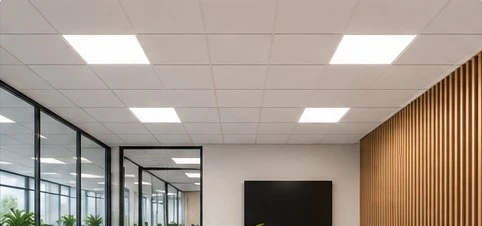
Meeting rooms need lighting that works with screens, seating positions and future changes to the space.
4. Look above the ceiling: drivers, access and emergency lighting
The visible panel is only part of the installation. Drivers need suitable access, wiring arrangements must comply with the applicable electrical requirements, and existing emergency lighting must not be compromised. Some offices rely on separate emergency luminaires; others have integrated emergency versions. The replacement strategy needs to account for whichever arrangement is already in place.
A contractor should also check switching arrangements and whether the proposed driver supports the control method being used. Buying a dimmable panel does not automatically make it compatible with every existing dimmer. For occupied buildings, ease of future driver replacement and access for maintenance deserve as much attention as the initial fitting cost.
5. Work out the cost of the whole changeover
A quick electricity calculation can be helpful, provided it uses the real operating hours. Suppose an older 72 W fitting is replaced by a 36 W LED panel and runs for 2,500 hours a year. The difference is 90 kWh annually per fitting. At an illustrative electricity rate of £0.25 per kWh, that is £22.50 per year before considering maintenance or controls. Across 40 fittings, the same assumptions produce £900 in annual electricity savings.
Those figures are an example, not a promised saving. Actual results depend on the old fitting’s measured consumption, the replacement product, occupancy, controls and tariff. Installation labour, disposal, any ceiling repairs and downtime should be included when comparing quotes. A cheaper panel that creates a second site visit is not necessarily the cheaper project.
Where square fittings make sense — and where they do not
Square ceiling lights are useful in suspended-grid offices, meeting rooms, reception areas and many circulation spaces. They offer a visually consistent solution where a modular ceiling already exists. In a room with an exposed ceiling, unusual architecture or frequently changing layouts, track or linear systems may be more practical. There is no reason to force every room into the same lighting format.
For businesses comparing a square led ceiling light with other ceiling options, Ledex Lighting’s UK collection provides a starting point for reviewing available square formats and specifications. The final choice should still be checked against the actual ceiling and the intended use of the room.
The five-minute conversation worth having before you order
Before approving the purchase, ask the installer to confirm the ceiling dimensions, mounting method, required light output, glare considerations, colour temperature, driver and control compatibility, and emergency-lighting arrangements. Request the exact product codes on the quotation, particularly if the building will be refurbished in phases.
The best ceiling-light upgrade is usually the one nobody notices after the work is finished: the lights fit, the space feels comfortable, and the maintenance team knows what has been installed. That outcome starts with checking the details while changes are still easy to make.







