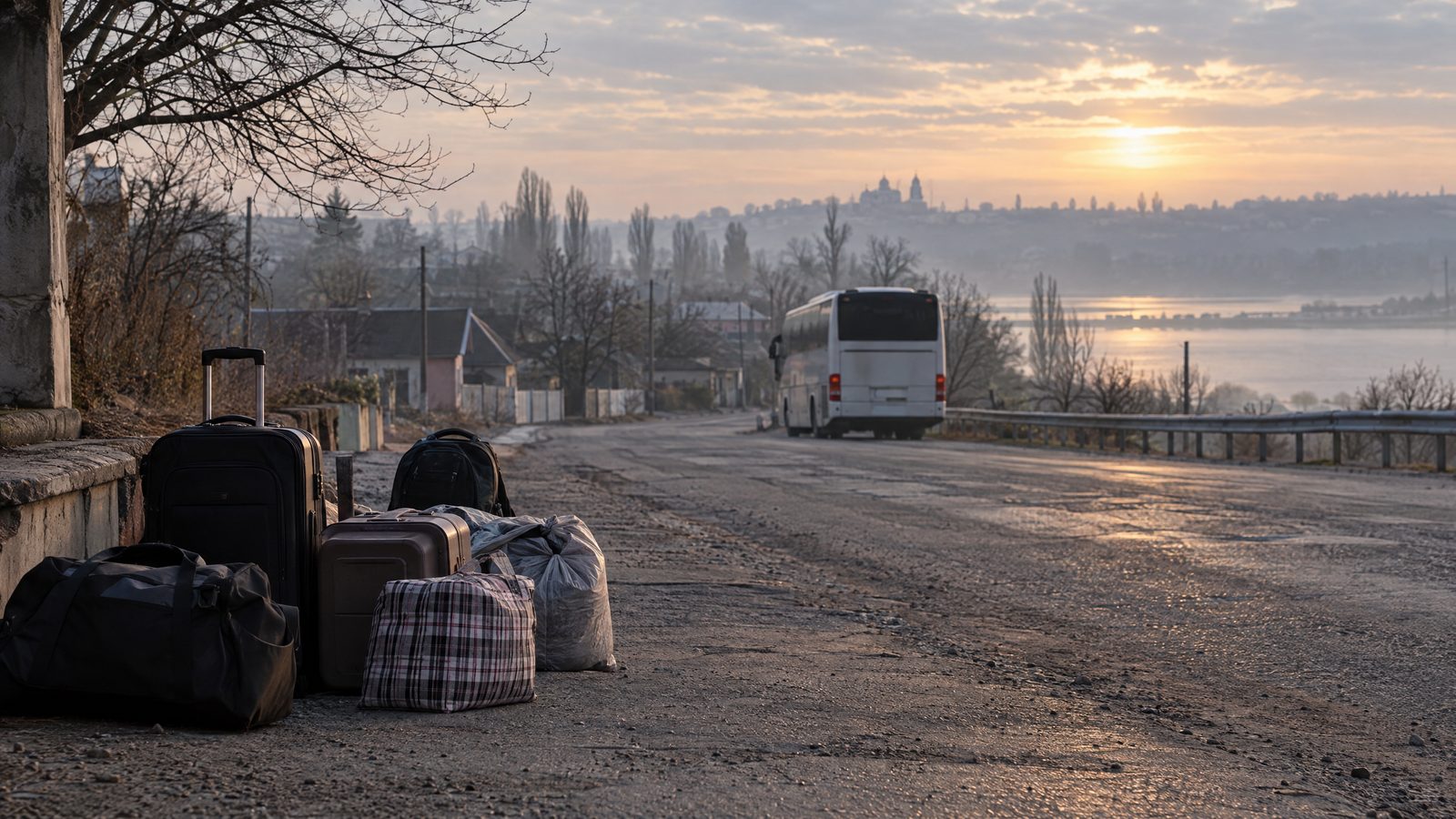

Residents left Russian-held Oleshky on 30 October during a local humanitarian ceasefire that allowed Russian and Ukrainian officials to enter the town together, deliver food and medicine and organise departures. No final evacuation total was publicly released by either side.
The operation offered a temporary humanitarian opening in the town, on the eastern bank of the Dnipro River in Ukraine’s southern Kherson region. Oleshky has been under Russian control since the early days of the full-scale invasion in 2022.
Contemporary accounts described the simultaneous presence of Russian and Ukrainian officials as an unusual joint humanitarian operation during the war. The convoy was reported to include 25 buses, ambulances and aid supplies, with roads designated for the operation demined before it entered.
Identical public statements from the two sides said residents could choose whether to leave or remain, and that those staying would receive humanitarian support. That was the announced policy, rather than independent confirmation of every resident’s choice or subsequent circumstances.
A limited humanitarian pause
The written announcement of the arrangement described a temporary halt to military action in Oleshky, a designated safe passage and coordination by non-military civilian representatives of the two sides. A public statement from the arrangement’s announced broker said the ceasefire had been expanded beyond the town to provide safe passage for humanitarian convoys.
Accounts differed over its starting date. Independent reports published on 27 October said the truce had taken effect at 01:00 GMT that day and was intended to run through Sunday 1 November. An official announcement issued on 23 October had instead given 29 October as the start date.
Later reporting consistently placed the ceasefire in force before the convoy operation on 30 October. The pause did not extend across the rest of Ukraine, where reports documented continuing military action.
The official announcement and independent reports described shortages of food, medicine, clean water, electricity and other essentials in Oleshky, alongside mine hazards and repeated attacks. The precise severity and causes of particular shortages are contested.
The town had roughly 24,000 residents before the full-scale war. Public estimates during the operation put its remaining population at about 1,700 to 2,000, but no formal demographic count had been carried out since 2022. Those figures therefore remain estimates, not a census.
Routes and outcomes remain unclear
The route for residents travelling to Ukrainian-controlled territory was not publicly disclosed in full. One Ukrainian negotiator said people travelling with the Ukrainian delegation left for Anapa in southern Russia, then were expected to fly to Belarus and continue by bus to Ukraine.
That account described an indirect journey, not a direct crossing of the Dnipro. The flights and onward bus travel were expected stages, rather than confirmation that those who departed had completed the journey.
A preliminary figure for people intending to return to Ukrainian-controlled territory was later withdrawn by the official who posted it because no exact figure was available. It cannot be treated as a confirmed evacuation total.
The International Committee of the Red Cross said on 30 October that it had not been asked to support the operation but was ready to help if requested. A United Nations humanitarian spokesperson likewise said the organisation had received no request to assist and was monitoring the situation.
The departures were therefore not described as an internationally supervised or United Nations-led evacuation. Independent monitoring and reporting raised concerns that travel through Russian-controlled territory could expose evacuees to pressure or involuntary transfer. Accounts also recorded fears expressed by residents and volunteers, without establishing the outcome for each person who left.
The local pause did not resolve wider issues in the war. Independent reporting said the parties remained far apart on a potential overall settlement, while the Kremlin characterised the Oleshky arrangement as a specific, isolated case without wider implications at that time.