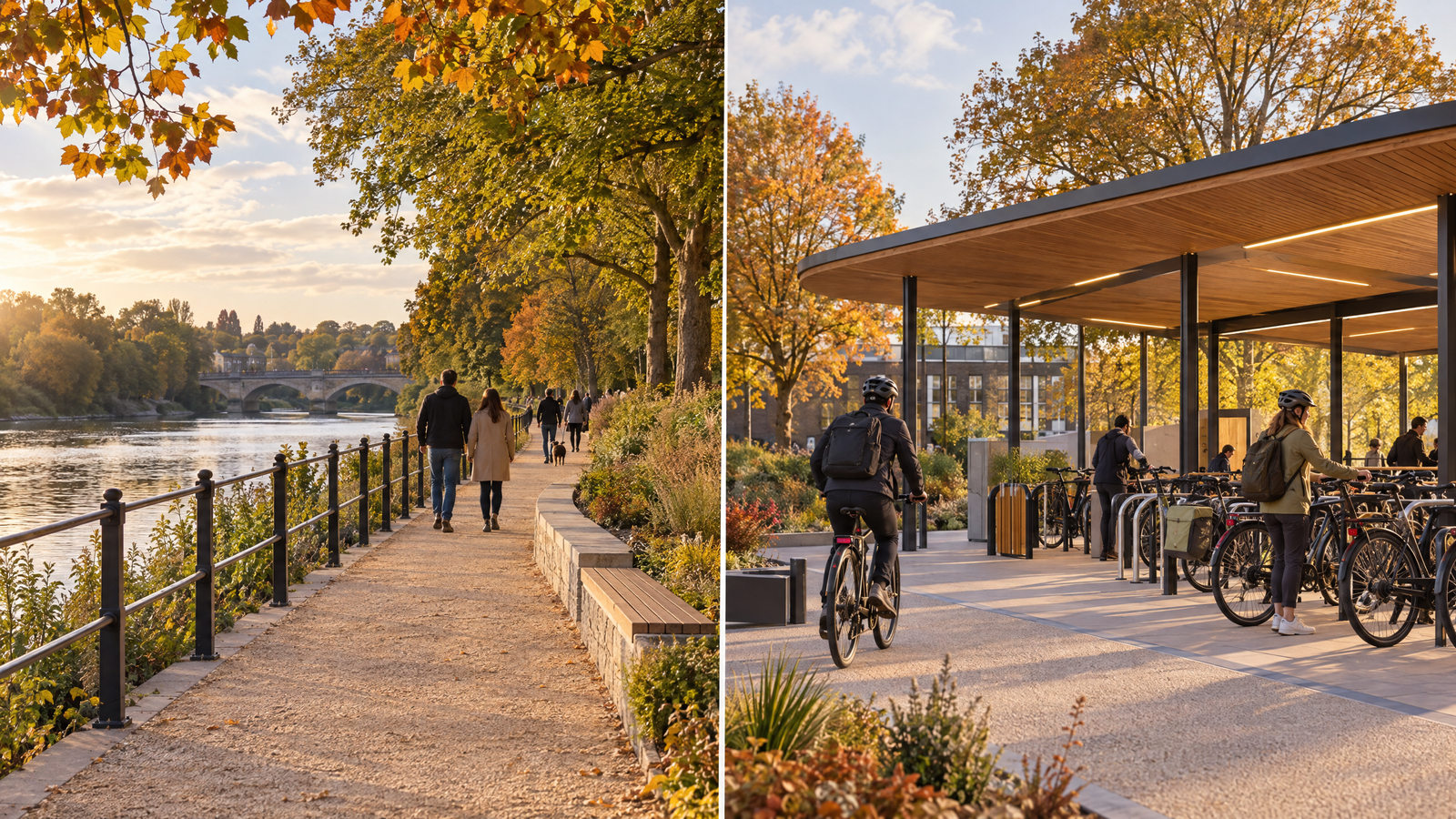

Two completed infrastructure projects in Richmond upon Thames have been recognised at the ICE London Awards 2026, with honours for a repaired Thames Path section at Kew and for the Richmond Cycle Hub.
The awards were held on 30 September, and the borough’s double success was announced the following day. The recognition concerns schemes that have already been delivered, rather than any new approval for capital spending or a fresh programme of works.
Two completed schemes recognised
The Thames Path at Kew won Best Project – Asset Resilience. The Richmond Cycle Hub won Best Project – Sustainability. The outcomes place the two schemes in separate award categories: one focused on extending the life and resilience of an existing riverside asset, and the other on sustainable transport infrastructure.
The Kew award recognised work on a section of the Thames Path between Richmond Lock and Kew Gardens. That route had been closed after a structural collapse in October 2024. The completed project stabilised 25 metres of riverbank and strengthened 150 metres of towpath, according to the council’s account of the scheme.
The cycle hub award recognised a new facility that opened in October 2025. The council says it invested £664,000 in the multi-storey hub, which provides more than 650 secure cycle parking spaces. It also says the facility produces around 24,500kWh of renewable energy each year and describes it as the country’s third-largest facility of its kind.
Kew towpath work followed structural collapse
The Thames Path between Richmond Lock and Kew Gardens is a well-used riverside walking route. Its closure after the October 2024 collapse made the repair and strengthening works significant for access along this part of the river as well as for the long-term condition of the towpath.
The scheme involved specialist marine equipment and more than 900 tonnes of material. The award body’s results describe the Kew project as an asset-life and resilience project, including a controlled floodplain-water solution. The council says the works were designed to protect the route against future erosion and collapse, although that should not be read as removing all future flood, riverbank or erosion risk on a tidal riverside asset.
Delivery brought together a number of organisations with interests in the river corridor and surrounding land. The project involved the Port of London Authority, the Environment Agency, the Crown Estate, Royal Mid-Surrey Golf Course, Kew Gardens and Hounslow Council, alongside Richmond Council.
Cycle hub recognised for sustainability
The Richmond Cycle Hub was recognised in the sustainability category for a facility intended to make cycling easier and greener. Its scale is central to the project’s local significance: more than 650 secure spaces give residents and visitors a large dedicated option for cycle parking, while the council-reported renewable generation figure forms part of the scheme’s environmental case.
The council says the hub was delivered in partnership with South Western Railway. It presents the facility as part of improved cycling infrastructure for Richmond town centre, supporting sustainable ways to get around and encouraging cleaner travel choices.
Unlike the Kew towpath scheme, which dealt with repair and resilience after a collapse, the cycle hub represents new active-travel infrastructure. The two awards therefore recognise different kinds of engineering outcome: one safeguarding an existing public route, the other adding capacity for secure cycle parking with sustainability features built into the facility.
Awards update, not a new works announcement
The double win is best understood as an awards update about completed projects. The Thames Path work has already addressed the damaged Kew section identified after the 2024 collapse, and the cycle hub has already opened. The awards do not in themselves create new construction powers, approve further spending or announce additional works.
For Richmond, the recognition highlights two recent infrastructure priorities: maintaining important riverside access and improving facilities for people who choose to cycle. The Kew project shows how a damaged public route was stabilised and strengthened through a multi-organisation effort, while the cycle hub shows the borough’s investment in secure, higher-capacity cycle parking and renewable-energy features.