
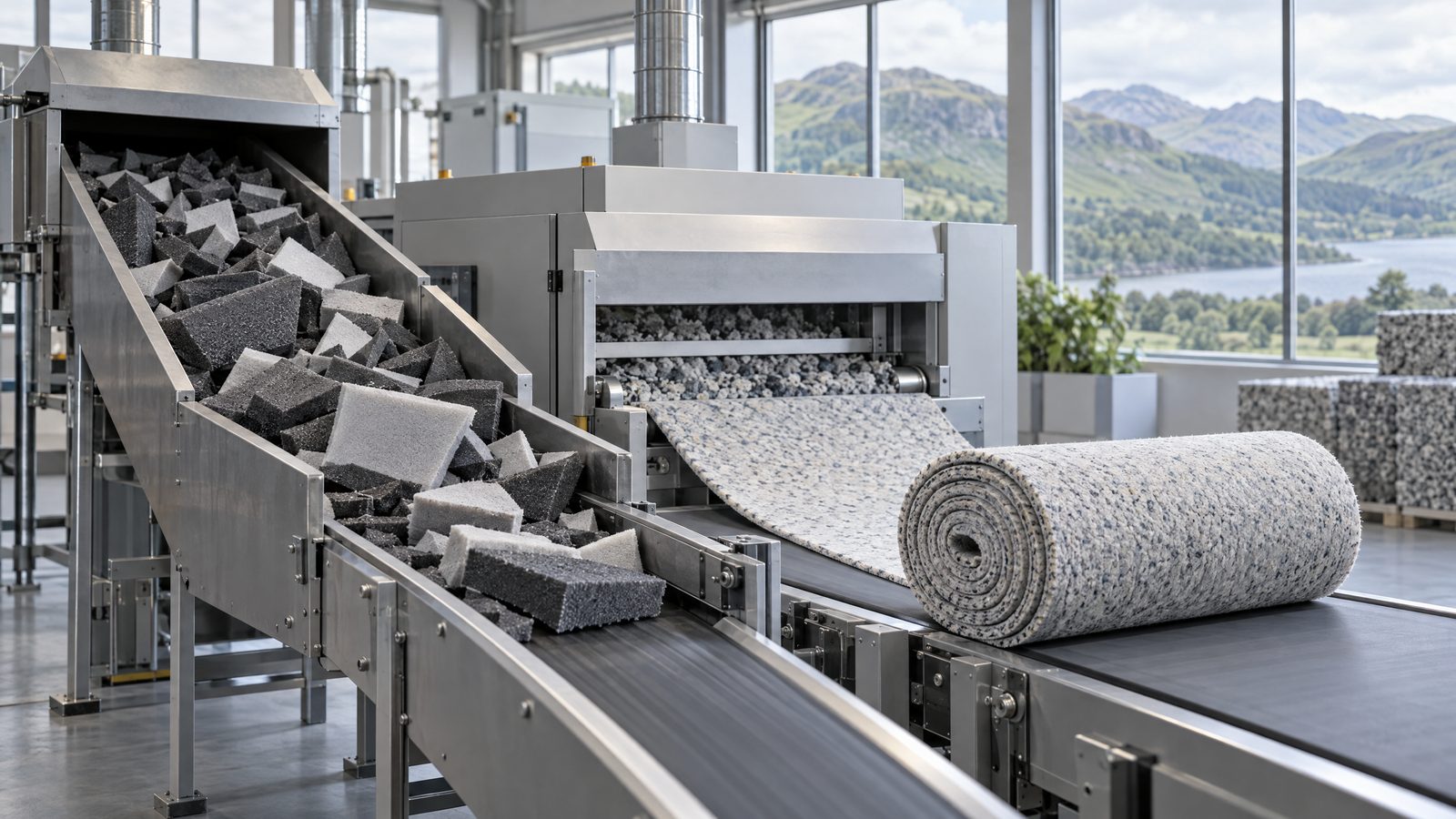

Sarva Foam is planning a foam-recycling manufacturing operation in Scotland with an initial capital investment of approximately £6 million. The proposal carries the potential for up to 100 Scottish jobs, including skilled manufacturing roles. It remains a proposal: the details released so far do not name a site, start date or recruitment timetable.
The intended operation would turn discarded foam into carpet underlay and flooring products. Its stated purpose is to keep material out of landfill while adding manufacturing capacity in Scotland. That places reuse of a difficult waste material at the centre of the plan, alongside the prospect of new industrial employment.
A first phase, rather than a completed investment
The initial £6 million is the first phase of a possible wider programme. A total of up to £12 million over three years is possible only if that first phase is delivered successfully and a wider commercial and funding package is confirmed. The larger figure is therefore not a committed total, and it should not be treated as money already invested in Scotland.
The same distinction applies to employment. The figure of up to 100 jobs is a potential outcome of the plan, not a confirmed number of posts that have been advertised or filled. The proposed roles include skilled manufacturing positions, but no occupational breakdown or timetable for recruitment has been set out.
The released details describe the first-stage sum as planned capital investment by Sarva Foam. They do not set out a precise Scottish location, the scale of the building, annual production capacity, the quantity of foam to be processed or a construction schedule. Those gaps matter when assessing the project’s future local effect.
Recycling aim and location still to be developed
The proposed operation would use material that might otherwise go to landfill. Carpet underlay and flooring products are the intended outputs. This is a circular-economy model in which a used material is processed into a new product rather than discarded after its first use.
However, no estimate has been released for waste diverted from landfill or for any resulting emissions reduction. The environmental benefit is an aim of the proposed model, not a measured outcome from an operating Scottish facility. Similarly, there is no public detail yet on the source of discarded foam or the customers for the planned products.
Sarva Foam is considering Scotland for its new manufacturing operation, and Scottish Enterprise is continuing to engage with the company as the plans develop. Until a specific site is identified, the published information does not establish the local authority area, planning position or the communities that might host the facility.
Announcement made during India visit
The investment plan was announced as First Minister John Swinney met Sarva Foam representatives in Mumbai. It formed part of a visit focused on trade and investment links between Scotland and India, with the wider aim of creating economic opportunities in Scotland and improving access to the Indian market for Scottish businesses and institutions.
Scotland’s stated strengths in the relationship include technology, financial services and clean energy. A projection cited during the visit put the Scotland-India trading partnership at more than £3 billion a year by 2030. That is a forward-looking estimate, rather than a measure of current trade or a guarantee of future investment.
What happens next
The immediate test for Sarva Foam’s proposal will be delivery of the initial phase. Only after that stage succeeds, and the commercial and funding arrangements are confirmed, could the plan reach the possible £12 million total over three years. The project should therefore be judged for now as an early-stage manufacturing investment proposal with potential employment and recycling benefits, rather than a factory that is already under construction or a jobs programme already in place.







