
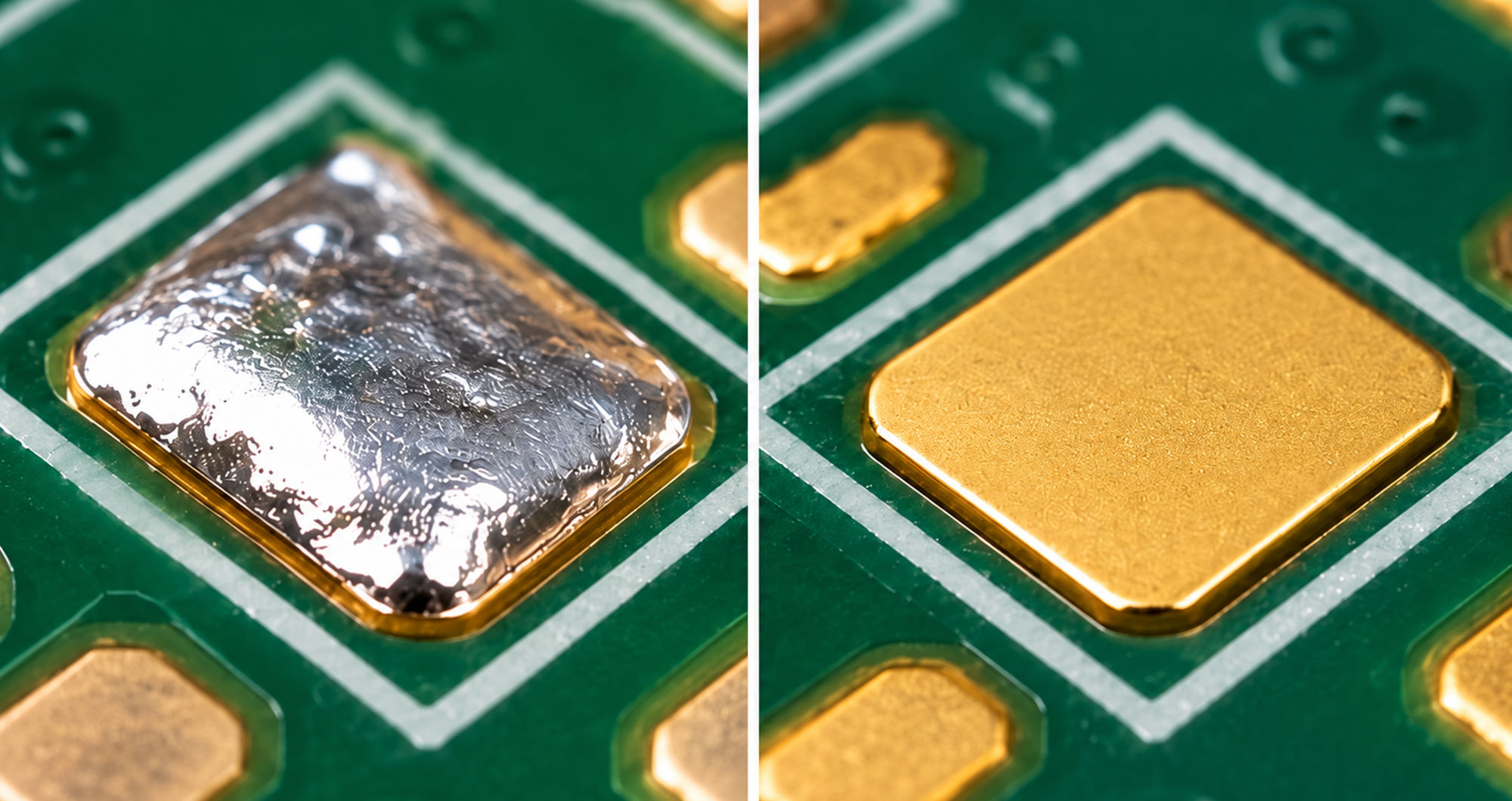

Lead-free HASL usually costs less; ENIG earns its premium where flatter pads improve assembly yield. Neither is universally more reliable. Component footprints, thermal exposure and plating quality determine whether the extra cost is justified.
Two Different Coatings on the Same Copper Pad
Hot air solder levelling (HASL) coats exposed copper in molten solder. Air knives remove excess solder, but the remaining thickness varies from pad to pad and across each pad. Lead-free HASL uses higher processing temperatures that require laminate review.
Electroless nickel immersion gold (ENIG) is deposited chemically rather than levelled with hot air. Nickel separates solder from copper, while thin gold protects nickel until assembly. ENIG is relatively planar, but plating chemistry and nickel-interface quality still matter.
| Selection factor | Lead-free HASL | ENIG |
| Initial fabrication cost | Generally lower | Generally higher |
| Pad height consistency | Variable solder thickness | More uniform plated surface |
| Fine-pitch SMT | Check carefully against footprint and assembly capability | Often preferred for small pads and tight spacing |
| Thermal exposure during finishing | Molten-solder immersion | Chemical plating, without a solder dip |
| Primary finish-specific concern | Uneven coating, thermal exposure | Nickel corrosion or defective plating interface |
| Best purchasing question | Can assembly tolerate the actual pad profile? | Can the supplier demonstrate ENIG process control? |
Where Flatness Changes Assembly Outcomes
Uneven solder coating matters when solder paste is deposited in small volumes and neighbouring pads have little margin for height variation. Fine-pitch BGA designs, QFNs, and very small passive components may be sensitive to inconsistent paste transfer or seating. ENIG removes one source of pad-height variability; it does not, by itself, correct a poor stencil aperture, inaccurate placement or an unsuitable reflow profile.
Pitch alone is not decisive; pad geometry, stencil design, coplanarity and assembly capability also matter. A 0.5 mm-pitch component does not automatically make HASL impossible, just as selecting ENIG does not guarantee a defect-free 0.4 mm-pitch assembly.
For larger solder lands, conventional through-hole joints and boards without demanding fine-pitch parts, lead-free HASL may be entirely adequate. A cost reduction is meaningful when the actual assembly process can demonstrate comparable first-pass acceptance.
Price the Accepted Assembly, Not Just the Bare Board
A finish quote measures fabrication expense. Compare the cost of an accepted assembly, including rework, scrap and inspection.
A useful comparison is:
Additional ENIG cost per lot = lot quantity × (ENIG board price − HASL board price).
Potential avoided cost = number of finish-related defects prevented × cost per affected assembly.
Consider a purely illustrative order of 1,000 boards. If ENIG adds £0.30 per board, the finish premium is £300. At £25 to investigate and rework one finish-related assembly defect, avoiding 12 such cases would offset that premium. This is a break-even test, not a claim that either finish will produce a particular defect rate. Real decisions require supplier quotes and measured pilot-build results.
If HASL already meets the yield target, there may be no loss for ENIG to prevent. Where coplanarity causes repeat defects, compare representative build results.
For additional process context, see this HASL and ENIG manufacturing comparison, especially when preparing a finish selection for a new PCB revision.
The Reliability Risks Are Different
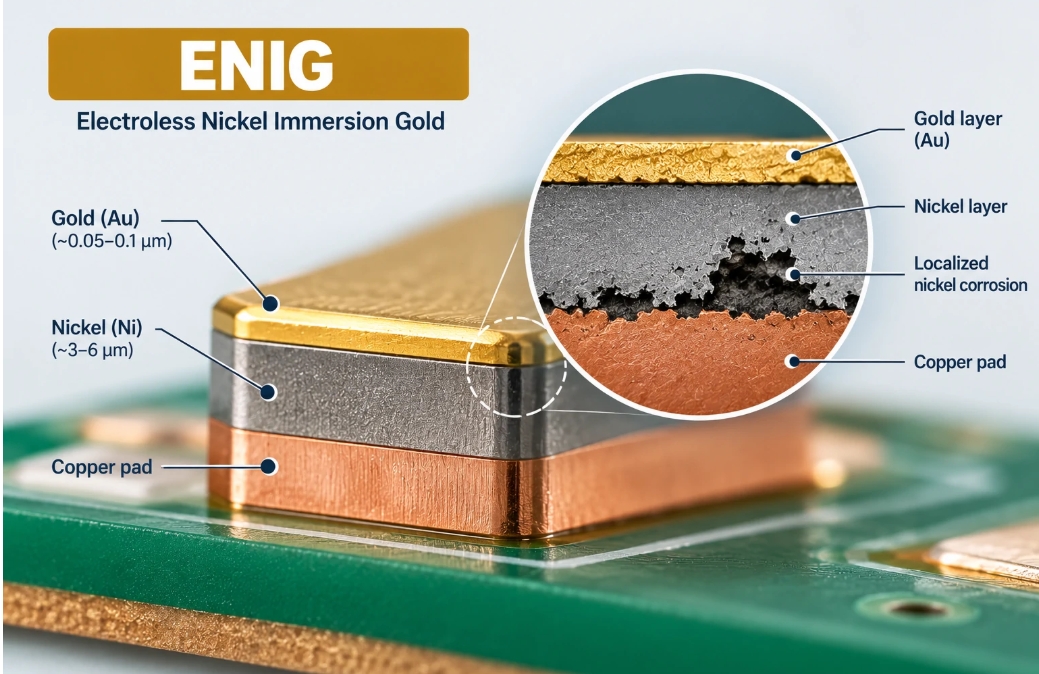
HASL’s main limitations are physical and thermal. The solder coating can be uneven, especially at small geometries. The solder bath also adds a high-temperature manufacturing exposure. For a thin board, a heat-sensitive material system or a complex multilayer stack, ask the fabricator to review its finishing process alongside the laminate’s thermal characteristics.
ENIG avoids a solder-levelling operation but introduces a different risk: localised corrosion or other defects at the nickel surface. Severe defects can compromise solder-joint integrity even if the pad looks acceptable before assembly. It is inaccurate to call ENIG universally more reliable without checking the plating process, inspection results and application conditions.
IPC-4552B addresses ENIG process control and performance, including finish thickness, corrosion evaluation and solderability. It is a useful basis for supplier discussions, but simply writing “ENIG” on a fabrication drawing does not replace agreement on acceptance requirements.
Neither finish has a universal shelf life. Request documented storage, handling and solderability limits rather than relying on generic claims.
Specify and Verify Before Production
A finish decision belongs in the fabrication drawing and purchasing documentation, not in a late email after quotation. Before release, the design and manufacturing teams should agree on:
The exact finish: state lead-free HASL or ENIG, not only “gold” or “HASL.”
Assembly-critical features: flag the finest-pitch packages, smallest pads and any unusual coplanarity needs.
Applicable criteria: identify the relevant ENIG standard and agreed inspection or solderability tests when needed.
Process evidence: request suitable finish-thickness measurements for ENIG and process verification appropriate to the project.
Build validation: compare placement defects, solder bridging, opens, rework hours and accepted assemblies on representative pilot lots.
In the first article inspection, record finish-related findings separately from stencil, component and reflow issues. Otherwise, a yield improvement may be incorrectly attributed to the surface finish when another process variable changed at the same time.
Which Finish Fits the Board?
| Board or assembly situation | Starting choice | Condition to verify |
| Cost-sensitive board with larger pads and through-hole components | Lead-free HASL | Proven soldering yield and laminate tolerance |
| Fine-pitch BGA/QFN assembly with limited pad-height margin | ENIG | Plating quality and actual assembly results |
| Thin or thermally sensitive board | Review ENIG first | Fabrication and laminate compatibility |
| Production with an established HASL process | Keep HASL under consideration | Evidence of a real benefit before paying the premium |
| Special contact or wire-bonding requirement | Neither by default | Confirm a finish designed for the specific interface |
Choose the lower-cost finish when it meets yield and reliability requirements; pay for ENIG when its benefits address a verified constraint.
Frequently Asked Questions
Is ENIG always better than HASL for SMT?
No. ENIG provides a more consistent pad surface and is often preferable for very small solder lands. For larger footprints, lead-free HASL may deliver acceptable assembly results at lower cost when the process has been validated.
Does lead-free HASL comply with RoHS requirements?
Lead-free HASL is intended for lead-restricted applications, but compliance depends on the actual materials and product requirements. Specify the lead-free variant explicitly and obtain the relevant compliance documentation from the manufacturer rather than assuming all HASL finishes qualify.
Can ENIG eliminate solder bridging on fine-pitch boards?
No. Its flatness can reduce one assembly variable, but bridging may still result from excessive paste, stencil design, placement offsets or reflow conditions. Review the full process before assigning a defect to the surface finish alone.
Is ENIG suitable for every connector or wire-bond application?
No. A solderable ENIG pad is not automatically suitable for repeated-wear contacts or gold-wire bonding. The contact geometry, wear expectations, and bonding method may require another finish, such as a qualified hard-gold or palladium-containing system.
How can buyers decide whether ENIG is worth the extra cost?
Compare identical board quotations, then quantify observed finish-related defects and rework in representative builds. ENIG is economically justified when its verified assembly or performance benefits exceed the added cost, not simply because it appears more premium.







