
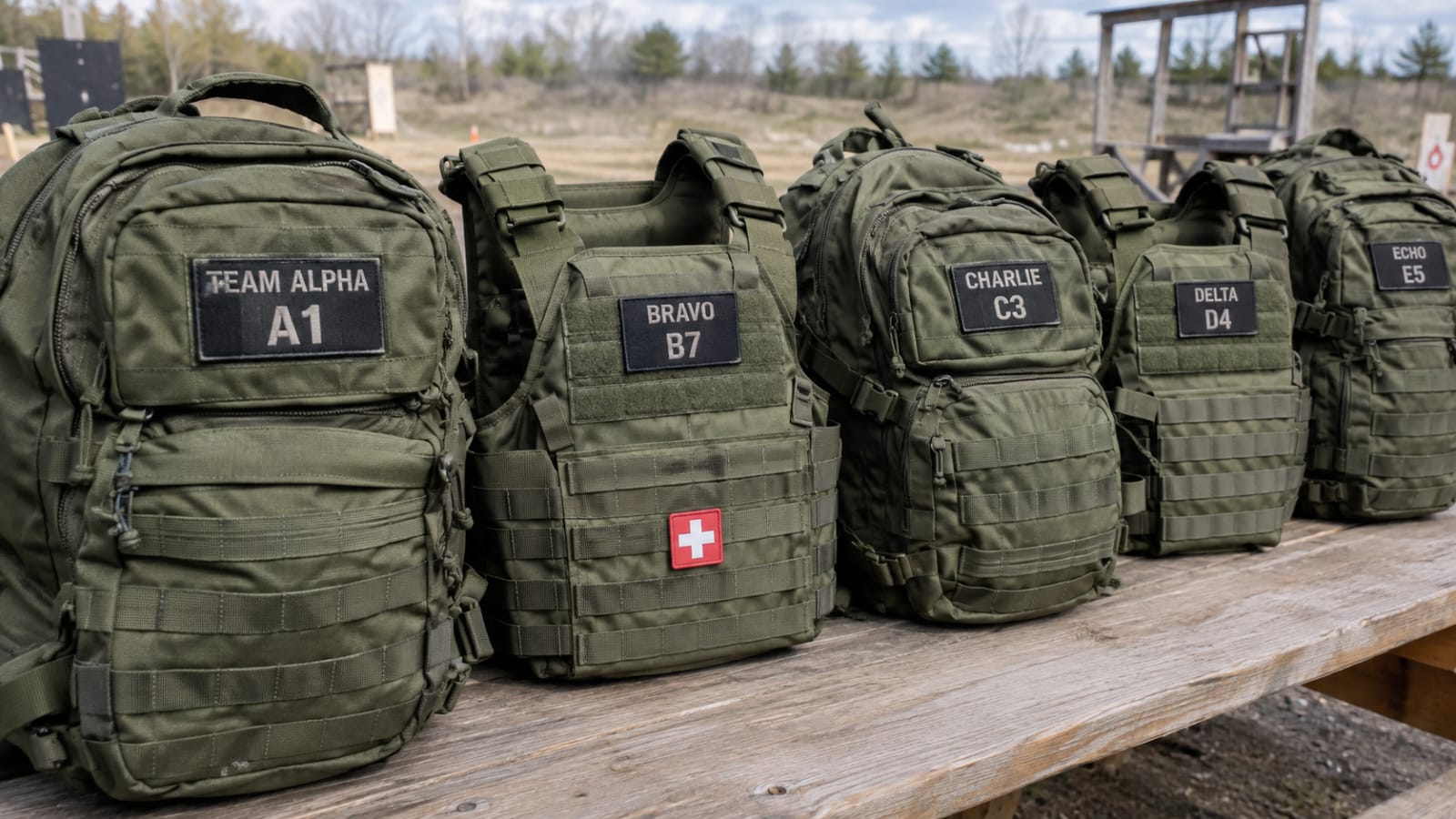

Shared field equipment helps teams work efficiently, but identifying who owns, carries or is responsible for each item can become difficult when several groups operate in the same location. Custom tactical patches provide a practical way to display team names, unit identifiers and role information on tactical bags, plate carriers, uniforms and other field gear.
Clear equipment identification supports team coordination, reduces confusion and makes shared resources easier to manage. Whether the setting involves military training, security operations, airsoft events or search-and-rescue exercises, consistent identification helps personnel recognise equipment and locate essential supplies.
What Is Team Identification on Shared Field Equipment?
Team identification is the process of marking equipment with visible information that connects an item to a specific group, person, role or function. These markings help users distinguish similar-looking equipment and understand its intended purpose.
Field teams frequently use standardised backpacks, tactical pouches, protective equipment and communication accessories. Although identical equipment creates a consistent appearance, it can make individual items difficult to distinguish.
A team identification system addresses this problem by adding recognisable markings, such as unit insignia, callsign patches, name tapes, colour-coded identifiers and equipment labels.
For example, a search-and-rescue organisation may use separate equipment bags for first-aid supplies, navigation tools and communications equipment. Clearly labelled bags allow volunteers to identify the correct resources without repeatedly opening identical compartments.
Effective identification communicates three essential details: who the equipment belongs to, what it contains or does, and who is responsible for managing it.
Why Does Clear Equipment Identification Matter?
1. Reduces Equipment Mix-Ups
Equipment mix-ups occur when personnel cannot distinguish between items that have similar appearances. This problem becomes more likely when teams share storage areas, transport vehicles or operational spaces.
Standard tactical backpacks, MOLLE pouches and protective gear often feature similar colours, dimensions and attachment systems. Without identifying marks, personnel may accidentally collect another team member’s equipment.
Visible team identifiers reduce this confusion by distinguishing individual items. A labelled equipment bag can display a unit name, while a callsign patch can associate personal gear with its assigned user.
This approach is particularly useful during training exercises, outdoor activities and large events involving multiple teams.
2. Improves Team Coordination
Team coordination depends on clear communication and an understanding of individual responsibilities. Identification markings support this process by making team affiliations and assigned roles easier to recognise.
During a field exercise, several groups may work within the same operational area. Team leaders need to distinguish their personnel, equipment and designated resources.
Unit patches, role identifiers and name tapes provide visual information that supports coordination. For example, a clearly marked communications equipment case allows personnel to identify its function without relying on verbal explanations.
Visual identification also supports handovers between shifts. Incoming personnel can recognise labelled resources and confirm their intended use with the outgoing team.
However, equipment markings should complement established communication procedures rather than replace them.
3. Supports Equipment Accountability
Equipment accountability is the process of recording which assets belong to an organisation, where they are located and who is responsible for them.
Shared field equipment may include radios, protective clothing, medical kits, navigation devices and specialist tools. Organisations need reliable methods to track these items during deployment, storage and maintenance.
Identification patches can display team ownership, while permanent asset labels can record individual serial numbers or inventory references.
These markings serve different purposes. A team patch identifies organisational affiliation, whereas an asset tag connects a specific item to an inventory record.
Using both systems creates a clearer relationship between equipment ownership and asset management.
4. Helps Personnel Locate Essential Equipment
Quick access to appropriate equipment matters during time-sensitive activities. Clearly labelled equipment reduces the need to search through multiple bags or ask other personnel where supplies are stored.
Medical response bags, communication cases and specialist equipment pouches benefit from simple, recognisable identifiers.
For instance, a first-aid pouch marked with a clear medical role label can be distinguished from a general storage pouch. Similarly, a communications bag labelled with its function can be located more easily among other field supplies.
High-contrast lettering, consistent placement and appropriate patch dimensions improve recognition.
Identification markings must remain readable in the conditions where equipment is used. Poor lighting, dirt, rain and obstructed surfaces can all affect visibility.
How Tactical Patches Support Equipment Identification
Tactical patches are durable identification badges designed for attachment to field clothing and equipment. They commonly display team names, unit insignia, callsigns, flags and role information.
Their construction makes them suitable for outdoor environments where conventional paper labels may become damaged or detached.
Hook-and-Loop Backing Allows Flexible Identification
Hook-and-loop fasteners provide a removable attachment method for equipment fitted with compatible loop panels.
Personnel can attach an identification patch to a tactical backpack, plate carrier, helmet cover or equipment pouch and replace it when the assignment changes.
This flexibility is particularly useful when several users share the same equipment.
For example, a training organisation can change the team identifier on an equipment bag between sessions without permanently altering the bag.
Equipment without an existing loop panel requires a compatible receiving panel or another attachment method.
Durable Materials Support Outdoor Use
Patch material affects durability, appearance and readability.
PVC tactical patches have a moulded, flexible surface that resists moisture and can be wiped clean after exposure to mud. Their raised lettering and symbols are suitable for simple, recognisable designs.
Embroidered patches use stitched threads to create traditional textile insignia. They work well for unit emblems, organisation names and identification badges.
Woven patches use fine threads to reproduce smaller lettering and detailed artwork. Their thinner construction is useful when a low-profile identification badge is preferred.
Material selection should reflect the equipment’s working environment, cleaning requirements and expected wear.
Custom Designs Create Consistent Team Recognition
A consistent identification design helps personnel recognise equipment associated with the same organisation.
Matching team logos, lettering styles and colour combinations establish a visual connection between uniforms, backpacks and equipment cases.
A security team, for example, may use matching identification patches on protective vests and designated equipment bags.
An airsoft squad may use a distinctive team emblem alongside individual callsign patches to distinguish group affiliation from personal identity.
Consistency makes identification easier to learn and maintain across different items.
What Information Should Equipment Identification Patches Display?
Equipment patches should communicate useful information without making the design unnecessarily complicated.
The most appropriate markings depend on the equipment’s purpose and the organisation’s operating procedures.
Common identification details include:
- Team or unit name: Identifies the organisation or group responsible for the equipment.
- Callsign or personal identifier: Connects equipment to an assigned team member.
- Role designation: Displays functions such as MEDIC, MARSHAL or COMMUNICATIONS where appropriate.
- Equipment category: Distinguishes first-aid kits, navigation equipment and general field supplies.
- Asset reference: Provides a short equipment code that connects to a separate inventory record.
- Colour-coded markings: Help distinguish departments, functions or equipment categories.
The information should remain concise. A short equipment identifier is easier to recognise than a patch containing several lines of small text.
Sensitive operational details, personal contact information and other confidential identifiers should not be displayed unnecessarily.
Why Patch Placement and Visibility Are Important
Patch placement determines whether identification remains visible during normal equipment use.
A well-designed patch provides limited value if straps, attachments or other accessories consistently cover it.
On tactical backpacks, identification patches are commonly positioned on front-facing loop panels. Plate carriers usually feature dedicated attachment areas on their front or rear surfaces. Equipment pouches may require smaller labels that fit their available space.
Placement should consider the equipment’s shape, handling requirements and expected orientation.
Selecting the Right Colour Contrast
Colour contrast affects how easily personnel can recognise lettering and symbols.
Black lettering on a dark background may be difficult to distinguish, particularly in poor lighting. A contrasting design generally improves readability when rapid recognition is the priority.
However, military-style equipment may require subdued identification colours to maintain a low visual profile.
Olive Drab, Ranger Green, Coyote Brown and Black are commonly associated with tactical clothing and field equipment.
Search-and-rescue groups, event personnel and other teams that require greater visibility may prefer brighter identification panels or suitable reflective materials.
The correct colour scheme depends on the operational context. Visibility requirements and uniform policies should guide the final design.
Matching Patch Size to Equipment
Patch dimensions should match the available attachment area and the amount of information displayed.
Small pouches generally suit compact identifiers, while larger backpacks can accommodate broader team-name patches.
A patch should not obstruct zips, handles, ventilation areas, safety instructions or equipment controls.
Legibility should take priority over decorative detail. Large lettering and simple symbols are often more effective than complicated artwork when identification must be recognised quickly.
Where Is Clear Team Identification Most Useful?
Military and Cadet Training
Military personnel and cadet organisations use identification markings to distinguish units, individual equipment and assigned roles.
During exercises, several participants may carry similar field packs, clothing and accessories. Unit insignia and personal identifiers help separate equipment belonging to different groups.
Identification should follow applicable organisational rules, particularly when official military insignia or restricted markings are involved.
Security and Event Operations
Security personnel frequently work across shared venues, temporary installations and rotating shifts.
Clearly identified equipment supports organised handovers and helps teams locate resources assigned to particular functions.
Role markings on authorised uniforms can also distinguish staff responsibilities. Equipment identifiers provide a complementary method of recognising cases, bags and shared supplies.
Airsoft and Milsim Teams
Airsoft and military simulation activities often involve participants wearing similar camouflage clothing and carrying comparable tactical equipment.
Team patches and callsign identifiers help players recognise affiliations and manage their personal gear.
Removable patches are particularly useful when participants change teams, attend different events or use borrowed equipment.
Event organisers may also use distinctive identification markings for marshals and authorised staff.
Search-and-Rescue and Outdoor Volunteer Groups
Search-and-rescue volunteers operate with equipment that may be distributed among different personnel and vehicles.
Clear labels help distinguish medical supplies, navigation resources and communications equipment.
Role identifiers also help personnel recognise designated team members during exercises and organised activities.
Identification systems should align with the organisation’s established equipment management and operational procedures.
How to Build an Effective Equipment Identification System
An effective identification system combines suitable markings with consistent equipment management practices.
The first step is to determine which items require identification. Shared backpacks, communication cases, first-aid pouches and specialist equipment are useful starting points.
Next, organisations should establish a standard naming convention. Team names, equipment categories and asset identifiers should follow a consistent format.
The identification design should then be matched to each item. This includes selecting suitable patch dimensions, materials, backing options and colour combinations.
Teams should also test whether markings remain readable when equipment is packed, worn or stored.
Finally, equipment checks should become part of routine issuing and returning procedures.
A patch helps personnel recognise an item, but an inventory record confirms its assignment, maintenance status and location. Using these systems together provides stronger accountability than relying on visual markings alone.
Common Equipment Identification Mistakes to Avoid
An identification system becomes less effective when markings are inconsistent, difficult to read or poorly positioned.
One common mistake is displaying too much information. Small lettering, complicated logos and excessive detail reduce recognition at normal viewing distances.
Another mistake is relying entirely on colour. Colour-coded equipment can be useful, but written labels or distinctive symbols provide additional identification cues.
Inconsistent placement also creates confusion. When similar equipment carries identification in different locations, personnel need more time to find the relevant markings.
Organisations should avoid using removable patches as the only record of equipment ownership. Detachable identifiers can be exchanged or lost, so permanent asset records remain important.
Finally, official insignia and specialist role identifiers should only be used with appropriate authorisation. Clear identification must not misrepresent a person’s authority, qualifications or organisational affiliation.
Conclusion
Clear team identification improves the organisation and usability of shared field equipment. Recognisable markings help personnel distinguish similar items, understand equipment functions and maintain consistent ownership information.
Tactical patches offer a flexible identification method for backpacks, uniforms, protective equipment and compatible field accessories. Their effectiveness depends on readable designs, suitable materials, secure attachment and consistent placement.
For military training groups, security organisations, airsoft teams and outdoor volunteers, a well-planned identification system supports coordination and equipment accountability.
When clear visual markings are combined with reliable inventory procedures and established team communication, shared equipment becomes easier to identify, issue, locate and manage.







