
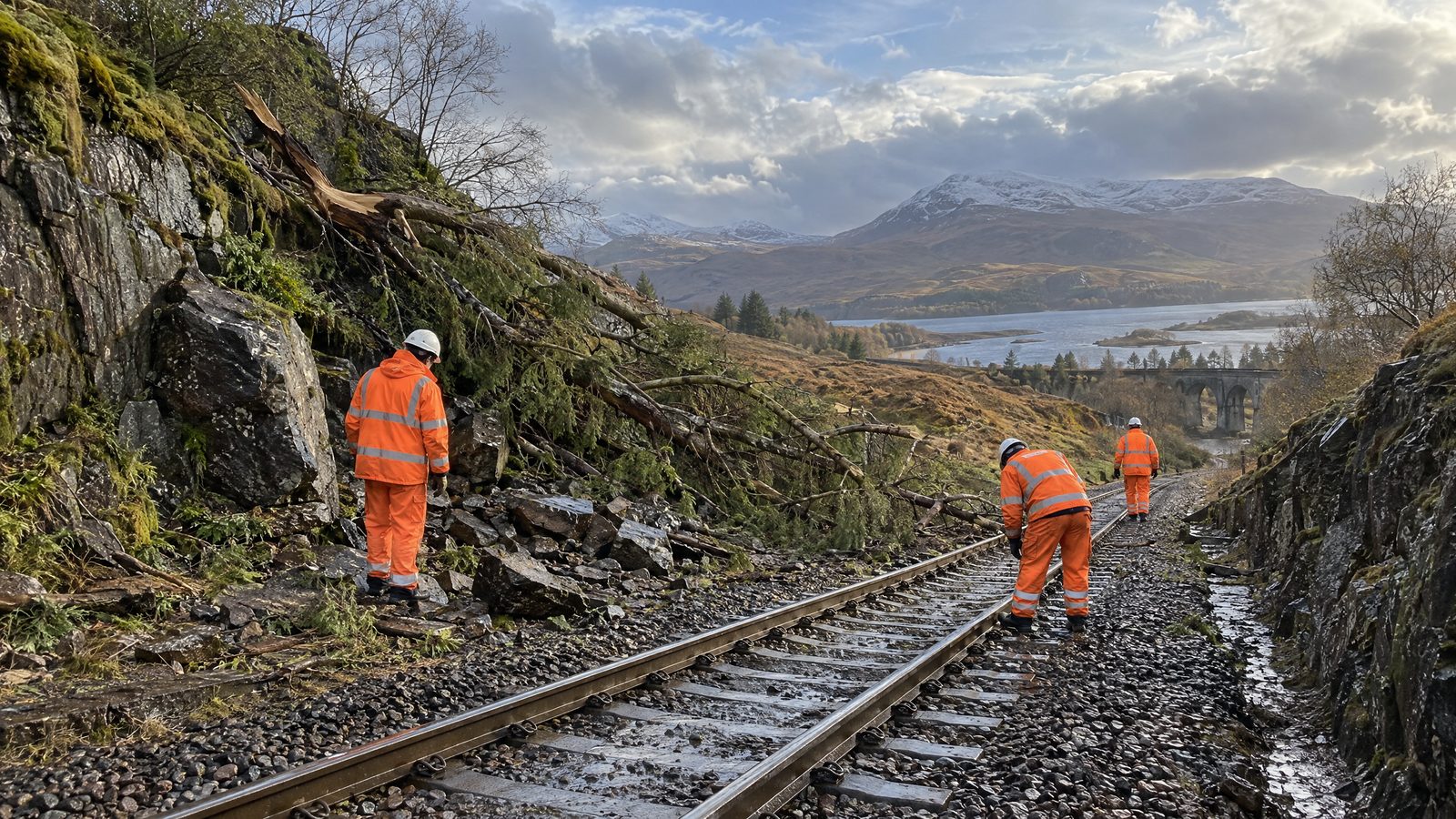

Storm Boelo recovery continues after rail, power and transport disruption
Recovery work continued across Scotland and North West England after Storm Boelo brought flooding, fallen trees, damage to railway equipment and widespread disruption to journeys and electricity supplies. The focus had moved from precautionary closures and weather warnings to the practical task of making routes safe, restoring power and assessing where further restrictions were still needed.
On Scotland’s railway, teams cleared fallen trees and other debris, dealt with flooding and power failures, and repaired damaged overhead lines. Inspections continued through the night before affected sections could reopen. The work was necessary because hazards left by high winds and heavy rain can remain after the most severe weather has passed, particularly where debris, water or damaged electrical equipment is close to the track.
Rail recovery remained dependent on checks
The expected position for Monday was that the vast majority of Scottish rail services would operate normally. That expectation did not amount to a guarantee for every route. Further morning disruption remained possible on the Inverness to Kyle of Lochalsh line, the Inverness to Thurso and Wick routes, the Glasgow Queen Street to Fort William and Oban services, and the Ayr to Stranraer line.
Those locations reflect the fact that recovery after a storm is not a single switch from closure to normal operation. Engineers need to inspect each affected stretch, remove any remaining obstruction and confirm that track, signalling and overhead equipment are safe. A route can therefore reopen at a different time from neighbouring lines, even when the weather has become less severe.
In North West England, the effects were also substantial. Flooding and downed overhead wires caused delays, service alterations and cancellations, while some operators suspended services on affected parts of the network. Railway engineers inspected routes, removed debris, managed flooding and assessed damage to the electrical infrastructure. The disruption was an observed operational impact, rather than the earlier possibility of problems set out in pre-storm travel advice.
Power and wider transport disruption
Scotland’s wider response included a meeting of the Scottish Government Resilience Room to consider the storm’s continuing effects. At the point covered by the update, around 40,000 electricity customers were without supply and about 26,000 had already had power restored. These were a snapshot of a fast-changing position, with ongoing winds making repair work more difficult in some places.
Flooding affected properties in Largs and Saltcoats, while some transport routes were damaged and fallen trees blocked roads. Rail, air and ferry services were also disrupted. The combination of wind, saturated ground and flooding meant that the impact extended beyond any one transport system: road access, electricity repairs and public travel could all be affected by the same local conditions.
The recovery picture was therefore uneven. Restored electricity supplies did not mean every customer was immediately reconnected, and the reopening of one rail route did not settle the position on another. Work on damaged infrastructure had to proceed alongside safety inspections and the continuing assessment of weather conditions. For passengers, this meant that a broadly improving network could still contain individual cancellations, altered services or longer journeys.
From preparation to an operational update
Earlier coverage of Storm Boelo centred on amber warnings, planned rail closures and the risk that severe weather might affect travel. The developments on 25 October provided the subsequent operational picture: trees and debris had to be cleared, overhead equipment required repair, flooding had affected transport, and power restoration was under way. That distinction matters because forecasts describe potential disruption, whereas the recovery operation records the work required after the storm’s effects have been felt.
Conditions were expected to improve in some areas later on 25 October, although the response remained alert to the possibility of further adverse weather early in the following week. People making journeys in the affected areas needed to allow for changing local conditions and check the status of their particular service before travelling. The immediate priority remained the safe restoration of rail, road, air, ferry and electricity services where Storm Boelo had caused damage or disruption.







