
For as long as most Londoners can remember, the Underground has been the place where phones go quiet. Messages wait in the outbox between stations, maps freeze on the escalator and the news app shows whatever it managed to load at street level. That era is nearly over.
Transport for London says the whole Tube network is on track for 4G and 5G coverage by the end of 2026, which leaves a more interesting question for the millions who ride it every day: what will they do with minutes that used to be offline?
Twenty years of promises
Mobile signal below ground is one of the longest-running pledges in London politics. The proposal came to life in 2005 and some years later, coverage was delivered by 2012. A target of 2019 came and went as well. The current project began in June 2021, when TfL awarded a 20-year concession to the company now called Boldyn Networks, and the eastern half of the Jubilee line was already connected at that point.
Progress since then has been steady. The Elizabeth line has been fully connected since December 2024, and by June 2026 around 60 per cent of the Tube’s underground stations had coverage. More than 600 engineers fit cables and antennas overnight, during the few hours when no trains are running. Anyone wondering whether their own route is live yet can follow the rollout on TfL’s connectivity pages.
Signal 58 metres down
The early data is encouraging. Network analysts at Ookla studied more than 50 million background signal scans collected across London between late March and the end of April 2026. Where 5G was available underground, the median signal measured -93 dBm, compared with -98 dBm for the city above. Signal strength is counted in negative numbers, so the figure closer to zero is the stronger one.
Hampstead, the deepest station at around 58 metres, still recorded a median 4G reading of -82 dBm.
Much of that comes down to how the network was built. Two runs of coaxial cable are laid through the tunnels at roughly train window height, so one can cover for the other, and the system was designed to support 5G from the outset. Coverage is still uneven in places. Ookla found that readings hold steady through the first 30 metres of depth and weaken further down.
How the commute is changing
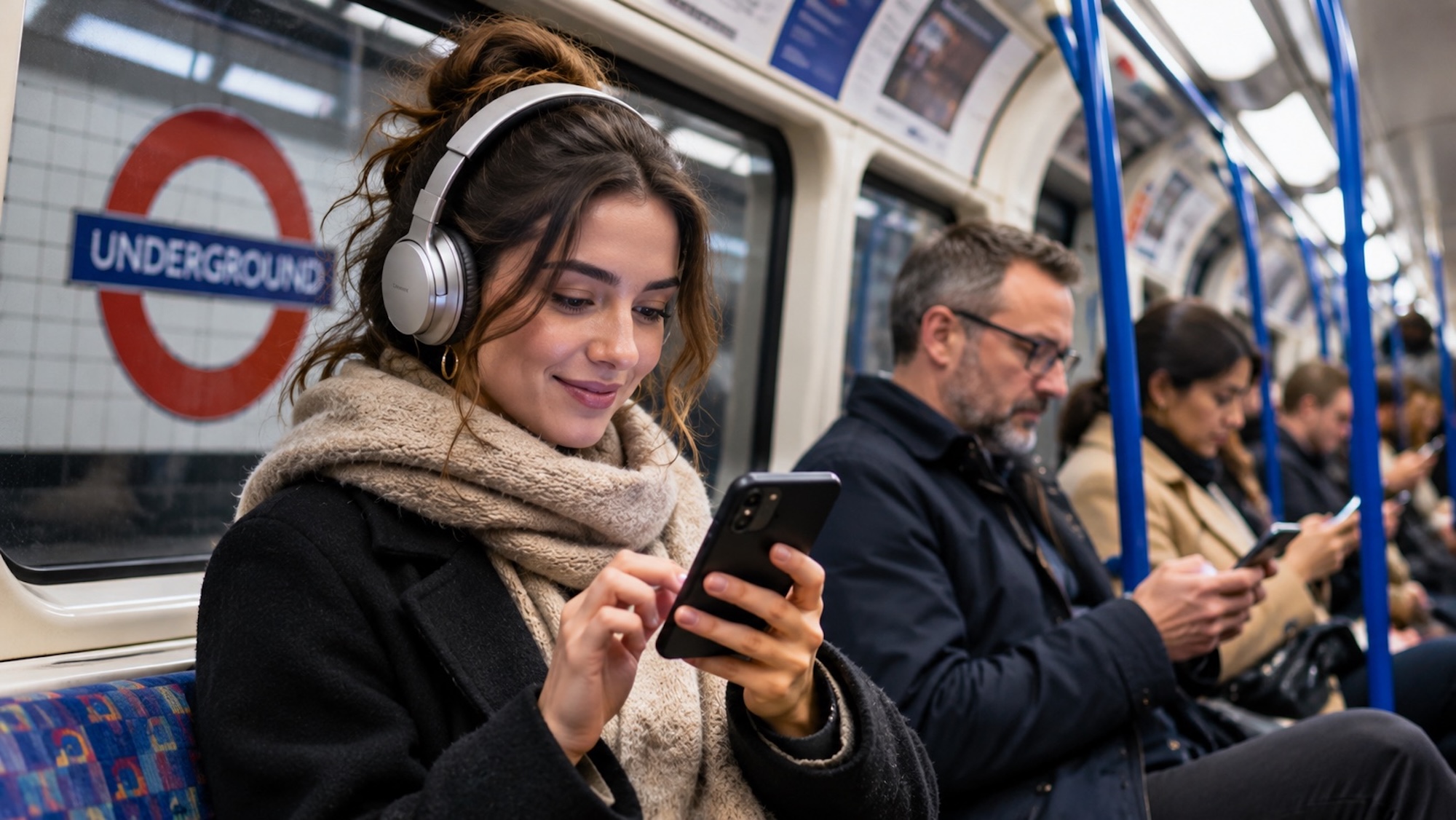
A smooth Tube journey used to depend on preparation. Commuters downloaded podcasts the night before, saved long reads for offline use and synced playlists while the home Wi-Fi was still in range. A live connection makes that routine optional. Replies go out between stations, a match highlight plays without stalling at every platform, and breaking news reaches passengers while the train is still in the tunnel.
The biggest change is for services that need a constant stream of data, since they simply did not work underground before. Video calls belong in that group, and so do multiplayer games and live casino tables. A blackjack hand at a live dealer table on MrVegas, for instance, is dealt by a real person in a studio and streamed as it happens, so there is nothing to download in advance the way you would with an episode of a series. Lighter formats suit the Tube just as well. Puzzle games, short news briefings and quick videos fit neatly into a journey of four or five stops.
The next test is capacity. A packed rush-hour carriage puts hundreds of phones inside one moving metal tube, and London’s networks are already stretched at street level, where Ookla now ranks the city’s median 5G download speed as the slowest of 18 European capitals.
For now, most passengers will settle for the small novelty of a message arriving mid-tunnel. Keeping a carriage quiet will soon come down to good manners alone.