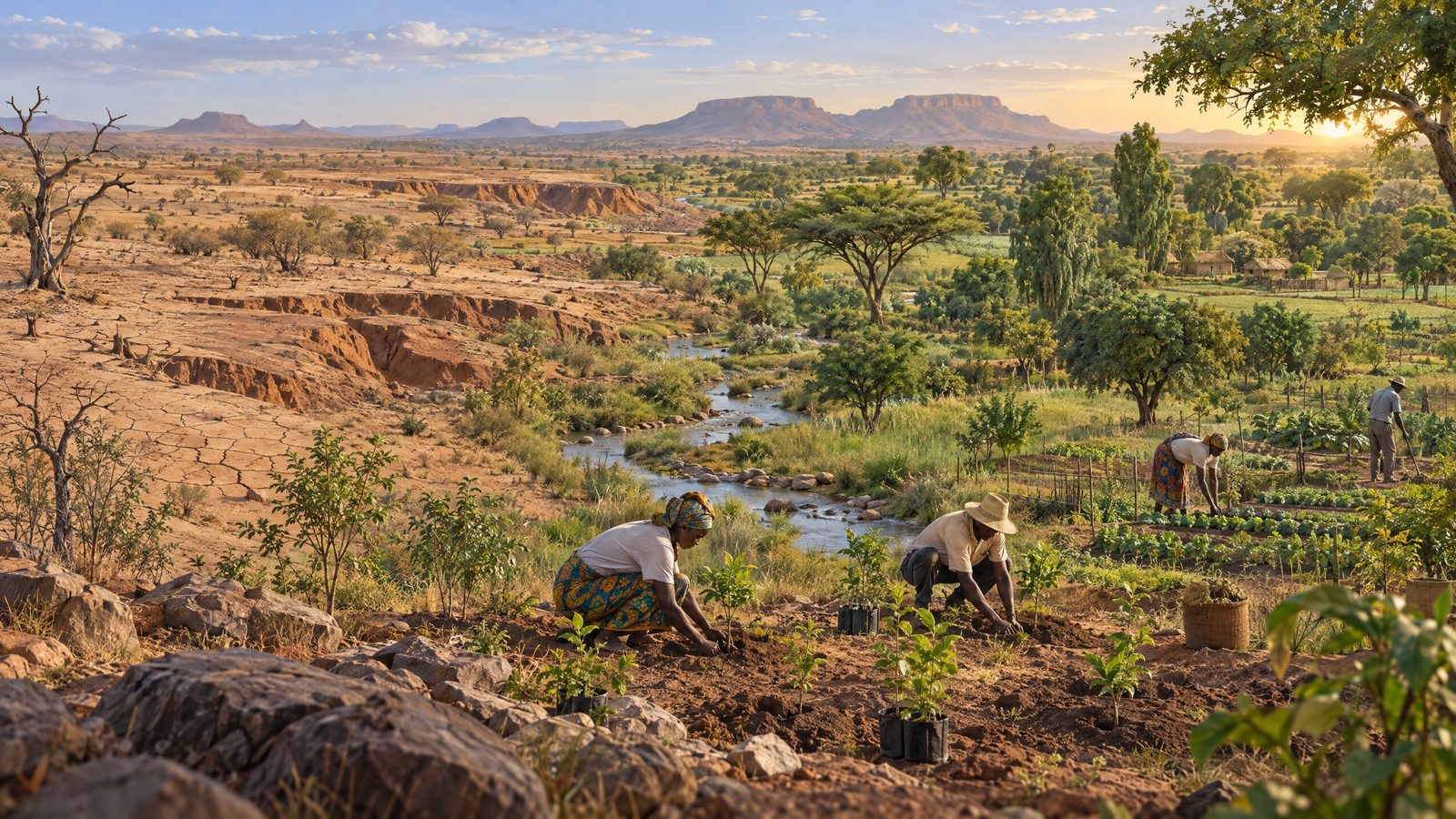

A new US$78 million programme will support land restoration and livelihoods across nine countries linked by Africa’s Great Green Wall, with overall resources expected to exceed US$500 million once co-financing is included.
The initiative, announced in Saint-Louis, Senegal, on 6 October, sets a target of restoring more than 270,000 hectares of degraded land and improving livelihoods for five million people. More than half of those expected to benefit are women, according to the programme announcement.
The participating countries are Burkina Faso, Chad, Ethiopia, The Gambia, Mali, Mauritania, Niger, Nigeria and Senegal. Their governments are working with the United Nations Environment Programme (UNEP), the West African Development Bank and the Pan-African Agency of the Great Green Wall under a shared regional framework.
How the programme will be delivered
UNEP is to implement eight of the programme’s ten projects and coordinate delivery across the region. The West African Development Bank will implement the other two. The design aims to connect national projects through common coordination, monitoring and knowledge-sharing, rather than treating each restoration effort as an isolated intervention.
The US$78 million grant comes from the Global Environment Facility. Additional financing from the Green Climate Fund, the International Fund for Agricultural Development, the Food and Agriculture Organization of the United Nations and bilateral partners takes total programme resources to more than US$500 million. The larger figure includes co-financing; it is not the size of the GEF grant.
The programme is called the Transformation Approach to Large Scale Investment in Support of the Implementation of the Great Green Wall Initiative. It builds on more than a decade of restoration work by participating countries and earlier GEF-backed efforts to assess degraded land and identify places where restoration could succeed.
Its approach encompasses landscapes and the ecosystems that support agriculture, pastoralism and rural livelihoods. UNEP says the regional framework is intended to improve alignment between national work, monitoring of progress and the exchange of practical knowledge among countries.
Country projects set different priorities
Mali has the largest stated restoration target: 150,000 hectares across Kayes, Nioro and Ségou. Niger is to rehabilitate 55,000 hectares of farmland, woodland and grazing land. In Ethiopia, the programme plans to restore 22,000 hectares of degraded land and bring a further 40,000 hectares of natural forest under improved management.
In The Gambia, work on wetlands and forest corridors is expected to benefit nearly 800,000 people, most of them women. Women-led enterprises are a central element of projects in Nigeria’s Kebbi State and Mauritania. Chad and Burkina Faso are focusing on drought-resilient land management for communities facing desertification.
These figures describe planned activities and expected beneficiaries, rather than completed restoration or outcomes already measured. The programme’s overall five-million-person livelihoods target is a projection attached to the new initiative.
A regional effort against land degradation
The Great Green Wall was launched in 2007 under the auspices of the African Union as an African-led effort to address desertification, land degradation and drought across the Sahel. Its work has developed beyond a narrow tree-planting concept towards broader management of land and natural resources.
The new programme is framed as a contribution to participating countries’ commitment to bring 30 per cent of degraded land under restoration by 2030. UNEP describes the Sahel as warming around 1.5 times faster than the global average and says about two-thirds of its productive land is degraded, placing pressure on food systems, water resources and livelihoods.
The announcement also notes that environmental stress, food insecurity and conflict have contributed to the displacement of more than four million people within the region. That context underlines the pressures the programme is designed to address, but the initiative’s stated measures are land restoration, improved land management and livelihood support; the announcement does not claim that the programme alone will resolve those wider challenges.
Delivery will depend on the participating governments and implementing partners translating the regional framework and financing into work on the ground. The programme’s stated targets provide a measure against which its restoration activity and expected livelihood benefits can be assessed over time.