
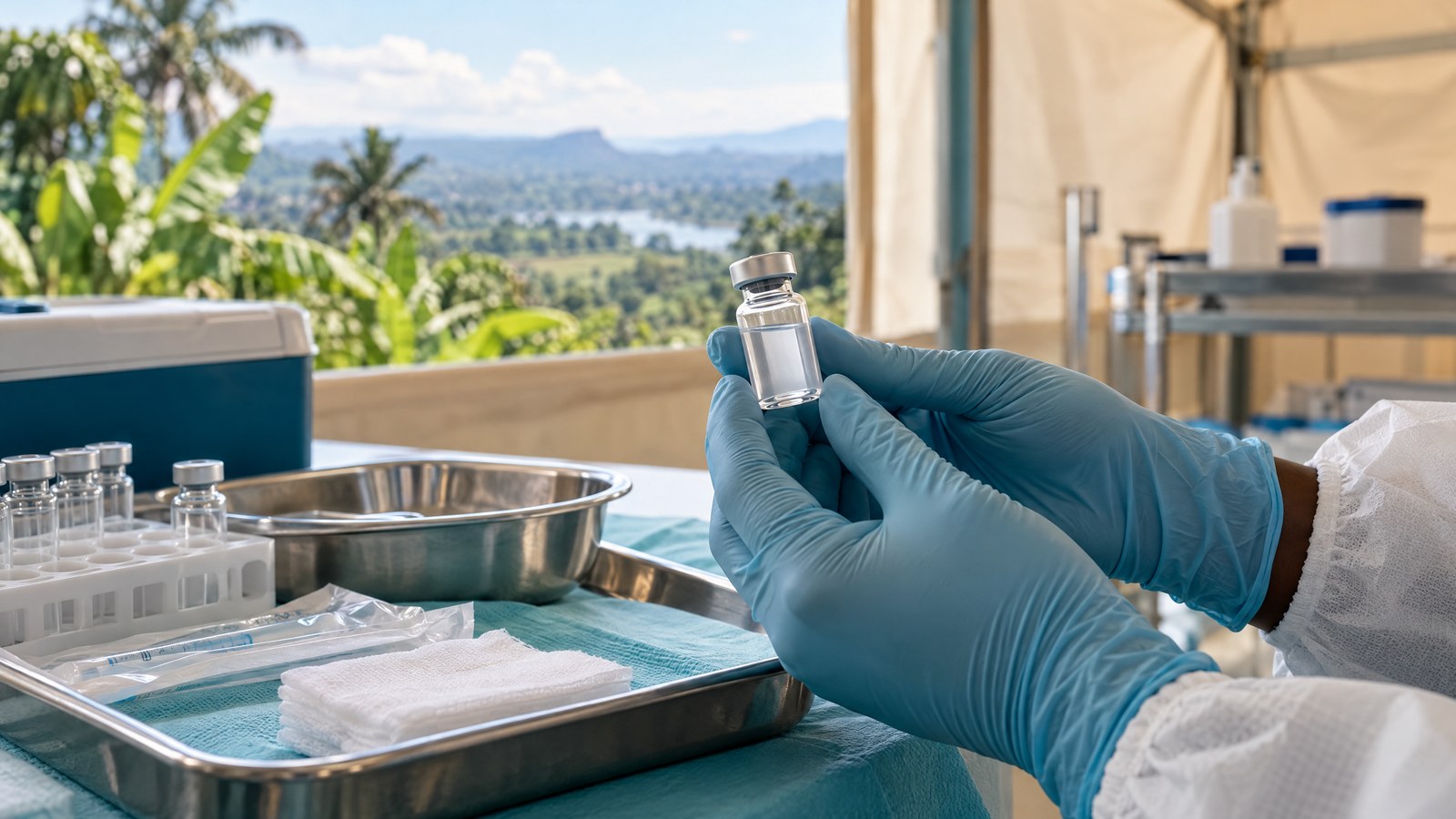

Health authorities in the Democratic Republic of the Congo have launched a Phase 2/3 trial of vaccine candidates against Bundibugyo virus in Bunia, with the first participants enrolled on 23 October. The trial is intended to generate evidence on candidates for a form of Ebola disease for which there is no approved vaccine or specific treatment.
The start of enrolment is a significant change in the response to an outbreak that has continued to expand across the country. It does not mean that a vaccine has been shown to work, or that protection is available to the public. The trial’s results and any later regulatory decisions will be needed before those questions can be answered.
The announcement comes as the latest figures describe a high and geographically dispersed burden of disease. As of 20 October, the Democratic Republic of the Congo had recorded 9,704 confirmed cases, including 4,687 confirmed deaths and 2,595 recoveries. The figures are a dated snapshot and should not be treated as a live total.
Eight provinces affected
Confirmed cases have been identified in 66 health zones across eight provinces. Ituri remains the most affected province, while cases have also been reported in Nord Kivu, Haut-Uélé, Tshopo, Bas-Uélé, Sud Kivu, Sud-Ubangi and Nord-Ubangi. Nord-Ubangi is the most recently affected province in the latest account.
The outbreak has increased since the previous update of 8 October, when the confirmed total was lower and a vaccine trial was described as expected later in the month. The new account reports an additional 976 confirmed cases and 482 confirmed deaths in the Democratic Republic of the Congo since that earlier update. Its central new development, however, is the move from an anticipated study to the enrolment of participants in Bunia.
Health teams are continuing surveillance, testing, infection prevention and control, clinical care, community engagement and logistics work alongside the research effort. These activities are intended to find cases, support patients and reduce opportunities for further transmission. They are not evidence that transmission has been brought under control.
Contact follow-up remains below the stated target
Response teams were following 30,130 contacts across six provinces. Of those, 24,017 were seen in the most recent 24-hour reporting period, a follow-up rate of 79.7 per cent. That was an improvement on the previous day’s 77.8 per cent, but remained below the 95 per cent target set for the response.
Contact follow-up is a core part of an Ebola response because people who may have been exposed can be monitored and assessed quickly if they become unwell. A shortfall against the target does not show why individual contacts were not seen, nor does it establish that they are infected. It does show that health authorities still face a substantial operational task across a large number of affected areas.
Bundibugyo virus disease is an Ebola disease caused by Bundibugyo virus. It can be transmitted through direct contact with the blood or other bodily fluids of an infected person, or through contaminated surfaces and materials. People are not infectious before symptoms begin, according to the latest public-health assessment.
Cases connected to the wider outbreak have also been reported in Kenya and Nigeria, adding to the importance of cross-border preparedness. But the Bunia trial is focused on a separate question: whether the candidate vaccines can provide a future tool against Bundibugyo virus. For now, the confirmed milestone is that the study has begun and its first participants have been enrolled; no efficacy findings have been reported.







