
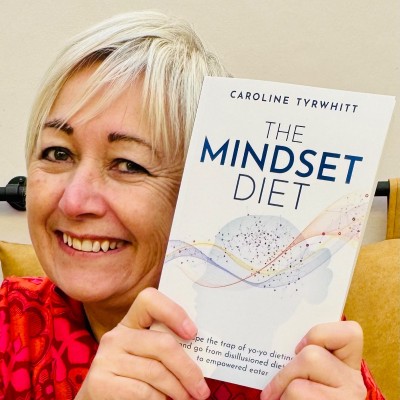
By Caroline Tyrwhitt, Food Relationship Coach and author of the bestselling book The Mindset Diet: Escape the trap of yo-yo dieting and go from disillusioned dieter to empowered eater.
Are you feeling trapped by the fear around weight gain? Anxious at the news that ultra processed foods you rely on make us put on weight? Frightened that you may get cancer or another disease because of your weight? Alarmed that they want to change the BMI rate so we’re classed as obese sooner yet you haven’t managed to solve your present problem?
If you’re desperate to lose weight and have been round the diet cycle millions of times already, the idea of a weekly injection to lose weight without trying must seem like a miracle. And the news of the shortage, must feel like your bubble’s burst.
When we’re feeling desperate and disheartened, we’re at risk of soothing with food and then the guilt being triggered and so we give up. Making a decision from a place of fear rarely serves us well, but if you seize the opportunity to consider instead what you really want from life and what is your real motivation for wanting to lose weight, then you can get more clarity on the best action for you.
Let me tell you first, it’s not your fault you’re trapped in the diet cycle. We’ve been programmed since childhood to ‘go on a diet’ to lose weight, yet most of us gain back the weight. A widely quoted statistic is 95% of people who lose weight regain it within two years. In my mind that means dieting doesn’t work.
There’s a plethora of diets out there to choose from and research suggests that the average person tries 126 diets in their lifetime.(1) So you’re in the company of many.
What’s the issue with going on a diet?
- When you deprive yourself, you focus on what you can’t have, you become less motivated and hyper focussed on the foods you can’t/shouldn’t/mustn’t eat and are more likely to self-sabotage,
- When you decrease your food intake, you slow your metabolism which means you now have to move more to burn the same calories and you burn less while you’re resting.(2)
- Dieting also reduces your muscle mass which causes you to burn less calories when resting too.(3)
- Dieting can lower leptin levels (4) and increase ghrelin levels (5) – making your feel more hungry and less able to satisfy your hunger.
- Your nutrition levels will likely be out of balance causing physical and hormonal issues.
- And each time you go round the cycle, you make it worse as well as possibly causing genetic changes that will change how you metabolise and store fat.(6)
- And when you stop dieting, you return to your old habits that were the cause of your weight gain in the first place thus causing you to regain more weight than you lost.
The great news is the injections don’t require you to follow a diet regime so won’t cause those issues.
They are designed to help you lose weight ‘naturally’. The different injections work in different ways, including affecting your appetite through hormone changes so you eat less. They are prescribed for people with diabetes as they help improve metabolic markers, such as insulin levels. Which sounds marvellous!

So what might be the potential problems with injections?
- There are lots of recorded side effects to the injections, including some that are potentially serious.
- The injections aren’t effective for everyone and not everyone can take them.
- There is a lack of long-term data on their safety.
- They are expensive and stop working when you stop injecting and so you regain your appetite and regain your weight.(7)
- The injections impact your dopamine, your reward and motivation hormone, making you feeling ‘desire-less’ and it is reported you feel a bit blah.(8)
- Just because you lose weight, doesn’t mean you are well. It’s what you eat and how you spend your day that matters. How you feed your gut affects your mood.
- Most importantly, like going on a diet, they don’t tackle the root cause of your problem.
So how do you solve the root cause of your weight gain so you can lose weight for good?
Instead of asking, how can I lose weight, why not ask how have I got to where I am now? And how can I resolve that? When you ask those questions, you uncover the influences and habits that have created your present situation. You can start to change your relationship with food.
Ask the questions without the judgement and blame yo-yo dieters tend to attach to the choices they make. When you have self-compassion, you will open your mind to alternatives to starving and depriving yourself and will be more open to personal change. Which is the only way to lose weight for good.
First, build your awareness of your habits – when, why, what and how you eat – and track your triggers. Observe yourself from the outside and just be curious so you can identify opportunities for improvement. You are only looking to make small, sustainable changes rather than the radical approach you are used to.
Look out for how much and how fast you eat, how much of the day you spend eating, what you do while you eat, and the thoughts you have just before and after you eat. These are all keys to your weight gain over time.
Additional focuses to your eating habits, would be to notice
- Your daily routines that could be contributing to weight gain or poor food choices – get enough sleep, reduce your stress, move and plan your eating.
- The people you eat with and if you have similar habits to them – they say weight is contagious (9) and that’s because we often match the habits of those around us.
- The language you use to talk about food and eating- change it to more neutral or motivational language to guide your brain to achieve the outcome you want.
- The beliefs and values that underly your eating habits – write your food story to uncover the events that have influenced your present relationship with food. Update those that sabotage your good intentions and are not serving you well.
- Your inner chatter and how it influences your eating and your attempts to change – make sure you speak kindly to yourself as positivity helps us grow, not criticism.
- What your body needs and how it feels – focus on nourishing yourself rather than on calories or diets, and eat when you’re hungry and stop when you begin to feel full.
We are all unique and therefore there is no right way, it is about what works for you, unravelling your habits. When you reflect on what got you here, you can work out how to get there (wherever that is for you). When you focus on self-improvement rather than acting out of fear, that’s self-empowerment. That will change your relationship with food and help you lose weight for good – without going on a diet.
Sources
- R.Stamp. (2020) “Average person will try 126 fad diets in their lifetime, polls claims.” Independent.
- Fothergill, E., et al. (2016). “Persistent metabolic adaptation 6 years after ‘The Biggest Loser’ competition.” Obesity.
- Stokes, T., et al. (2019). “Resistance exercise training and protein supplementation in the management of sarcopenia.” Journal of Cachexia, Sarcopenia and Muscle.
- Rosenbaum, M., & Leibel, R. L. (2010). “Adaptive thermogenesis in humans.” International Journal of Obesity
- Sumithran, P., et al. (2011). “Long-term persistence of hormonal adaptations to weight loss.” New England Journal of Medicine
- Friedman, J. M. (2003). “A war on obesity, not the obese.” Science.
- Wilding, J. P. H., et al. (2021). “Once-Weekly Semaglutide in Adults with Overweight or Obesity.” New England Journal of Medicine,
- Mitchell, J. E., & Haddock, C. K. (2000). “Phentermine abuse and dependence.” International Journal of Eating Disorders,
- Christakis, N. A., & Fowler, J. H. (2007). “The spread of obesity in a large social network over 32 years.” New England Journal of Medicine.
Feature Image by Diana Polekhina on Unsplash