


In August, Skyrora, a space rocket firm based in Glasgow, became the first homegrown UK company to receive a launch operator licence. Now, Skyrora is preparing to launch Skylark L, originally planned from the SaxaVord site in the Shetland Islands. But who funds Skyrora’s ambitions to make Great Britain a global player in the space sector?
Max Polyakov is best known as the founder of Firefly Aerospace, a US aerospace firm. This year, the Firefly went public and is now valued at $8 billion USD. Firefly’s success today is closely connected with Polyakov’s decision to infuse the company with funding and Ukrainian space technology in 2017. Let’s take a closer look at Polyakov’s background as an entrepreneur.
Apart from Firefly, Polyakov has also founded and invested substantial funding in several space technology companies and is developing self-sufficient, vertically integrated space ecosystems. His investment fund, Noosphere Ventures (USA), focuses on cutting-edge developments in rocketry, satellite systems, and geospatial analysis. Noosphere Ventures strongly believes in its mission to use space for the benefit of humanity. This vision is in line with Polyakov’s business philosophy, which is based on the principles of New Space: democratizing access to space technologies and fostering the growth of the private space industry.
IT Roots
Throughout the 1990s and 2000s, Polyakov founded several successful internet companies. In the early 2000s, for example, he founded one of the first IT outsourcing companies in Ukraine. And in 2012, he founded the Renatus Media company, a social and mobile games publisher. Renatus quickly attracted over 10 million users worldwide and became a leading US-based publishing company for the Apple App Store, Google Play, Amazon App Store, and Facebook.
Max Polyakov and Firefly’s story
In 2017, a subsidiary of Max Polyakov’s Noosphere Ventures purchased the assets, patents and intellectual property of the firm now known as Firefly Aerospace. That investment marked the beginning of Firefly’s road to success. The company was founded as Firefly Space Systems in 2014 but soon found itself on the verge of bankruptcy. According to media reports, Polyakov injected up to $210 million into Firefly Aerospace, along with new technologies and Polyakov’s strategic vision. Under his leadership, Firefly Space Systems was completely restructured and renamed Firefly Aerospace.
The company signed several contracts with NASA, and partnered with such giants as Northrop Grumman, L3Harris, and Lockheed Martin. Firefly Aerospace’s key development was its Alpha light-class launch vehicle, which first flew in 2021.
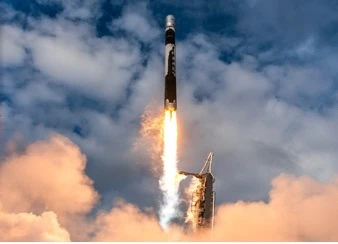
Liftoff of the Firefly Alpha launch vehicle
Polyakov played a significant role in making Firefly Aerospace one of the prominent space companies. The successful Blue Ghost’s landing on the Moon in 2025 is one of the recent milestones of the company. The lander’s development began under Polyakov’s leadership in 2018. This summer, the company went public on the NASDAQ high-tech exchange. The IPO delivered strong results, generating $868 million in proceeds and pushing the firm’s closing valuation to a record $8.5 billion. In November 2025, Firefly acquired SciTec, a leader in advanced national security technologies and a key software provider for missile defence systems, including the U.S. government’s new Golden Dome initiative.
Max Polyakov and Skyrora: A Shared Vision
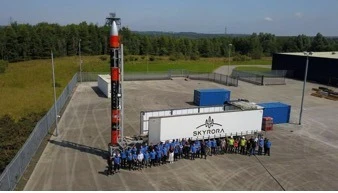
Skyrora XL launch vehicle at the SaxaVord spaceport launch site
Earlier this year, it was revealed that Max Polyakov made significant investments in another ambitious company: the British rocket developer Skyrora. Skyrora is a Scotland-based rocket company that is on course to become the first British firm to launch a sub-orbital rocket from UK soil.
Skyrora, under Volodymyr Levikin’s leadership, focuses on developing launch vehicle technology. The Scottish firm’s technological strengths are based on a range of innovations in the aerospace sector. Both its suborbital Skylark L rocket and the orbital Skyrora XL use environmentally friendly fuel made from recycled plastic called Ecosene.
Moreover, in August 2025, Skyrora was granted a commercial space launch license by the UK Civil Aviation Authority (CAA). This is a historic milestone for both the company and the UK space sector, as Skyrora has become the first UK-based manufacturer to receive such a licence.
The company is now authorised to launch from a licensed spaceport, SaxaVord, with the goal of making up to 16 launches per year by 2030. Both Polyakov and Skyrora are concerned with addressing environmental challenges and share the goal to scale Skyrora’s offering to the level required to deliver a regular commercial launch programme.
Feature image source Max Polyakov’s press office
Image of the Firefly rocket Source: fireflyspace.com
Image of the Skyrora rocket Source: skyrora.com







