


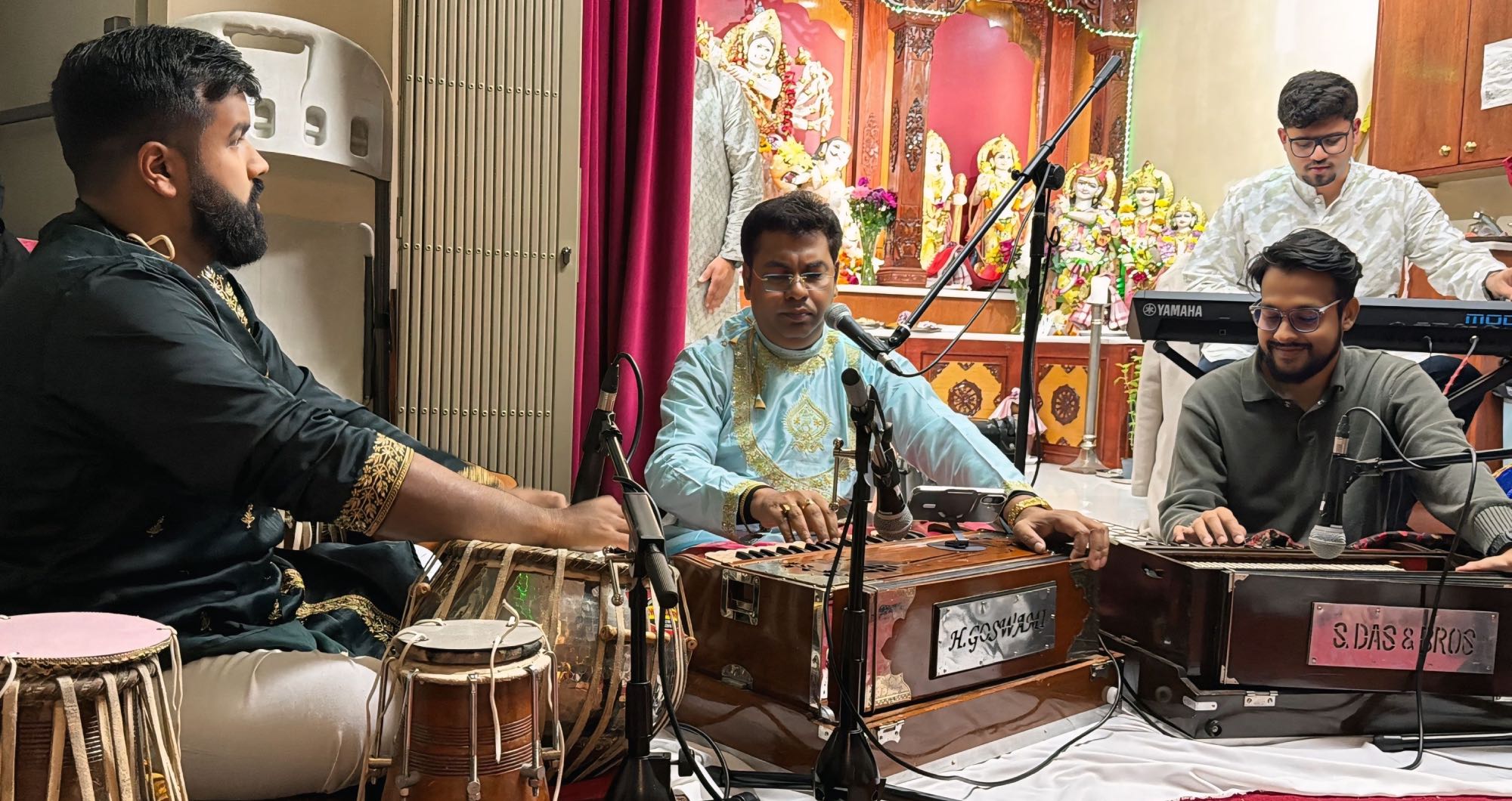
Kirtan Samrat Pt. Palash Sarkar performed a programme of traditional devotional music at the Durga Puja Festival organised by Hindu Pragati Sangha in Mile End, London, on 19 October 2026, presenting a selection of Bengali devotional and Vaishnava compositions to an audience gathered for the annual festival.
Sarkar was accompanied by harmonium virtuoso Sadakat Aman Khan, tabla master Himanish Goswami and keyboard player Attreyo Bhattacharya. The programme included Tobo Chorono Dhoabe Sharodo Shishire, Shishir Jole Dhue Akhi Shorot Elo Bhore, Aan Giri Tworay Tara, Jao Jao Giri Aanite Gouri, Eto Goyna Beti Kothay Peli, Eisi Lagi Lagan, Probhu Mere Ab Gun Chit Na Dhar, Probhujī Tum Chandan Ham Pani and Ekbar Broje Cholo O Brojonath. The selection moved between compositions associated with the autumn season, Durga Puja and Vaishnava devotional traditions, with Sarkar’s vocal performance supported by harmonium, tabla and keyboard.
The performance drew on the musical language of Mahajani Padabali Kirtan, a tradition closely connected with Bengali Vaishnava literature and devotional poetry. Sarkar’s singing featured extended melodic passages, ornamentation and changes in pace, while the instrumental accompaniment responded to the movement of the vocal lines. Rather than following a fixed arrangement throughout, the musicians adapted to the phrasing and development of the compositions.
“Mahajani Padabali Kirtan carries not only music but also poetry, philosophy and the devotional traditions of Bengal,” said Pt. Palash Sarkar. “My aim has always been to preserve this tradition and to make its musical and literary heritage accessible to audiences and students beyond Bengal.”
Sarkar has spent more than four decades as a performing musician and has also worked as a teacher of traditional music. His work has focused particularly on Mahajani Padabali Kirtan and Vaishnava literature, and he has performed and taught in India and overseas. He is also associated with Kirtankotha, an academy established to promote and teach Mahajani Kirtan and other forms of Indian traditional music. His approach places emphasis on both the musical structure of Kirtan and the literary meaning of the compositions.
“A tradition remains alive when it is passed from one generation to another,” he said. “Performance and teaching therefore have to work together if this music is to continue.”
The instrumentalists provided different elements of the musical arrangement. Khan’s harmonium supported the vocal melodies, while Goswami’s tabla established the rhythmic framework and Bhattacharya’s keyboard added harmonic accompaniment. The combination allowed the performance to retain the character of traditional devotional music while working within a contemporary stage setting.
“The accompaniment has to respond to the singer rather than simply follow a fixed arrangement,” said Sadakat Aman Khan. “In Kirtan, the phrasing, tempo and intensity can change during the performance, so the musicians have to listen closely and respond to what is happening musically.”
The programme formed part of the wider Durga Puja celebrations at Hindu Pragati Sangha, where religious observance and cultural activities were presented alongside one another. Several of the opening songs reflected the seasonal imagery associated with Sharod, the autumn period in Bengal during which Durga Puja takes place, before the programme moved into further devotional compositions connected with Bengali and Vaishnava traditions. The inclusion of Mahajani Padabali Kirtan also reflected the role of traditional music in Bengali community events in London, where cultural programmes often accompany religious celebrations.
For Sarkar, presenting the repertoire in London provided an opportunity to place a longstanding Bengali musical tradition within a different geographical and cultural setting.
“When traditional music is performed outside its original setting, it can reach people who may have a connection with the culture as well as those discovering it for the first time,” he said. “The important thing is that the music continues to be performed, understood and passed on.”
The performance concluded with Ekbar Broje Cholo O Brojonath, bringing the programme to a close with a final devotional composition. The evening formed part of the wider cultural programme surrounding Durga Puja at Hindu Pragati Sangha, linking religious celebration with the presentation of a traditional form of Bengali music in London’s East End.







