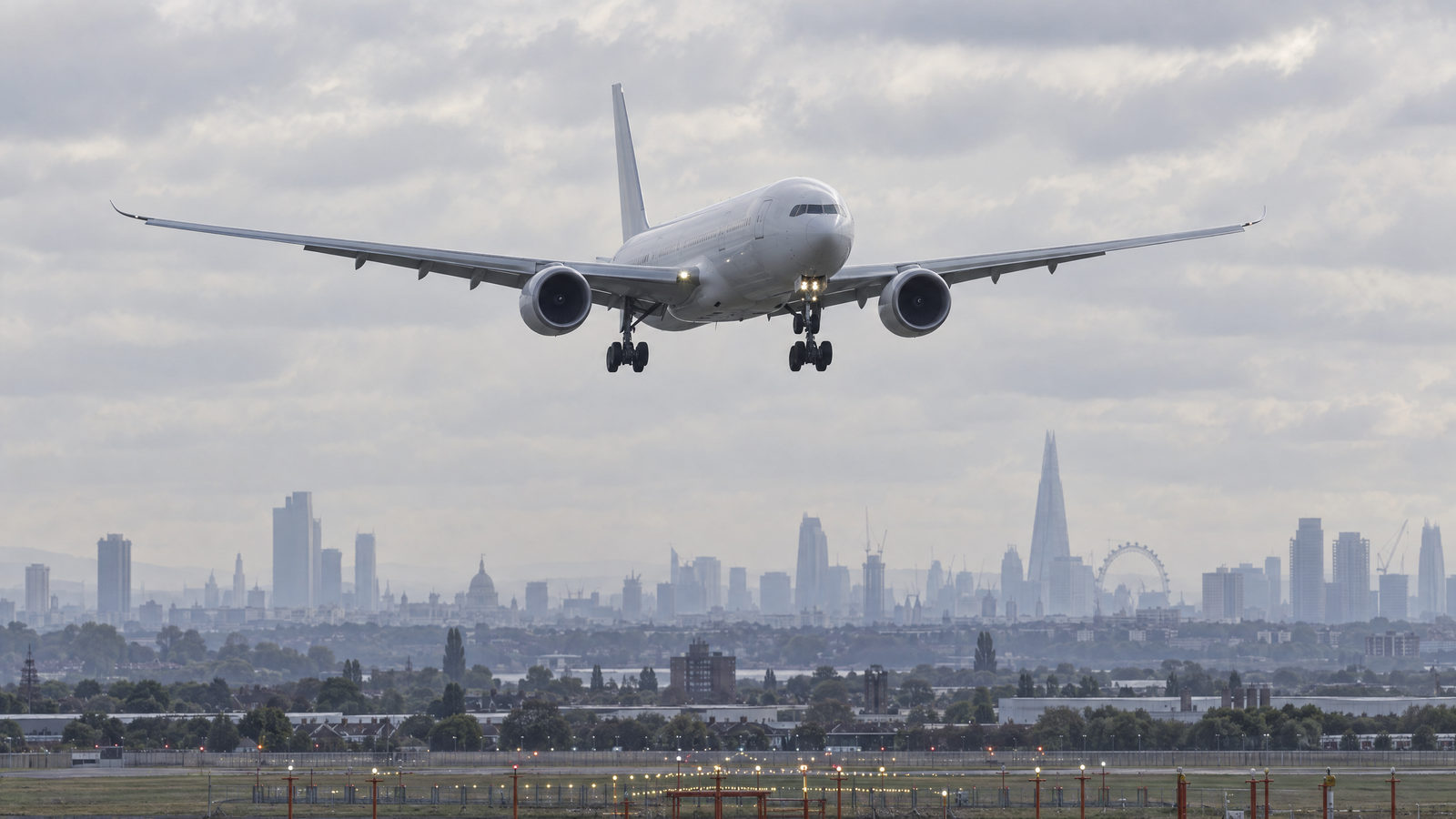

A London–Chicago flight returned to Heathrow on Monday after a technical issue prompted an emergency descent over Ireland, with oxygen masks deploying in the cabin. The Boeing 777-200ER landed safely and passengers left the aircraft normally. The journey ended at its departure airport instead of continuing across the Atlantic.
What happened to the flight
British Airways flight BA295 left Heathrow bound for Chicago O’Hare. After climbing to a cruising altitude of about 37,000 feet, it descended to around 9,000 feet while over Ireland and turned back towards London. The aircraft’s emergency transponder code was 7700, the general code used to alert air traffic control that an aircraft is dealing with an emergency.
The descent of roughly 28,000 feet was the most striking part of the incident, but the figures alone do not identify the fault. The precise technical problem has not been confirmed. A cabin pressurisation failure has been discussed as a possible explanation, but it should not be treated as an established cause on the information available.
Oxygen masks appeared from the overhead panels as the aircraft descended. On a passenger aircraft, these masks are intended to provide oxygen if cabin conditions require it; their deployment is a safety response, not a diagnosis of which component has failed. Likewise, a 7700 code communicates that assistance or priority handling is needed, but does not specify whether the problem is mechanical, medical or otherwise.
A safe landing, but a disrupted journey
The flight returned to Heathrow rather than proceeding to Chicago. Passengers disembarked normally after landing, and arrangements were being made to help them resume their travel. For people booked on a long-haul service, an early return can mean missed connections, a later departure and an unplanned wait at the airport, even when the landing itself is uneventful.
The aircraft remained airborne after turning back before making its approach to Heathrow. That sequence does not, by itself, establish why the crew chose the route or how they managed the aircraft. Long-distance aircraft carry substantial fuel, and weight can be one consideration in planning an early landing; it would be speculation to say that fuel management was the reason for any particular manoeuvre on this flight.
There is also a difference between an emergency declaration and an accident. The emergency code and rapid descent indicate that the crew treated the situation seriously and followed a procedure that gave controllers notice. They do not mean that the aircraft was lost or that passengers were injured. In this case, the known outcome was a return to the airport, a safe landing and a normal disembarkation.
The cause remains the key unanswered question
The available description remains at the level of a technical issue. Without a confirmed finding, it is not possible to say whether the event involved cabin pressure, a sensor, an environmental-control component, or another system. Nor does the visible release of masks prove that passengers had to use them for a particular length of time. Those details matter: treating a plausible explanation as fact can give a misleading account of what happened.
For travellers, the immediate practical issue is the interruption to the scheduled London–Chicago service and the onward plans of those on board. The safety outcome is clear, but the technical explanation is not. Until it is confirmed, the most accurate account is that BA295 made an emergency descent after a technical problem prompted an emergency descent, returned to Heathrow, and landed safely.