
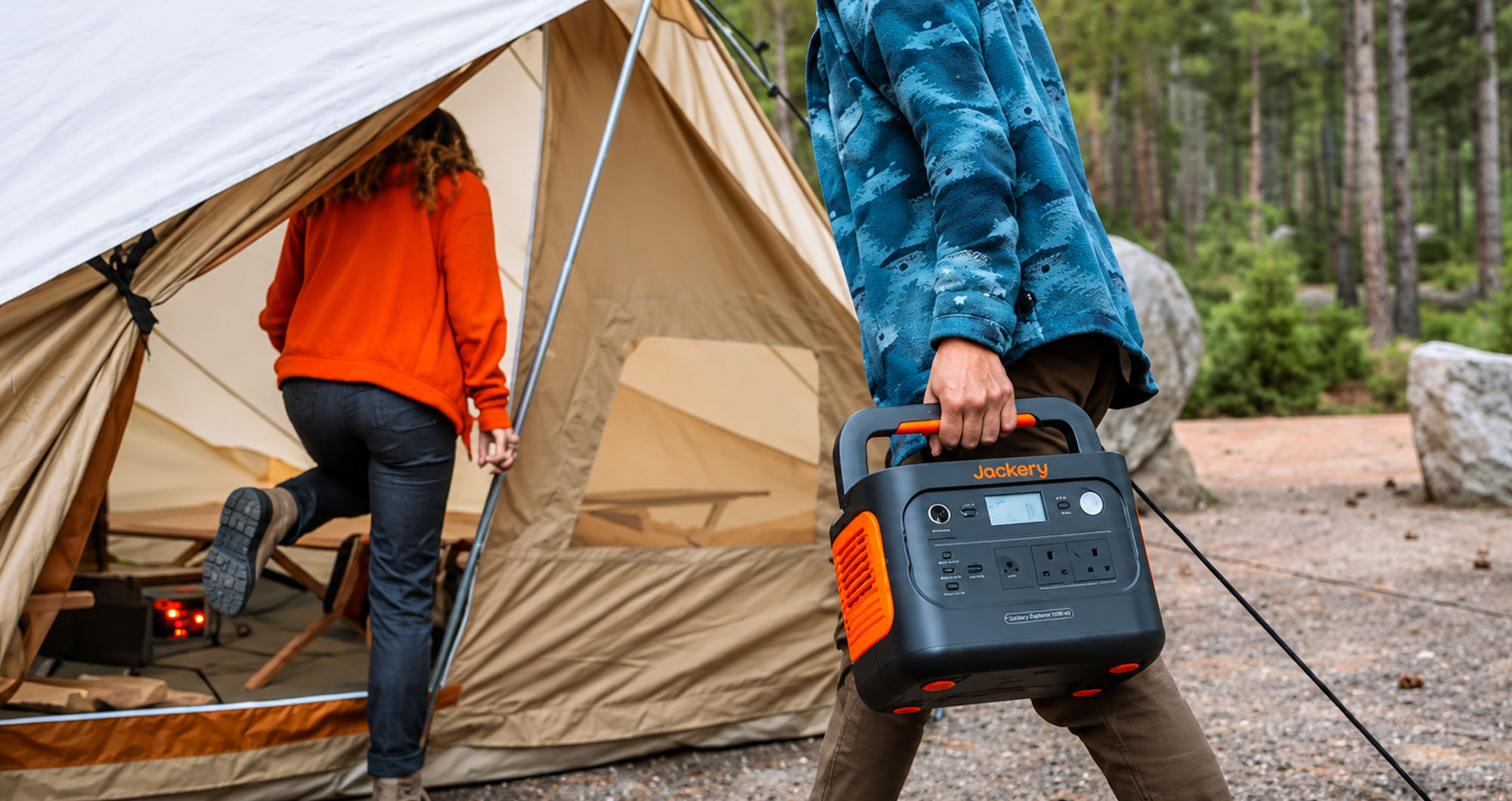

At a campsite after dark, phones, head torches and a cool box all need power at once. A portable power station can supply them, provided its capacity, outputs and recharging suit the way you camp.
What Will You Power on Your Camping Trips?
A portable power station stores electricity in a built-in battery and supplies it through AC, USB and 12 V outlets. Watts describe power; watt-hours describe stored energy, and runtime depends on the load and conversion losses. Compressor cool boxes cycle on and off, so use the model’s 24-hour figure.
| Item | Consumption assumption | Daily use | Wh per day |
|---|---|---|---|
| Two phones | About 15 Wh per charge | One charge each | 30 |
| LED lantern | 5 W | 5 hours | 25 |
| Laptop | 40 W average | 1.5 hours | 60 |
| 12 V compressor cool box | 135 Wh per day | 24 hours | 135 |
These illustrative figures add up to about 250 Wh a day. For two days without recharging, starting full, with 85% efficiency and a 20% reserve as example assumptions, the kit needs 250 × 2 ÷ (0.85 × 0.80) ≈ 735 Wh of rated capacity, without adding the same reserve again. Rated output must also cover anything used at once.
Which Features Matter Most at the Campsite?
AC, USB-C and 12 V Outputs
Head torches, phones, and camera batteries charge over USB; many cool boxes use 12 V, and a coffee maker needs AC. Check that USB-C delivers enough for your laptop, whether ports share power when used together, and whether any port doubles as an input.
Recharging: Hook-Up, Car and Solar
On hook-up, what matters is whether the station refills overnight. A car socket usually charges far more slowly, so check how much a typical drive adds, which cable it needs and which charging sources can be combined. Maximum solar input limits what panels add, so compare charging times with your stops, drives and sunshine.
Weight, Size and Overnight Use
Consider the walk from the car park, how often you carry it and your boot space; weight generally rises with capacity. Overnight, a lantern or fan may draw so little that energy-saving mode switches the output off. Check the low-load threshold, the switch-off delay and whether this setting can be disabled.
Battery Life, Warranty and the Full Cost
Cycle Ratings and Warranty Terms
Whether a station uses lithium iron phosphate (LiFePO4) or other cells, compare cycle ratings only when the remaining-capacity threshold and test conditions are comparable. The Jackery Explorer 1000 v2 is rated for 4,000 cycles to 70% capacity. That is neither an end-of-life date nor a promise of years, and matters most to frequent campers.
The warranty terms worth checking include the length of cover, eligible purchase channels, any registration needed for an extension and what the battery cover includes or excludes. Proof of purchase matters too, as does who handles claims and who pays any shipping costs. Statutory rights against the seller are separate.
Accessories, Bundles and Total Price
Car cables, solar connectors and extension leads are often extras, so check the standard box contents and any promotional gifts separately. If you need panels, compare bundles and separate purchases on the same model, panels, accessories, warranty terms and seller eligibility, including VAT and delivery. Price per watt-hour only helps between stations with similar features and support.
How the Checks Change With Your Camping Plans
Hook-up access, recharging, and your kit change which checks matter most. Any portable power station model named below only illustrates the numbers.
Tent Camping With Electric Hook-Up
With hook-up every night, a station mainly helps if you want power away from the hook-up point. Capacity can stay small, and weight matters on the walk to the pitch. A compact model such as the Jackery Explorer 240 v2 is a candidate once daily energy, combined load, and individual port limits are checked.
Off-Grid Weekends Without Hook-Up
Under the example’s two-day assumptions, the kit needs about 735 Wh. The Jackery Explorer 1000 v2 (1,070 Wh, 1,500 W) exceeds that without a top-up, though its outputs still need checking. A 512 Wh station would need about 180 Wh of usable recharge during the trip, arriving before the reserve is reached.
Campervan and Family Trips
For a kettle or coffee maker, check both output and runtime. At 1,000 W, 15 minutes uses about 250 Wh, and home kettles often exceed what smaller stations supply, so check the rating plate or use a low-wattage travel kettle. A 2,200 W station may meet the running power, but capacity, start-up demand, connections, and handling still matter.
FAQs Before Buying a Portable Power Station
What Are Your Rights If You Buy Online?
When you buy online from a business, you normally have 14 days after receipt to cancel, even if nothing is wrong. For a change-of-mind return, handling beyond what is needed to inspect the item may reduce the refund. Faulty goods, or goods not as described, can generally be rejected within 30 days for a full refund, sale items included.
Can You Charge It on a Cold Trip?
UK spring and autumn nights can approach freezing, and charging limits are often narrower than operating ones. Check the permitted charging temperature in the manual and make sure the station itself is within that range before charging.
What Should You Check Before Your First Trip?
On delivery, check the model, accessories, and condition, and keep the order details and serial number. The supplied manual sets out first-charge and periodic-recharging requirements, including any conditions attached to the battery cover. Test your own kit at home too; bundle panels may arrive separately.
Final Thoughts
Choosing a portable power station for camping starts with your kit list, daily watt-hours, and the time until you can recharge. Then check outputs, charging, weight, battery ratings, warranty terms, and the full price of equivalent setups. If you only charge a phone or two, a power bank may be enough.







