

Groundbreaking #NameTheBias Campaign Sheds Light on Disparities and Pushes for Urgent Government Action
- 8th January is Ethnicity Pay Gap Day. A new survey by People Like Us and Censuswide shows alarming disparities in workplace treatment and pay transparency between white and ethnic minority workers in the UK.
- Ethnic minority professionals report higher expectations of out-of-hours work compared to white employees
- Nearly 3 in 5 (58%) working professionals surveyed would support the UK adopting the EU Pay Transparency Directive, requiring companies to share information on salaries before interviews and banning employers from asking about a candidate’s salary history
- People Like Us is reaffirming its call to the UK government to introduce mandatory ethnicity pay gap reporting with a clear implementation timeline. It also urges businesses on more equitable workplace practices by providing guidance from industry experts
- #NameTheBias is created by creative agency Worth Your While, featuring British Bangladeshi lyricist Yasmin Ali and directed by award-winning Naghmeh Pour. See the film here: https://www.youtube.com/watch?v=3uTwt6FYX98
Does what you’re called actually matter? Yes, says a powerful new campaign for workplace equality champions People Like Us, spotlighting the stark inequities in pay, workplace treatment, and job prospects linked to ethnically diverse names.
Created by independent creative studio Worth Your While, #NameTheBias exposes how hidden “name bias” in UK hiring practices impacts ethnic minorities’ earning potential before they even set foot in an interview, and is pushing for urgent government action on ethnicity pay gap reporting.
Launching on Ethnicity Pay Gap Day (8 January 2025) – alongside a new survey by People Like Us and Censuswide – which shows alarming disparities in workplace treatment and pay transparency between white and ethnic minority workers in the UK – the campaign draws on research from the University of Oxford revealing that candidates with ethnic-minority names must submit 60% more job applications to secure a callback compared to white British applicants.
With disparities unchanged since the 1960s, #NameTheBias aims to spark national conversation, educate policymakers, and push for a timeline for the introduction of mandatory ethnicity pay gap reporting to address systemic inequalities in the workplace.
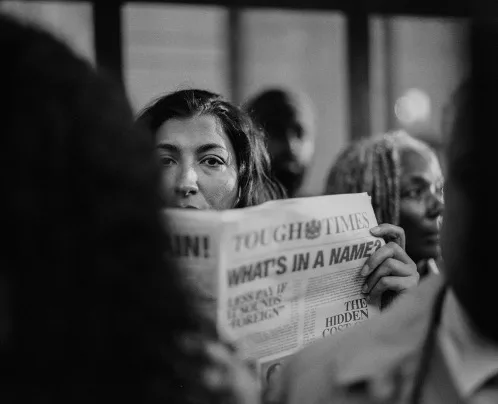
The centrepiece of the multimedia campaign is a two-minute film, directed by award-winning filmmaker Naghmeh Pour through new—land, which poses the question: do names matter? Shakespeare may not have thought so when he penned the lines – “What’s in a name? That which we call a rose by any other name would smell just as sweet” in Romeo & Juliet – but the film shows us otherwise, as British Bangladeshi lyricist, Yasmin Ali, subverts the Bard’s age-old question with a bespoke spoken word piece.
Watch the film here: https://www.youtube.com/watch?v=3uTwt6FYX98
Starkly shot in black-and-white, the film captures a group of ethnic minority workers waiting at a bus stop while Ali lyrically describes the ripple effects of having the ‘wrong’ name on employment prospects and career progression. When the bus finally arrives, white commuters board first, the doors closing in their ethnic counterparts’ faces as a vivid visual metaphor.
Drawing on her own minority ethnic background, Ali’s performance brings a blistering authenticity and emotional depth to the film, which concludes with the line: “My name might mean I’m paid less / But I know I’m worth more” – underlining the campaign’s call for urgent systemic reform.
Bringing the cause to the heart of the government, the film is set to be screened at events at both the House of Lords and Houses of Parliament on 8th January, alongside a live poetry performance by Ali.
Accompanying the brand film, which will be showcased online, across social platforms, and key digital media placements, the multimedia campaign will be backed by social influencer activation within the spoken word community and People Like Us network. Additional elements include striking OOH billboards across London highlighting the impact of racial name bias in hiring, which take inspiration from design elements of a job application form and feature hand-written excerpts of the poem from Ali’s notebook. Expert guidance for individuals on handling salary conversations and for businesses on creating equitable workplace practices will also be available on the People Like Us website.
#NameTheBias is the latest instalment of work created in People Like Us’ long-running partnership with independent creative studio Worth Your While, with previous campaigns including Signatures for Signatures and the Autocorrected Pay Gap.
Having spent over five years dismantling barriers for ethnically diverse professionals, the efforts of People Like Us – together with a breadth of forward-thinking organisations and businesses – were rewarded by ethnicity pay gap reporting being included in a draft bill in the King’s Speech in July 2024.
However, systemic inequities still persist, as key findings from the new survey by People Like Us and Censuswide – https://www.plu.org.uk/ – show: ethnic minority workers face greater barriers to discussing pay, disproportionately experience negative repercussions, and feel the impact of a lack of representation in leadership roles.
In seeking to spark a national conversation, the new campaign aligns with the organisation’s advocacy for mandatory ethnicity pay gap reporting, a critical step toward addressing structural inequalities in UK workplaces. Beyond this, it also addresses two of the UN’s Sustainable Development Goals: promoting sustained, inclusive economic growth, full productive employment, decent work for all; and reducing inequality within and among countries.
Sheeraz Gulsher, Co-Founder of People Like Us, added: “This campaign exposes how name bias quietly contributes to unequal pay and career stagnation for millions of workers. By sparking awareness and offering practical tools, we aim to empower individuals and push businesses and policymakers toward meaningful change.”
Yasmin Ali, spoken word artist said: “When people are judged by their names before their abilities, it reflects deep-rooted biases we must confront. I hope this piece challenges perceptions and opens conversations about fairness, equity, and opportunity.”
Tim Pashen, Creative Director & Partner, Worth Your While commented: “What’s in a name? This famous Shakespearean verse has had people pondering throughout the ages. Well, it’s a good question. So we subverted this 400-year-old British classic. Stripped out the roses and the Montagues, to highlight that what’s in a name, can mean you’re not paid the same. Simply because it doesn’t sound ‘white’ or ‘British’.”
Naghmeh Pour, Director, new—land added: “Sometimes, a project hits so close to home that you can’t let it go. When Worth Your While and People Like Us approached me, I was deeply inspired by their passion and dedication to the cause. The issue at the heart of the film – inequality in pay and opportunities tied to ethnicity — is something I’ve experienced myself and witnessed other people experience too. This made the film deeply personal for me, and the journey of creating it was emotional. I’m so proud of this film, my hope is that, through the film and the campaign around it, we can spark hope and inspire real action from those in charge.”
Key Survey Findings:
Overlooked: Ethnic minority workers were almost twice as likely to have a pay rise or promotion rescinded due to the current economic climate (40% compared to 23% of white workers).
Overworked: The majority of UK workers are working longer than their contracted hours (53%), consistent across ethnicities. Almost a third of ethnic minority employees (32%) report working 8+ hours above their contracted hours weekly, compounding pay inequities. Additionally, non-white employees work an average of 6.95 extra unpaid hours each week, compared to 6.27 hours for white employees.
Right to disconnect and additional expectations: 50% of working professionals support Labour’s recently shelved “right to disconnect” bill. Ethnic minority workers report higher expectations of out-of-hours work compared to white employees. 26% of non-white employees work on weekends to catch up or get a head start on the following week, compared to 16% of white employees. Furthermore, 23% of ethnically diverse employees have had time off for stress, compared to 16% of white employees.
Discomfort in discussing pay: More than 70% of ethnic minority workers worry there would be negative consequences from discussing their pay, compared to 51% of white workers. Concerns for ethnic minority groups include being seen as disruptive (30%), facing career limitations (28%), or losing their job (23%). Only around a fifth (21%) of working professionals surveyed said their employer publishes salary bands for roles so people understand the lower and upper limit
Retention risks: A high ethnicity pay gap would lead 33% of ethnically diverse talent to worry about their career progression and consider looking for roles elsewhere, compared to 16% of white employees. Additionally, 66% of ethnic minority professionals would either discount roles with companies with high ethnicity pay gaps or would only consider them if there were other compelling reasons (46% of white professionals felt the same).
Hiring challenges: The risks are starker for employers if they don’t address these inequities. Not only will existing employees consider working elsewhere, but replacing them will also be more difficult. Over a quarter (26%) of potential future employees would not be willing to work for a company that has a high ethnicity pay gap, regardless of ethnicity.
High pay gaps might also deter customers: 40.5% of ethnically diverse working professionals expressed reluctance in buying from companies with large ethnicity pay gaps, while only 34.5% said it wouldn’t factor into their buying decisions.
Support for pay transparency: almost 3 in 5 (57%) working professionals surveyed would be for the UK adopting the EU Pay Transparency Directive to require companies to share information on salaries before interviews and employers being banned from asking about a candidate’s salary history.
About the Research Methodology
The research was conducted by Censuswide, among a sample of 2005 Working Professionals in the UK, aged 18+ (excluding sole traders). The data was collected between 23.10.2024 – 08.11.2024. Censuswide abides by and employs members of the Market Research Society and follows the MRS code of conduct and ESOMAR principles. Censuswide is also a member of the British Polling Council.
Research
PLU / Censuswide study – https://www.plu.org.uk/
CSI report: Are employers in Britain discriminating against ethnic minorities? (2019))
About People Like Us
People Like Us is an award-winning not-for-profit organisation dedicated to celebrating and supporting UK media, marketing, and communications professionals from Black, Asian, Mixed Race, and minority ethnic backgrounds. Its mission is to elevate ethnically diverse professionals by dismantling workplace barriers and providing support to navigate these challenges through networking events and tailored career solutions.
About Yasmin Ali
Yasmin Ali (Y.A) is committed to creating and performing work that challenges the issue of underestimating talent from underrepresented communities.
As a British Bangladeshi lyricist, her expression of self through her art, challenges so many misconceptions, cultural stereotypes and stigmas. Her career so far demonstrates her commitment to working with purpose through her practise. Yasmin advocates and articulate messages that can only be received through the power of word. She writes and performs with passion and a God-given talent that allows her to speak freely whilst maintaining her authenticity.







