
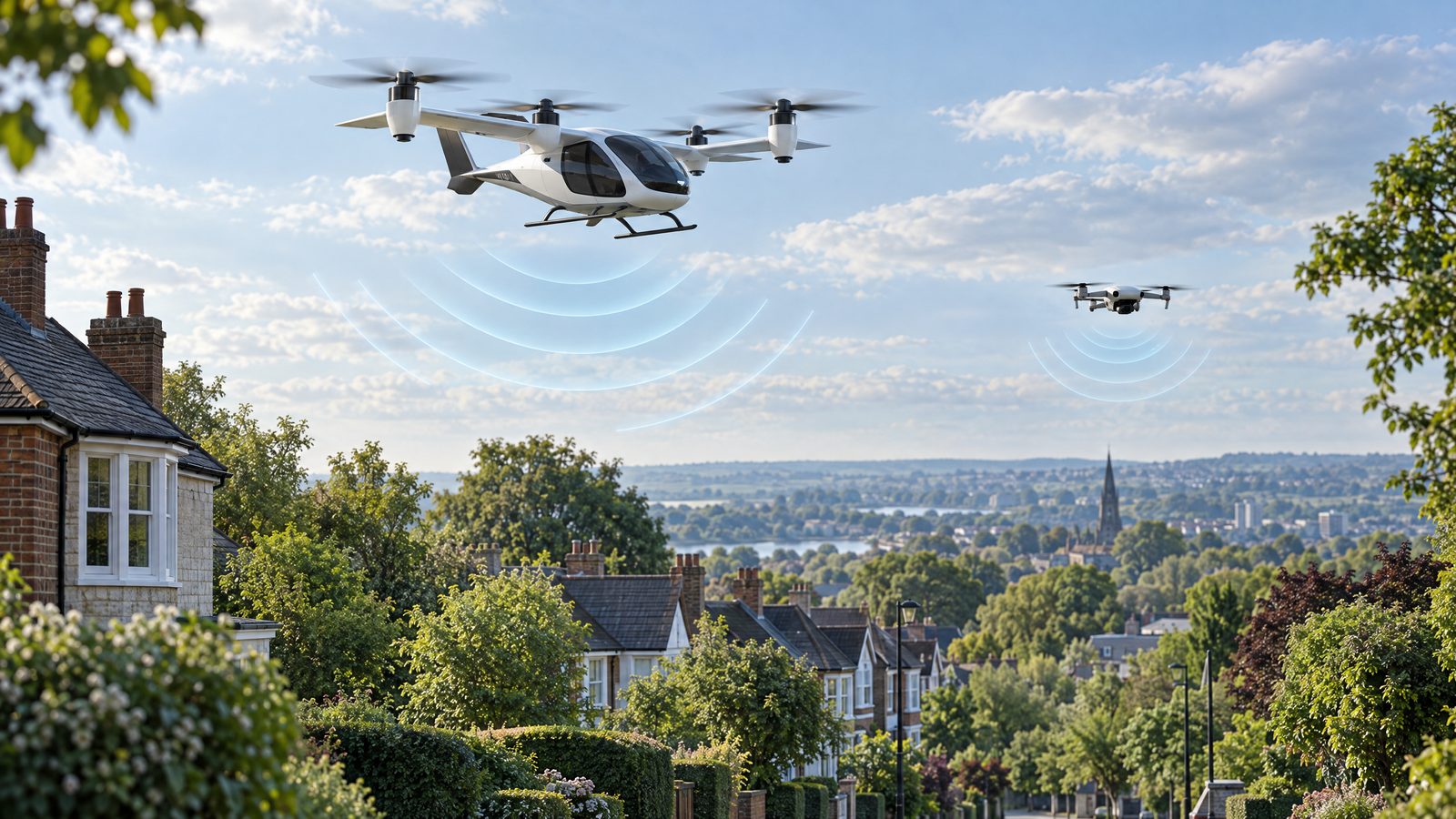

The UK Civil Aviation Authority has set out how noise from commercial drones and electric vertical take-off and landing aircraft should be assessed as their use develops. Its new Civil Aviation Publication, CAP3304, argues that noise planning needs to account for where and how these aircraft may operate, rather than simply borrowing assumptions from conventional aviation.
The distinction matters because the aircraft are expected to be quieter than conventional helicopters performing similar roles. That comparison does not mean they will be inaudible or have no community impact. Drones and eVTOL aircraft may fly at lower altitudes, closer to homes and across places that have not traditionally experienced regular aircraft noise. The sound itself, how often flights occur, and the visibility of aircraft may all affect how residents experience operations.
A different pattern of exposure
Established aircraft-noise management has largely developed around familiar operations and locations. Emerging commercial uses could be more varied. Drones may be used to inspect infrastructure, support emergency response, move goods or deliver medical supplies. Early eVTOL applications could include airport transfers, regional links and emergency-service support. These are potential uses, not evidence that routine passenger air-taxi services have already begun.
Repeated activity near homes may raise practical questions different from those around a conventional airport: whether a route passes over residential areas, how many movements occur, how aircraft are operated and what information communities receive. CAP3304 treats these as matters for proportionate assessment and suitable procedures. It does not announce a single fixed noise limit or publish a timetable for services to start.
Design, routes and community response
The CAA identifies several connected priorities. Quieter aircraft design can address noise at source. Assessment methods need to be proportionate to the type and scale of operation, while routes and operating procedures can help shape where and when sound is experienced. The report also stresses transparent engagement with communities, accessible arrangements for complaints and systematic collection of operational and noise data.
Those elements are linked. Data from actual operations can help regulators and operators understand whether predicted exposure matches experience. Clear complaint channels can identify concerns that aggregate measurements might miss, while open engagement gives residents a way to understand proposed operations and raise issues early. As evidence accumulates, assessment and operating practices can be refined rather than treated as settled before the sector has developed.
The publication reviews existing policy and regulatory arrangements and sets out options for noise management, stakeholder engagement and governance. Its emphasis is on a transitional approach that can change as operational experience and the evidence base improve. This is a framework for developing practice, not a new blanket authorisation for drone or eVTOL flights.
Policy ahead of wider use
The work is intended to support the Department for Transport’s development of a national policy on drone noise. The CAA says early policy should provide a consistent and proportionate framework for trials, initial deployments and emerging commercial services. That approach aims to give operators clearer expectations while allowing community protection to develop alongside the technology.
The report also sits within the CAA’s Future of Flight programme, which concerns the safe integration of drones and eVTOL aircraft into UK airspace. Noise is one part of that broader task, alongside safety, security and environmental protection. Planning for noise before activity becomes routine may help public authorities distinguish between different aircraft and operating patterns instead of assuming one rule will fit every use.
For communities, the immediate significance is not a sudden change in flights but an attempt to establish what responsible growth should take into account. The CAA’s approach recognises both the potential value of new connections and the need to measure, explain and respond to their local effects. Whether emerging services earn public acceptance will depend in part on whether those safeguards are turned into workable assessments, routes, data practices and meaningful ways for people to be heard.







