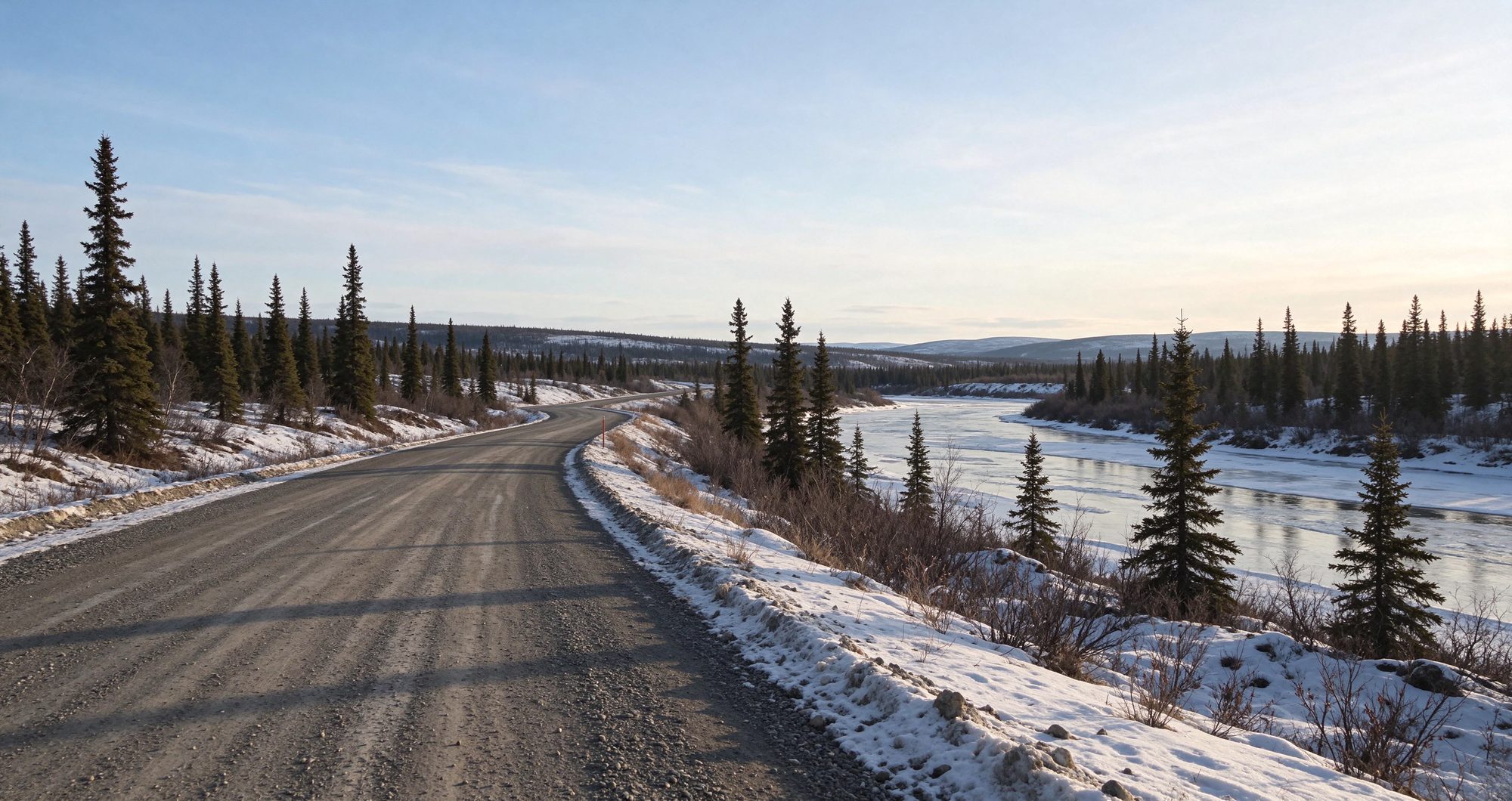

Canada has listed the proposed Mackenzie Valley Highway as a project of national interest, giving an 800-kilometre northern road scheme a new federal regulatory status while retaining its treaty-based environmental assessment. The announcement in Yellowknife on 27 November also included more than C$120 million to prepare a separate Arctic road corridor for construction.
The highway would link Highway 1 at Wrigley with the Dempster Highway south of Inuvik in the Northwest Territories. Its all-season gravel route would pass near Tulita, Norman Wells and Fort Good Hope, bringing those communities year-round road access for the first time. They currently depend on aircraft, river barges and winter roads rather than a permanent road connection.
The planned route would improve transport access for more than 10,000 people, including approximately 1,900 in the Sahtu region who would gain an all-season connection. More reliable deliveries of food, fuel, medicine and construction materials are among the intended benefits. The road is projected to reduce the drive between Yellowknife and Inuvik from about 38 hours to roughly 23 hours.
New status, with assessment still required
The listing under the Building Canada Act is the first for a project in Canada’s territories. It follows the highway’s referral to the Major Projects Office in March and a process launched in June to consider national-interest status. The latest decision therefore moves the scheme beyond an earlier proposal for listing.
The Major Projects Office can now coordinate federal regulatory requirements during the environmental assessment and bring departments together to reduce duplication. If the project is approved through the treaty-based assessment process, federal authorisations can be consolidated rather than issued separately through several ministers.
The designation does not replace the environmental assessment and regulatory regime under the Mackenzie Valley Resource Management Act. An impact assessment by the Mackenzie Valley Environmental Impact Review Board remains part of the process, with further decisions and permits required. Listing is not a finding that the entire highway is ready to build or that every environmental condition has been settled.
Shared governance and federal funding
On 25 November, Sahtu Secretariat Incorporated, the Gwich’in Tribal Council, Pehdzéh Kı̨ First Nation and the Canadian and Northwest Territories governments signed a Leadership Governance Understanding. It establishes arrangements for shared leadership and collaboration on the highway, including procurement and community readiness. Indigenous participation in planning and construction remains central to the governance framework.
The federal government has committed to fully funding construction and certain maintenance costs, including through proposed Budget 2026 funding and the Arctic Infrastructure Fund. The commitment to maintenance does not yet specify all the practical arrangements. Earlier federal support included C$405 million announced in September for development work, routing and design, and the Great Bear River Bridge near Tulita.
A planned Crown corporation will provide specialist engineering, contracting and project-management expertise for complex infrastructure schemes, initially focusing on the highway. It has not yet been established. The Northwest Territories government is also advancing a community readiness strategy with Indigenous governments, organisations and communities to address potential adverse effects and opportunities from construction and the transition to all-season access.
A separate route towards the Arctic Ocean
The additional funding concerns the Arctic Economic and Security Corridor, a distinct proposed all-season road running approximately 400 kilometres north from Yellowknife to the Nunavut border. The Tłı̨chǫ Government and Yellowknives Dene First Nation lead that project in partnership with the Northwest Territories government.
The investment will support detailed route selection, environmental studies, engineering and regulatory work, with the aim of making the corridor ready for construction by 2029. If connected to the Grays Bay Road and Port project, it would link Yellowknife to a deepwater port on the Arctic Ocean and improve access to mineral resources. That port connection remains a proposed outcome, not an operating transport link.