
For many businesses, keeping a workplace clean is about maintaining a professional environment as much as supporting employee wellbeing and productivity. Dust, tracked-in dirt, and everyday debris accumulate more quickly in commercial settings than many business owners expect, even in relatively small offices. According to guidance from the UK’s Health and Safety Executive (HSE), employers are responsible for maintaining workplaces that are clean, safe, and suitable for employees and visitors. Regular floor maintenance is one practical part of meeting that responsibility.
As robotic cleaning technology has improved, many small businesses have begun considering whether a consumer robot vacuum can manage routine cleaning or whether investing in a commercial robot vacuum makes better long-term sense. The answer depends less on marketing claims and more on practical considerations such as floor area, daily foot traffic, flooring types, office layout, and how much time staff can realistically dedicate to maintaining the equipment.
For many businesses, keeping a workplace clean is about maintaining a professional environment as much as supporting employee wellbeing and productivity. As businesses increasingly adopt technology to improve efficiency and reduce operating costs, automated cleaning has become another practical investment alongside broader workplace improvements. London Daily News recently explored this wider trend in its article Smart Upgrades That Improve Utility Efficiency in Small Businesses, which highlights how modern technologies can help businesses operate more efficiently.
How Much Cleaning Demand Does Your Business Generate?
Small commercial premises generally experience heavier floor wear than homes. Employees, visitors, deliveries, and customers repeatedly use the same entrances and walkways, allowing dust and grit to build up quickly. Reception areas, waiting rooms, kitchens, and collaborative workspaces often require more frequent cleaning than private offices.
Before comparing specifications or choosing between consumer and commercial machines, it helps to assess three practical factors:
- Total floor area
- Average daily foot traffic
- How consistently does the floor need to appear clean
These factors usually provide a more accurate indication of cleaning requirements than suction figures or feature lists alone.
| Office Environment | Typical Recommendation |
|---|---|
| Under 1,000 sq ft with light daily traffic | Consumer robot vacuum is generally suitable. |
| Up to 1,500 sq ft with moderate traffic | Consumer models remain effective when scheduled for multiple cleaning cycles. |
| 1,500–2,500 sq ft with heavy daily use | Consumer models may cope, but performance depends on layout and debris levels. |
| More than 2,500 sq ft of continuous public traffic | Commercial cleaning equipment or professional cleaning services are often the more practical solution. |
Consumer robot vacuums are designed primarily for routine maintenance rather than replacing comprehensive commercial cleaning. Businesses that schedule regular deep cleaning while allowing a robot vacuum to manage everyday dust and debris often achieve the best balance between cleanliness and operating costs.
For additional guidance on maintaining safe and hygienic workplaces, the UK Health and Safety Executive (HSE) provides practical advice on workplace housekeeping and cleanliness.
When Does a Commercial Robot Vacuum Become Worthwhile?
Commercial robot vacuums become increasingly beneficial when businesses require extended operating hours, larger dust capacity, or the ability to manage consistently demanding environments.
Examples include:
- Busy reception areas with continuous visitor traffic.
- Retail premises where entrances collect significant outdoor debris.
- Hair salons where hair accumulates throughout the day.
- Workshops producing fine dust or light manufacturing waste.
- Businesses require multiple cleaning cycles every day.
Even then, robotic cleaning should be viewed as one component of an overall cleaning strategy rather than a complete replacement for manual cleaning. Wet spills, bathrooms, kitchens, staircases, and sensitive clinical environments still require human attention and appropriate cleaning procedures.
The British Cleaning Council also highlights the importance of maintaining high cleaning standards in workplaces to support hygiene, employee wellbeing, and public confidence:
Dense Chairs and Office Furniture Create the Biggest Navigation Challenge
Once cleaning demand has been assessed, the office layout becomes the next important consideration.
Unlike many homes, office environments change throughout the day. Staff move chairs between desks and meeting rooms, visitors place bags beside seating areas, deliveries temporarily block walkways, and charging cables often appear across floors before presentations or meetings.
These constantly changing obstacles can reduce cleaning efficiency regardless of how powerful the vacuum itself may be.
Businesses usually experience better results when a few simple preparation steps become part of the daily routine:
- Push chairs beneath desks before scheduled cleaning.
- Keep charging cables off the floor where possible.
- Leave sufficient clearance around display units and storage cabinets.
- Secure lightweight mats that may catch brushes or wheels.
- Configure no-go zones for fragile furniture or temporary storage areas.
Modern navigation systems have improved considerably in recent years. Businesses comparing different navigation technologies may find it helpful to review how current eufy robot vacuum models approach obstacle detection, route planning, and automatic cleaning schedules before deciding whether a consumer model is suitable for their office layout.
How Daily Cleaning Affects Batteries, Brushes, and Long-Term Performance
Consumer robot vacuums are generally designed for routine household cleaning, where they may operate once a day or only a few times each week. Small offices often demand considerably more. Many businesses schedule a cleaning cycle before opening, another during quieter periods, and a final pass after closing.
Running several cleaning cycles each day naturally increases wear on components such as brushes, filters, batteries, and drive motors. In most cases, performance gradually declines rather than failing suddenly. A business owner may first notice more dust remaining around entrances, shorter battery life, or brushes becoming tangled more frequently.
Routine maintenance therefore, becomes just as important as choosing the right machine.
Typical Daily Cleaning Schedules
| Office Type | Suggested Daily Cleaning Schedule |
|---|---|
| Private office | 1–2 cleaning cycles |
| Small professional practice | 2 cleaning cycles |
| Retail shop | 2–3 cleaning cycles |
| Hair salon | 3–4 cleaning cycles depending on customer volume |
| Shared workspace | 2–3 cleaning cycles with scheduled recharge |
Consumer models generally perform well when debris remains light and office layouts stay predictable. However, businesses experiencing consistently heavy debris or requiring near-continuous operation may find commercial equipment offers greater long-term durability.
Regardless of the model chosen, replacing worn brushes, cleaning filters regularly, and checking wheel assemblies will usually extend the machine’s working life more effectively than relying on maximum suction settings alone.
How Often Should the Dustbin Be Emptied?
Dust accumulates more quickly in commercial environments than in most homes. Entryways collect grit, waiting areas gather dust from frequent foot traffic, and communal kitchens often generate food crumbs throughout the day.
Although self-emptying docking stations reduce manual intervention, routine inspection remains important. Ignoring full dust bags or clogged filters eventually reduces cleaning performance regardless of the vacuum’s specifications.
Recommended Emptying Schedule
| Workplace | Suggested Dustbin Maintenance |
|---|---|
| Small office | Every 2–3 days |
| Medical practice | Every 1–2 days |
| Boutique retail | Daily |
| Hair salon | Daily |
| Shared workspace | Every 2 days |
After periods of wet weather, additional inspections around entrances are often worthwhile because moisture and grit can fill collection bins much faster than expected.
The British Cleaning Council has repeatedly highlighted the importance of maintaining workplace cleanliness as part of broader health and hygiene practices, particularly in shared environments.
Which Flooring Types Work Best with Consumer Robot Vacuums?
Not every flooring surface responds equally well to robotic cleaning. Understanding how different materials affect navigation, brush wear, and debris collection helps businesses choose equipment that matches their workspace.
Sealed Vinyl and PVC Flooring
These are among the easiest surfaces for consumer robot vacuums to maintain. Fine dust, footprints, and everyday debris are generally collected efficiently during scheduled daily cleaning.
Ceramic or Porcelain Tile
Level tiles with narrow grout lines usually perform very well. Daily robotic cleaning helps prevent dust accumulation, although stained grout will still require occasional manual cleaning.
Low-Pile Commercial Carpet
Many consumer models can clean low-pile commercial carpet effectively, particularly where debris consists mainly of dust and light dirt.
Businesses should secure loose mats and ensure transitions between hard flooring and carpet remain smooth enough for consistent navigation.
Thick Carpet and High-Pile Rugs
Dense carpet creates greater resistance, reducing battery efficiency while increasing brush wear. Businesses with extensive carpeted areas may benefit from testing a demonstration unit before making a purchasing decision.
Mixed-floor offices generally achieve better results when cleaning zones are configured separately within the robot’s application, allowing hard floors, carpeted areas, and no-go zones to follow different cleaning routines.
For businesses reviewing flooring maintenance more broadly, the Health and Safety Executive (HSE) also advises employers to maintain flooring in a condition that reduces hazards such as slips and trips while supporting safe workplace operation.
Features That Reduce Maintenance for Busy Staff
For many small businesses, the best robot vacuum is not necessarily the one with the highest advertised specifications. Instead, it is the model that requires the least staff intervention while delivering consistent cleaning performance.
When employees already manage customer enquiries, appointments, stock control, and administrative work, routine maintenance should remain straightforward.
Features Worth Prioritising
| Common Workplace Challenge | Helpful Feature |
|---|---|
| Frequent chair movement | Advanced obstacle recognition |
| Multiple daily cleaning cycles | Automatic recharge and resume |
| Heavy entry dust | Self-emptying dust station |
| Mixed flooring | Automatic floor detection |
| Cables and office equipment | Intelligent object avoidance |
| Limited staff time | Automated maintenance functions |
Rather than focusing solely on suction figures, businesses should compare navigation reliability, maintenance requirements, and automation features that reduce everyday workload.
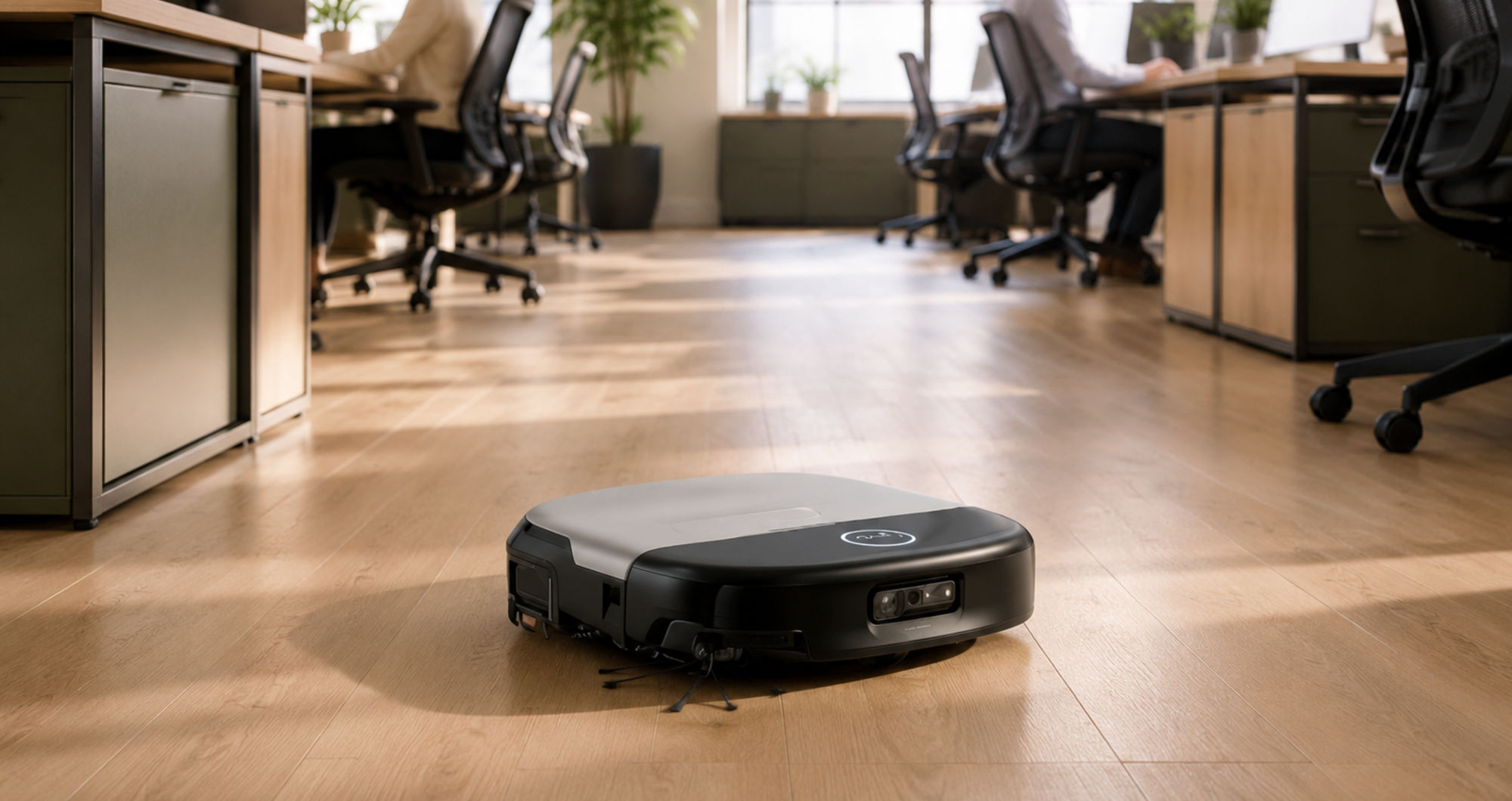
For businesses researching current consumer models, the eufy Robot Vacuum Omni S2 provides an example of how manufacturers are combining several automated maintenance features into a single system. It includes high suction performance, AI-assisted obstacle recognition, automatic mop washing, self-emptying dust collection, and automated drying within its docking station.
These features may reduce the amount of manual attention required between cleaning cycles, particularly in offices where the vacuum operates several times each day. However, they should be viewed as convenience features rather than replacements for routine inspections, periodic maintenance, or scheduled professional cleaning.
Ultimately, the most suitable solution depends less on brand alone and more on matching the equipment to the size, layout, flooring, and cleaning demands of the workplace.
Practical Considerations Before Buying
Before investing in either a consumer or commercial robot vacuum, it is worth assessing how the machine will fit into existing cleaning routines rather than expecting it to replace them entirely.
A short evaluation can help determine whether the investment is likely to deliver consistent value.
Office Cleaning Assessment Checklist
| Question | Why It Matters |
|---|---|
| How large is the floor area? | Larger spaces require longer cleaning cycles and may exceed the practical limits of consumer models. |
| How many people use the space each day? | Higher foot traffic usually means faster dust and debris accumulation. |
| What types of flooring are present? | Hard floors, carpet, and mixed surfaces require different cleaning strategies. |
| Are chairs and furniture moved frequently? | Dynamic layouts increase navigation complexity. |
| Will staff prepare the workspace before the scheduled cleaning? | Simple preparation often improves cleaning efficiency. |
| Is a professional cleaning service already in place? | Robot vacuums work best as part of a wider cleaning routine rather than a complete replacement. |
Businesses that answer these questions before purchasing are generally more likely to choose equipment that matches their operational needs rather than relying solely on advertised specifications.
Expert Guidance and Workplace Hygiene
Maintaining clean workplaces is not simply about appearance. Good housekeeping contributes to employee wellbeing, visitor confidence, and safer working environments.
The UK Health and Safety Executive (HSE) recommends that workplaces should be kept clean, organised, and free from unnecessary hazards as part of effective health and safety management.
Helpful UK guidance includes:
- Health and Safety Executive (HSE) – Workplace Health and Safety
- British Cleaning Council
These resources provide practical information for employers seeking to maintain safe and hygienic working environments alongside their regular cleaning schedules.
Conclusion
Choosing between a commercial robot vacuum and a consumer model depends less on product marketing and more on understanding the day-to-day demands of the workplace.
For many offices under approximately 1,500 square feet, a quality consumer robot vacuum can provide reliable maintenance cleaning when daily foot traffic remains moderate, furniture layouts are reasonably predictable, and staff perform basic upkeep such as emptying dustbins and replacing filters.
Larger premises, businesses with continuous public access, or workplaces producing significant debris may benefit from commercial equipment or a combination of robotic and professional manual cleaning.
Ultimately, robotic vacuums are most effective when viewed as part of a broader cleaning strategy rather than a complete replacement for conventional cleaning methods. Assessing floor size, traffic levels, maintenance requirements, and workplace layout before purchasing helps businesses select equipment that supports long-term cleanliness while making efficient use of staff time.