
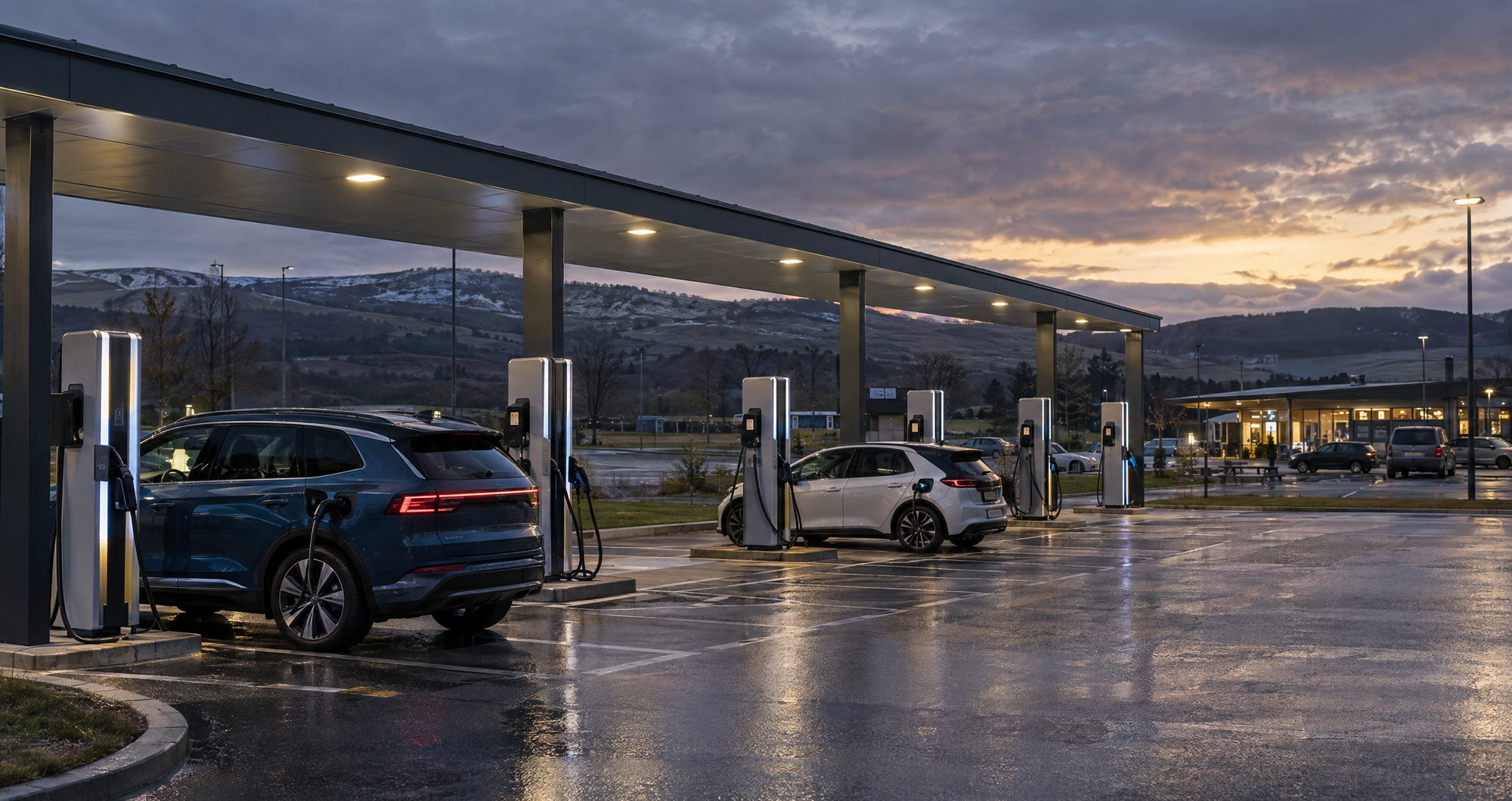

Battery-electric cars took 32.0 per cent of the UK new car market in October, their highest share yet, as total registrations rose 5.4 per cent to 152,730 vehicles.
The figures, published by the Society of Motor Manufacturers and Traders on 5 November, show electric registrations up 32.7 per cent year on year to 48,858, while petrol fell 11.6 per cent to 56,876 and 37.2 per cent of the market. The gap between the two powertrains is now the narrowest on record.
The eleventh consecutive month of growth
October was the eleventh consecutive month of market growth, but all of the increase came from plug-in vehicles. Plug-in hybrids added 22,898 units, up 30.1 per cent, while conventional hybrids fell 5 per cent and diesel fell 15.9 per cent.
Year to date, the UK has registered 503,805 battery-electric cars, up 30.4 per cent and 26.6 per cent of the market. Petrol’s year-to-date share has fallen to 41.1 per cent from 47.2 per cent a year earlier.
At the current rate, electric cars could outsell petrol cars outright in a single month before the end of the year, most likely in December, when manufacturers push to meet both consumer demand and the annual target under the zero-emission vehicle mandate.
Chinese brands are driving the growth
Much of the volume increase came from Chinese-owned brands. BYD registered 6,065 cars, up 73 per cent; Jaecoo registered 6,089; Chery 3,707 and Leapmotor 1,773. Tesla, by contrast, fell 45 per cent to 282 units in what is traditionally a weak first month of a quarter for the company.
The shift reflects a change in the competitive landscape. Chinese manufacturers have entered the UK with lower-priced models and generous equipment levels, and they have done so through dealer networks that established brands have been closing.
For consumers, the result has been more choice at the cheaper end of the electric market, which is where the transition has been slowest. Most early electric adopters bought larger, more expensive cars through company schemes; the next phase depends on convincing private buyers of smaller vehicles.
The mandate problem
The trade body used the release to repeat its call for the government to soften the zero-emission vehicle mandate, which requires manufacturers to sell a rising proportion of zero-emission cars each year. It forecasts a 27.2 per cent electric share for 2026 against a 33 per cent target, 32 per cent for 2027 against 38 per cent, and 37.5 per cent for 2028 against 52 per cent.
The industry’s argument is that targets can force supply but cannot create demand, and that manufacturers are discounting heavily to meet them, which erodes the profits needed to fund the transition. The government’s counter-argument is that the mandate is what has driven the investment in charging and the price reductions that are now bringing electric cars within reach.
A government review of the mandate is already under way. Pressure points cited by the industry include an electric vehicle-specific road tax from 2028, confirmed in the recent Budget, and the retention of 20 per cent VAT on public charging, which makes charging away from home more expensive than refuelling at home.
What to watch
The December registration figures will show whether electric cars can pass petrol in a single month, a symbolic threshold that would be reported around the world. The more important number is the private retail share, which remains well below the fleet share and which determines whether the transition continues once company car incentives have done their work.
The mandate review will decide how much flexibility manufacturers get in the years when the targets rise fastest. That decision, more than any single month’s registrations, will shape how quickly the UK fleet changes.







