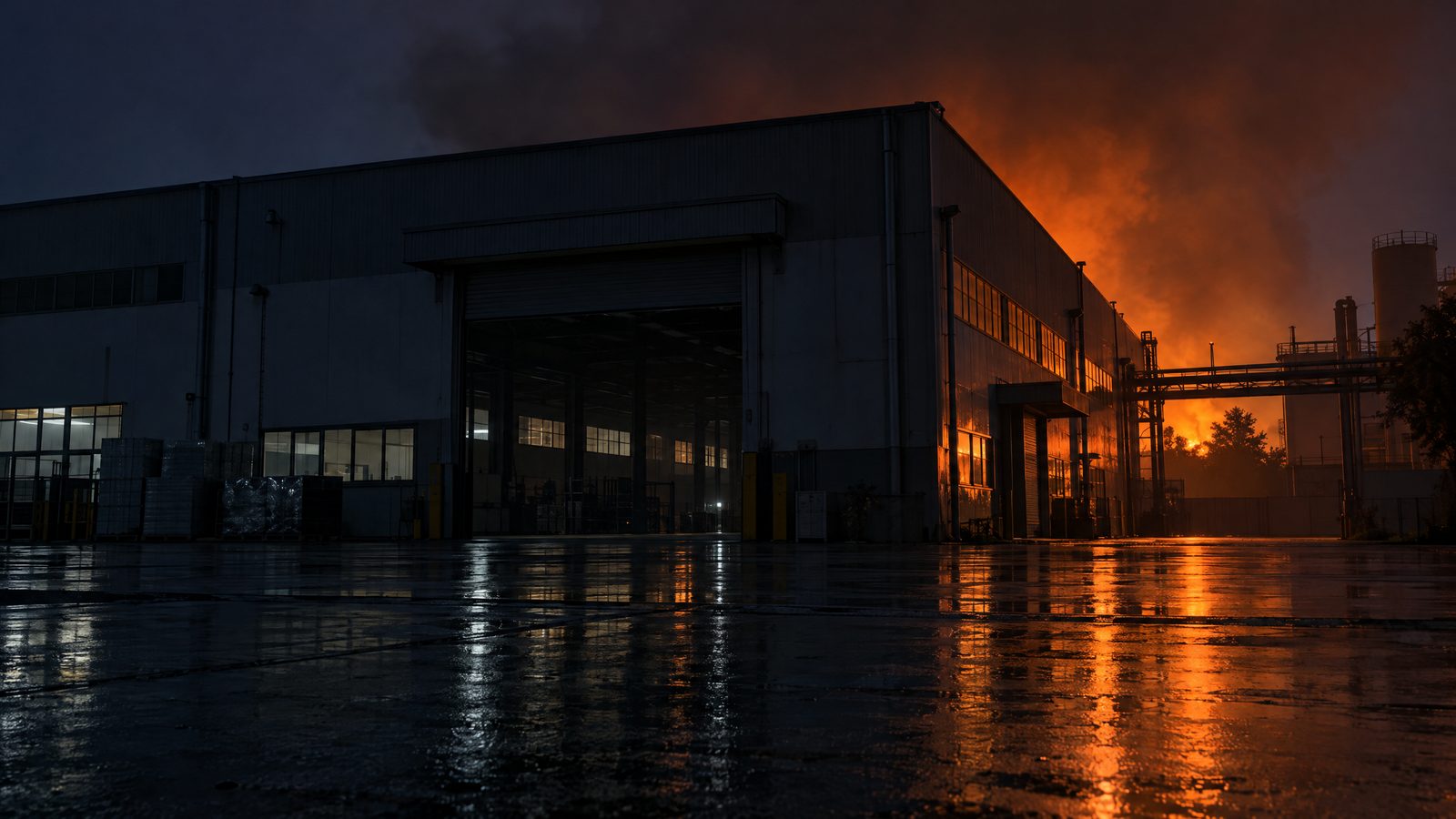

Four people died and two were injured after a fire broke out at a footwear manufacturing unit in Delhi’s Mangolpuri Industrial Area on 30 October 2026. Six people were recovered unconscious from the premises and taken to hospital.
The fire broke out at about 9.30pm at B-293/294 in Phase 1 of the industrial area. Police and fire-service teams responded, with the Delhi Fire Service sending about 20 water tenders to the site.
All six people were taken to Sanjay Gandhi Memorial Hospital in Mangolpuri. Four were declared dead and two were receiving treatment. The death and injury figures relate to those recovered unconscious; they do not establish the total number of people present at the factory.
The cause of the blaze remained unknown. Outer District Deputy Commissioner of Police Vikram Singh said police were investigating how it started and determining how many workers had been at the unit. He also said the factory owner had been summoned.
Fire contained in basement
Delhi Fire Service ADO Paras Kumar said the fire began in the basement and was contained there. He said it had been extinguished and that the response had reached the cooling-down stage.
Kumar’s statement established the location of the outbreak, but not what caused it. His account of a basement fire should therefore be distinguished from the separate police investigation into why the blaze began. That question remained unresolved.
The cooling-down stage described by Kumar followed the extinguishing of the fire. His statement concerned the condition of the blaze and the fire-service response, rather than the medical condition of the two people receiving treatment or the outcome of the police inquiry.
The emergency response involved police and fire-service teams at the industrial premises, alongside the transfer of the six unconscious people to hospital. About 20 water tenders were sent, while Kumar’s account placed the fire itself within the basement of the footwear unit.
Police investigating cause and worker numbers
Singh’s statement identified two matters police were examining: the cause of the fire and the number of workers who had been present. Establishing the workforce at the time is distinct from counting those recovered and taken to hospital.
Six people being recovered unconscious does not, by itself, establish that only six people were inside the factory. Police were still determining worker numbers, so the casualty figures cannot be treated as a complete account of occupancy when the fire broke out.
The factory owner’s summons was a procedural step disclosed during that continuing investigation. It did not establish a cause or responsibility for the fire. Singh’s account described inquiries still under way, rather than a finding about how the incident happened.
The investigation was therefore separate from the fire-service assessment that the blaze had been extinguished. Bringing the fire under control did not resolve the questions police were examining about its cause or how many workers had been present at the unit.
For the two injured people, the confirmed position was that they were receiving treatment at Sanjay Gandhi Memorial Hospital. The four deaths were recorded after the six unconscious people had been taken there; the treatment status of the other two remained distinct from those deaths.
The incident left four people dead and two injured, with the basement fire extinguished and cooling down. Police inquiries into its cause and the number of workers present remained ongoing, and the owner had been summoned as part of that process.