
Smartwatches are no longer simple notification devices; between 2025 and 2030, they will mature into intelligent, autonomous companions that blend advanced health monitoring, artificial intelligence, and augmented reality into everyday life. This article explores the technical trends, user benefits, challenges, and likely timelines for the next wave of wearable innovation.
AI: The New Intelligence at the Wrist
Artificial intelligence will move from cloud-dependent assistants to on-device, context-aware agents. Instead of showing raw metrics, future smartwatches will interpret patterns, forecast risks, and suggest actions in plain language. Expect features such as predictive health alerts, personalised coaching that adapts in real time, contextual shortcuts based on location and routine, and improved natural-language understanding that functions even when the paired phone is unavailable.
Health Tracking Reaches Clinical Utility
Health sensing will be the single biggest value driver. Advances in sensor hardware, signal processing, and machine learning will push wearables toward medical-grade accuracy for several metrics. Cuffless blood pressure estimation, improved continuous ECG and SpO2 monitoring, and meaningful progress toward non-invasive glucose sensing are all plausible within this window. Continuous respiratory pattern analysis and early detection algorithms for arrhythmias and sleep-disordered breathing will enable watches to serve as first-line screening tools, with secure data pipelines to clinicians for follow-up.
Augmented Reality on the Wrist
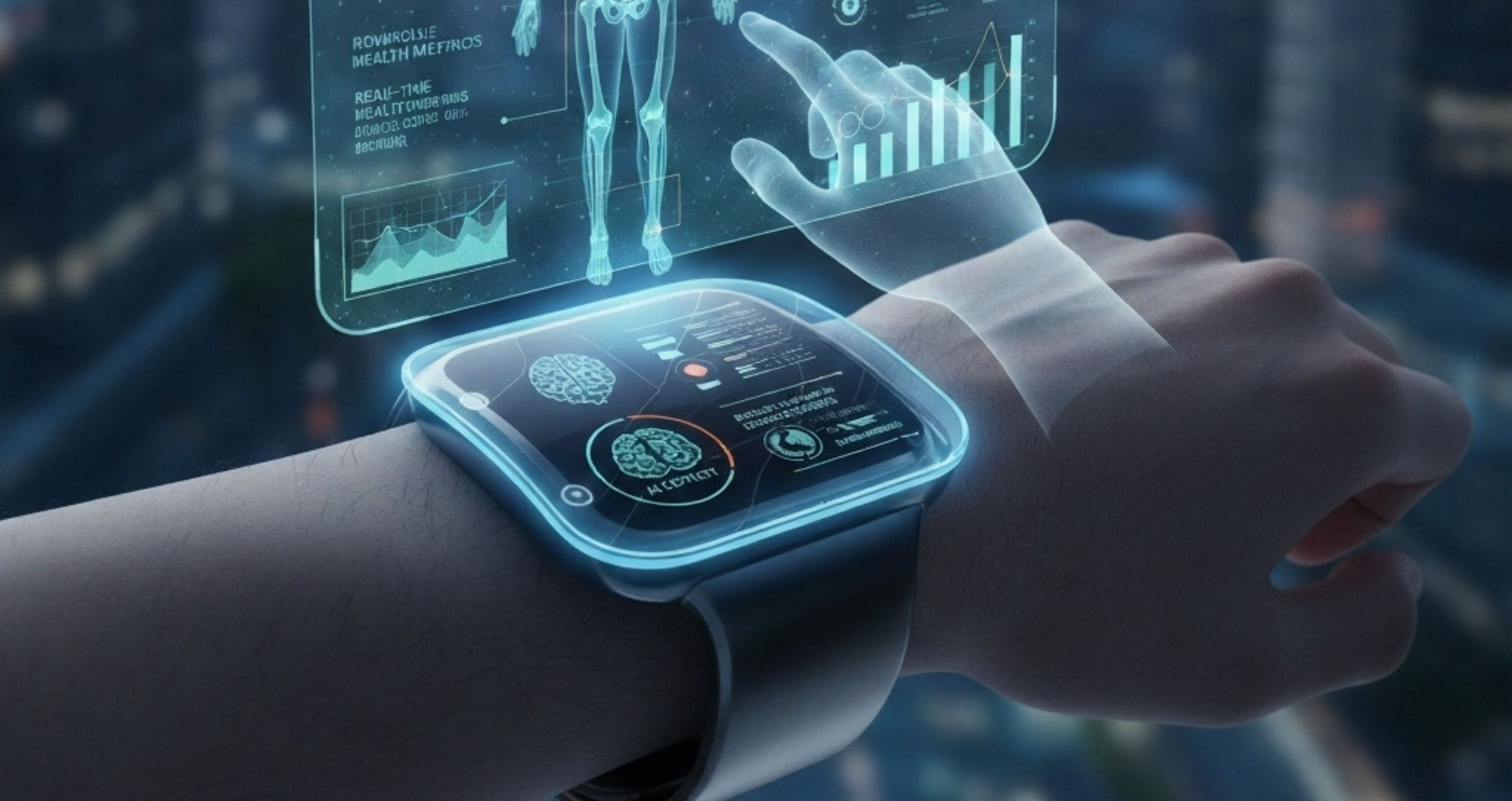
AR interfaces will expand interaction models beyond small screens. Micro projectors, wrist-to-hand displays, and coordinated AR glasses will allow watches to present contextual overlays—turn-by-turn navigation, translation subtitles, floating widgets for messaging, and animated exercise guidance. Gesture recognition and wrist-based controls will reduce dependence on touch inputs, enabling more natural, glanceable experiences while you walk, cycle, or work.
Battery, Efficiency, and New Power Models
Battery technology and power management must improve to support AI and AR workloads. Expect a combination of hardware and software solutions: more efficient AI accelerators, low-power always-on sensors, microLED and other low-energy displays, and gradual adoption of higher-density chemistries such as solid-state options. Hybrid charging—solar cells built into bezels or straps, kinetic energy harvesting, and thermal generators—will extend uptime and reduce user friction.
Stand-Alone Capabilities and Connectivity
By the mid-to-late decade, many high-end watches will no longer be mere smartphone companions. eSIM, integrated 5G/LPWAN radios, and more capable processors will enable standalone apps for maps, messaging, and streaming. Offline-first AI models running locally will respect privacy and reduce latency. While a phone will still be useful for heavy content creation, watches may handle most day-to-day tasks for users who value minimalism or high mobility.
Design, Personalisation, and Fashion Tech
Wearables must fit people’s wardrobes and identities. Expect collaborations with fashion houses, modular hardware (interchangeable bezels and smart straps), and adaptive materials that alter texture or color. Digital watch faces will evolve into authenticated, brand-approved canvases—licensed complications and dynamic skins that change with weather, calendar events, or biometric signals. Manufacturers will balance thinness with hidden sensor stacks, offering both classic and futuristic form factors.
Privacy, Regulation, and Clinical Validation
As watches take on health roles, privacy and regulatory compliance become critical. Medical claims will require clinical validation and approvals; data sharing will need strong encryption, explicit consent flows, and clear ownership policies. Regulators and insurers may begin to accept verified wearable metrics for remote monitoring; however, that requires standardised data formats, audit trails, and robust false-positive mitigation.
Ecosystem Integration and New Use Cases
Smartwatches will be the hub for an expanding personal ecosystem: smart homes, vehicles, AR glasses, workplace access, and personalised commerce. Seamless authentication from the wrist will let users unlock cars, approve payments, or share emergency health data with first responders. For enterprise use, centralised device management and privacy-preserving telemetry will unlock fleet health monitoring and location-aware workflows.
Challenges and Constraints
Despite rapid progress, challenges remain. Non-invasive glucose sensing is especially hard and may see partial solutions before a fully reliable consumer product. Battery physics and thermal limits constrain continuous high-power features. Interoperability between platforms (iOS, Android, proprietary OS) will require cross-industry standards. Finally, user trust hinges on transparent algorithms, equitable performance across demographics, and accessible support for diverse populations.
Timeline: What to Expect, When
Short-term (2025–2026): Wider adoption of on-device AI features, incremental improvements in ECG and SpO2 accuracy, modest AR demos, eSIM ubiquity in premium models. Mid-term (2027–2028): Noticeable gains in battery life, validated cuffless blood pressure, deeper ecosystem integrations, and more robust standalone apps. Late-term (2029–2030): Mature AR interactions, clinically validated monitoring for multiple conditions, broader acceptance of wearables in healthcare workflows, and significantly more standalone use cases.
Where to Explore and Buy Models
If you want to compare current models and upcoming releases, check the curated selections of smart watches to evaluate features, pricing, and compatibility. For a broader view of electronics and related accessories, you can also visit Cybermart.
Conclusion
The period from 2025 to 2030 will be transformative for smartwatches. Advances in AI, health sensing, AR, battery technology, and connectivity will turn wrist devices into trusted personal assistants and preliminary health monitors. For users, that means more proactive health insights, fewer interruptions, and richer interactions; for the industry, it demands rigorous validation, strong privacy protections, and device designs that people want to wear every day.