
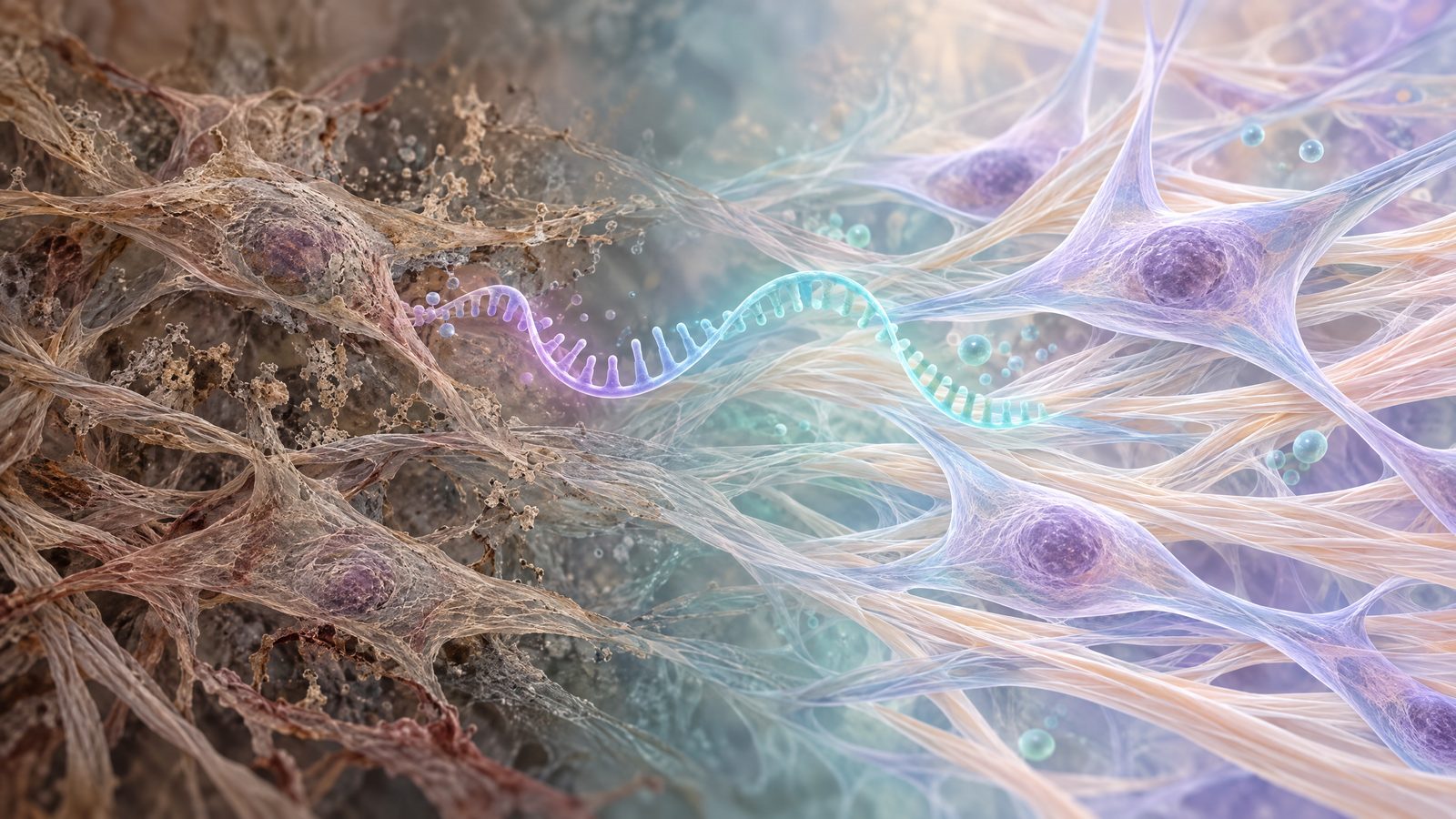

A gene involved in processing RNA has reduced several signs of cellular ageing in laboratory experiments and was associated with longer median lifespan in a small study of aged mice, researchers have found. The work also introduces a gene-expression-based method for screening potential targets, but it does not establish a treatment for people.
The study, published on 14 October, examined SRSF1, an RNA-processing and splicing factor. The team developed a machine-learning model to estimate the “transcriptomic age” of human skin fibroblasts from patterns of gene activity. Fibroblasts are connective-tissue cells that help maintain the structure of skin and other tissues. Researchers then used the model to screen a selected set of genes for their capacity to shift aged cells towards a younger molecular profile.
Signals in aged cells
SRSF1 emerged as a leading candidate when its expression was increased in aged fibroblasts. The experiments found changes in gene activity towards younger patterns, alongside reductions in cellular senescence, inflammatory signalling and proteostatic stress. Senescence describes a state in which damaged cells stop dividing but remain in the tissue; proteostatic stress concerns the systems that maintain the balance and turnover of proteins.
The work also tested whether the changes came at the cost of cell identity. The study reports that treated fibroblasts retained features associated with their specialised role and did not activate the pluripotency programmes used to return cells to a less specialised state. Preserving identity is important in this line of research because broad cellular reprogramming can disrupt the functions that distinguish one cell type from another.
The age predictor was built around gene-expression patterns in human skin fibroblasts, and the screening work focused on a defined library rather than every gene. Its estimate is a research measure of molecular state, not a direct reading of a person’s biological age or a clinical test. Results in cultured cells cannot show that the same effects will occur safely or consistently in a living person.
A small mouse experiment
In a separate experiment, aged mice received inducible SRSF1 expression. The paper reports that the treatment reduced the rate at which frailty progressed by 44 per cent and was associated with a 14 per cent extension in median lifespan compared with controls. The lifespan comparison involved nine to ten animals per group, a small sample that makes the estimate uncertain and in need of replication.
The intervention was delivered using a gene-transfer approach and was designed for experimental expression in mice. A result in animals does not demonstrate safety, effectiveness or an appropriate dose in people. The study does not report a human trial, and the findings do not justify clinical use or self-directed attempts to alter gene activity.
SRSF1 is involved in RNA processing, including splicing, through which cells assemble messenger RNA in different forms before using it to produce proteins. The researchers describe the gene as affecting several features of ageing in parallel, while noting that the detailed mechanisms behind those changes need further investigation. The results therefore point to a possible research direction rather than a complete explanation of how ageing changes across the body.
From screening to possible therapies
The screening approach is intended to help researchers identify candidate genes by measuring shifts in gene expression. That can make large-scale searches more systematic, but a favourable score in a cell model is only an early step. Candidates still need testing in further models, assessment of potential harms and work on how any intervention could be delivered to the right tissues.
The researchers’ findings add to efforts to study whether some age-related changes can be modified without erasing a cell’s specialised function. Whether SRSF1 can eventually inform a safe therapy remains an open question. For now, the reported evidence is limited to laboratory cells and a small mouse experiment, with no demonstrated benefit for human health or lifespan.







