
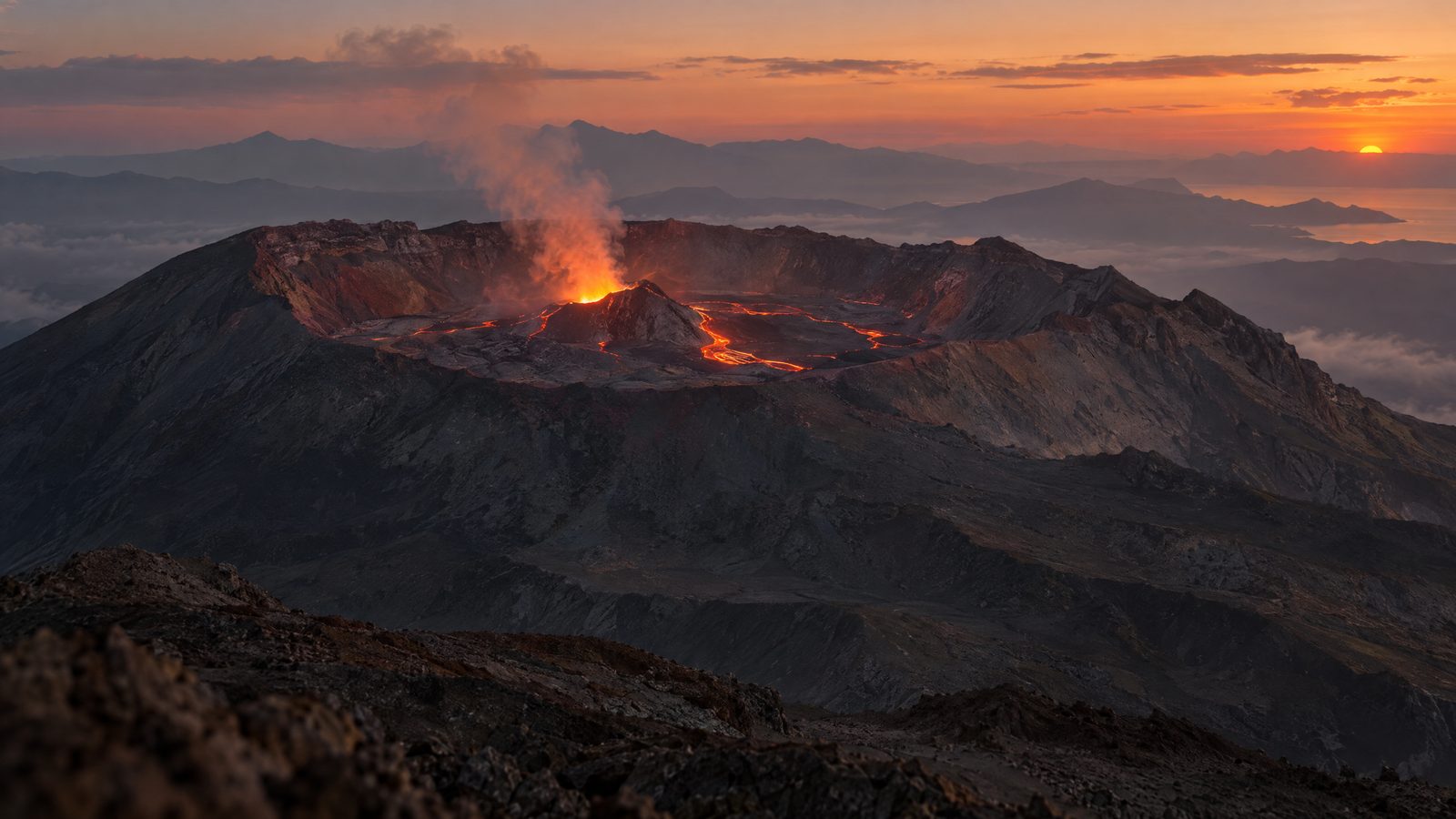

Kīlauea’s south summit vent began producing continuous lava overflows near dawn on Friday, 16 October, after a night of shorter bursts. The Hawaiian Volcano Observatory recorded repeated overflows from about 10.16pm on Thursday, followed by a high-volume surge at 5.10am that covered the area within roughly 300 feet of the vent in about ten minutes.
The activity then became sustained from 5.56am. A small dome fountain inside the vent fed several channels of pāhoehoe lava — a fluid form of basaltic lava — across the nearby surface. The channels reached close to half a mile from the vent. Their volume, and the fountain’s size, waxed and waned during observations. Spatter was also seen at the north, south and west vents overnight, alongside persistent glow and occasional flames.
The change marks a shift from the intermittent overflows described in the observatory’s previous daily update. On 15 October, activity had resumed at the north vent, with 12 overflows recorded during the day and one from the south vent. By the following morning, the south vent had become the focus of sustained surface activity. The observations do not establish that a larger lava-fountaining episode has begun.
Seismic tremor became more continuous at about 6am, around the time the south vent activity became continuous and drainback stopped. Twenty-one earthquakes were recorded across the summit region in the preceding 24 hours, mostly to the south and east. Tilt measurements showed small changes and an overall slight inflationary trend since Wednesday. GPS stations on opposite sides of Halemaʻumaʻu also recorded a small increase in distance since late September, consistent with longer-term inflation of the summit magma reservoir.
Scientists said the vigorous overflows indicate magma remains very close to the surface in the established vent complex and can continue to produce smaller dome fountains. They cannot forecast when another high lava-fountaining episode might occur: irregular ground-deformation patterns since the last major episode have prevented forecast modelling. A future episode from the north-south vent complex remains possible, but so do further magma intrusion beneath the summit or passive eruption along existing cracks. These are possibilities, not predictions that any one outcome will occur.
The East Rift Zone and Southwest Rift Zone remained quiet in the latest assessment, with low seismicity and ground deformation and no significant deformation recorded. Sulphur dioxide emissions from the East Rift Zone remained below the detection limit. During pauses between summit episodes, the observatory says summit sulphur dioxide emissions typically vary between 1,000 and 5,000 tonnes a day; that range is not a measurement of the current emissions during the overflow activity.
The volcano alert level remained Watch and the aviation colour code Orange. The observatory said conditions could change rapidly and continued coordination with Hawaiʻi Volcanoes National Park and Hawaiʻi County’s civil-defence agency. The eruptive activity is within a closed area of the national park, but the monitoring notice warns that intrusions can create hazards including earthquakes, ground cracks and small landslides. Lava flows, volcanic gas and loose volcanic fragments can also pose hazards near active vents. The Park’s 16 October afternoon update separately noted the continuing south-vent spatter and overflows, and said temporary safety closures were in place.
Kīlauea has been erupting episodically from vents in Halemaʻumaʻu since December 2024. Its high-fountaining episodes have generally lasted less than 12 hours and been separated by pauses of at least two weeks. The new observation is therefore a further development within a continuing summit eruption, rather than evidence that another major fountaining episode has already started.







