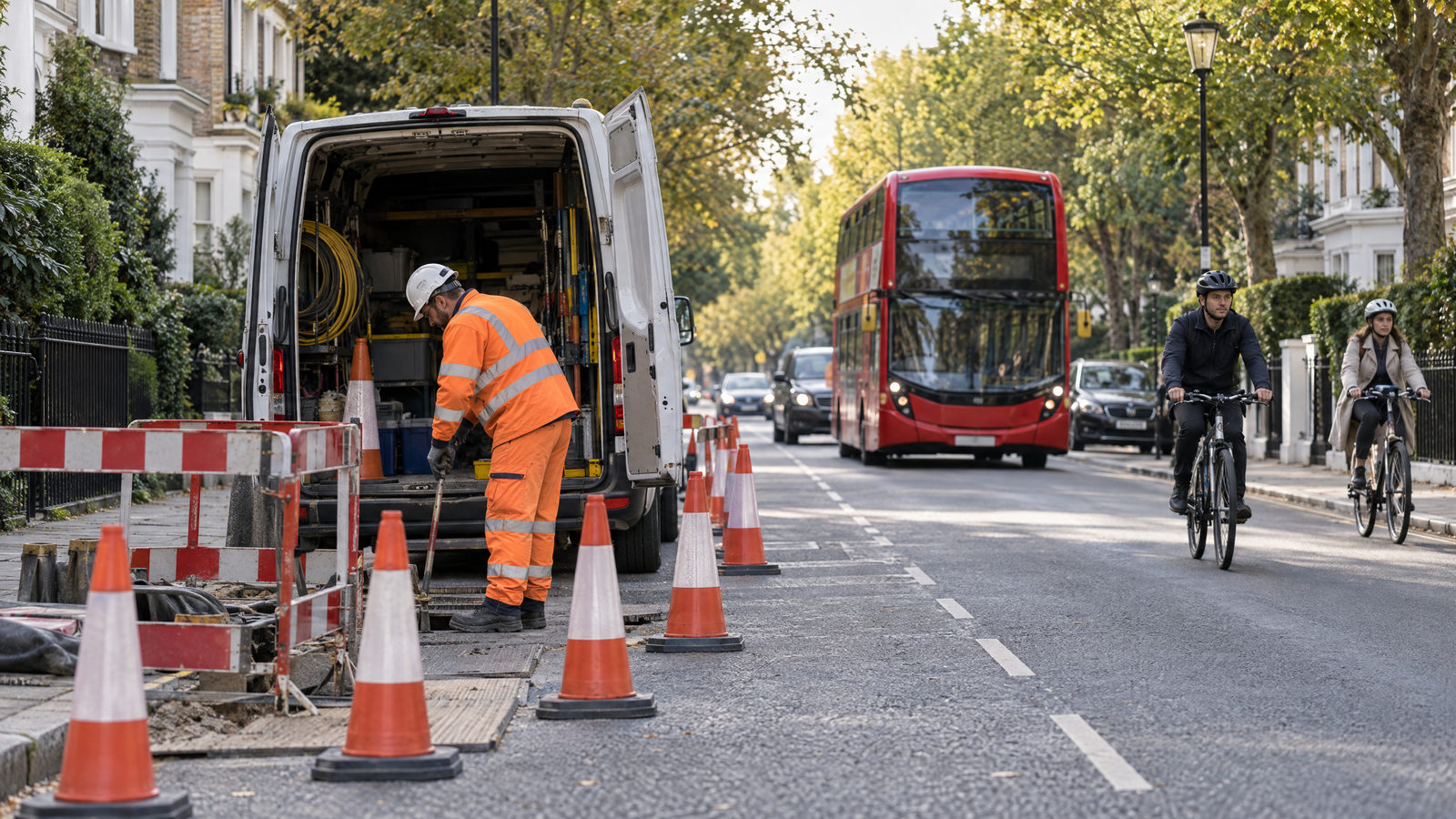

Charges begin after four-week trial
Hammersmith & Fulham has started charging utility companies and contractors for roadworks on designated busy routes during peak periods, in a bid to reduce congestion and disruption across the borough. The lane-rental scheme began on Monday 5 October, following a four-week trial that ran from 24 August to 21 September.
The charge applies when works occupy a road included in the scheme during specified periods. The borough says the selected locations account for 17.1 per cent of its road network and are among the streets where works can have the greatest effect on traffic and residents. The arrangement changes the cost of scheduling work at those locations; it does not remove utility companies’ right to dig up roads to maintain or upgrade their infrastructure.
Daily charges range from £1,000 to £2,500, depending on the sensitivity of the location. The scheme guidance also identifies a £1,500 middle band. On weekdays, the charging windows are 7am to 10am and 3pm to 7pm. At the highest band, charges may apply continuously from 7am to 7pm. The listed weekend periods are also 7am to 10am and 3pm to 7pm.
The council’s stated purpose is to encourage companies to plan works more carefully, finish them faster, coordinate with other works promoters and, where possible, move activity to quieter times. Reducing the duration or peak-time impact of lane closures is intended to lessen delays for people travelling through the affected roads, including local residents and businesses.
Revenue is intended to be reinvested in the borough’s highways and measures to reduce traffic disruption. The council lists pothole repairs and road-surface maintenance alongside traffic-management technology and congestion-reduction projects as uses for the funds. The authority describes the scheme as an incentive for more efficient work rather than a ban on necessary repairs.
Targeted streets, not borough-wide charges
The 17.1 per cent coverage figure means the charges do not apply across every Hammersmith & Fulham road. They are targeted at selected, traffic-sensitive parts of the network. The scheme’s operating guidance gives a borough map of affected streets, but the rules depend on both the location and the time a work site occupies the highway. Companies planning work therefore need to take account of the relevant street and its charging window.
Peak-time charges are intended to make a prolonged or poorly timed occupation more expensive than completing works efficiently or arranging them outside the busiest periods. The borough says the approach is designed to reduce lane closures and diversions, while improving the management of works on roads, pavements and pedestrian crossing points.
Cllr Nicole Trehy, the council’s cabinet member for climate emergency and travel, said residents were frustrated by closures and congestion caused by works on busy roads at busy times. She said the council wanted companies to work more efficiently and avoid peak periods, and linked reduced traffic delay with safer conditions for walking and cycling to schools and workplaces.
The scheme has been approved by the Department for Transport. Hammersmith & Fulham is among London boroughs adopting lane rental alongside existing street-works controls. For people travelling locally, the practical change is that utility and contractor works on the designated roads now face a daily charge during the published peak windows; whether that produces fewer or shorter disruptions will depend on how companies schedule and carry out their jobs.