

There is a particular kind of misery that belongs to the British bathroom in winter. The dash from the bedroom across a cold landing. The dread of bare feet on the tiled floor. The towel that has been hanging since morning, still faintly damp, cold, and unwelcoming against the skin.
It is a small discomfort, but it is a daily one. And like all daily discomforts, it shapes how a home feels in ways we rarely stop to notice.
The heated towel rail is the quiet remedy. It is not glamorous. It does not transform a room the way a freestanding bath or a marble vanity might. But it changes the daily experience of a bathroom more than almost any other upgrade—and in winter, that difference is everything.
The Daily Ritual
Think about the sequence of a morning shower in January.
You wake, cross a cold floor. You turn on the water, shower and then step out into air that feels colder than the water was. Finally, you reach for a towel that has spent the night absorbing the chill of the room.
Now imagine the same sequence with a heated towel rail.
The towel is warm and dry; the air around it is slightly warmer. The rail itself takes the edge off the room; the bathroom no longer feels like a place you endure and leave. It feels like a place you want to linger in.
This is the real case for the heated towel rail: not luxury, but daily comfort. It turns the most functional room in the house into somewhere genuinely pleasant.
What a Heated Towel Rail Actually Does
A heated towel rail performs three jobs at once.
1. It Dries Towels
This is the obvious function, and the most important. A damp towel left hanging in a cold bathroom becomes a breeding ground for bacteria and mildew. It smells musty. It never quite dries.
A heated rail dries towels thoroughly between uses. They stay fresh longer, need washing less often, and feel far better against the skin. Over a year, this saves water, energy, and detergent.
2. It Warms the Room
A heated towel rail is a small radiator. It will not heat a large bathroom on its own, but it takes the chill off the air, especially in smaller rooms. In a compact London bathroom, it can be the difference between a cold room and a comfortable one.
3. It Adds a Focal Point
Bathrooms are often the most neglected rooms in the house, design-wise. A well-chosen towel rail—particularly a chrome or brushed brass ladder design—adds a vertical, architectural element that lifts the whole scheme. It looks deliberate. It looks considered.
Choosing the Right Rail
Not all towel rails are equal. The choice depends on your heating system, your bathroom size, and how you want to use it.
Central Heating (Hydronic) Rails
Connected to your boiler and filled with hot water, just like a radiator.
- Pros: Cheap to run if your heating is on, powerful, and integrated with your system.
- Cons: Only works when the heating is running. In summer, your towels will be cold again.
- Best for: Bathrooms used mainly in the morning and evening, when the heating is on anyway.
Electric Rails
Filled with oil or a thermal fluid and heated by an electric element.
- Pros: Independent of the central heating. Can run year-round on a timer or thermostat. Often dual-fuel capable.
- Cons: More expensive to run. Requires an electrical connection, ideally on a fused spur.
- Best for: Bathrooms used at odd hours, homes with underfloor heating, and anyone who wants warm towels in July.
Dual-Fuel Rails
Connected to the central heating and fitted with an electric element.
- Pros: The best of both. Hydronic when the heating is on, electric when it is not. Ideal for year-round warm towels.
- Cons: Higher upfront cost and slightly more complex installation.
- Best for: Almost everyone, if budget allows.
Size, Style, and Placement
Size
A common mistake is choosing a rail that is too small. A short rail may look neat, but it will not hold enough towels or emit enough heat. As a rule:
- Small bathroom (under 4m²): 400–600mm wide, 700–1000mm high.
- Medium bathroom (4–8m²): 600–800mm wide, 1000–1200mm high.
- Large bathroom (over 8m²): 800–1200mm wide, or multiple rails.
If you are relying on the rail for warmth, check its heat output in BTUs or watts against the size of the room.
Style
- Ladder rails. Straightforward, practical, and available in countless designs. The default choice.
- Flat panel rails. Sleek and modern. Less good at holding towels but better as radiators.
- Traditional column rails. Cast iron or chrome, often with a vintage look. Beautiful in period properties.
- Freestanding rails. No wall fixing required. Ideal for renters or awkward layouts.
- Wall-mounted towel warmers. Compact and hinged, often used alongside a larger radiator.
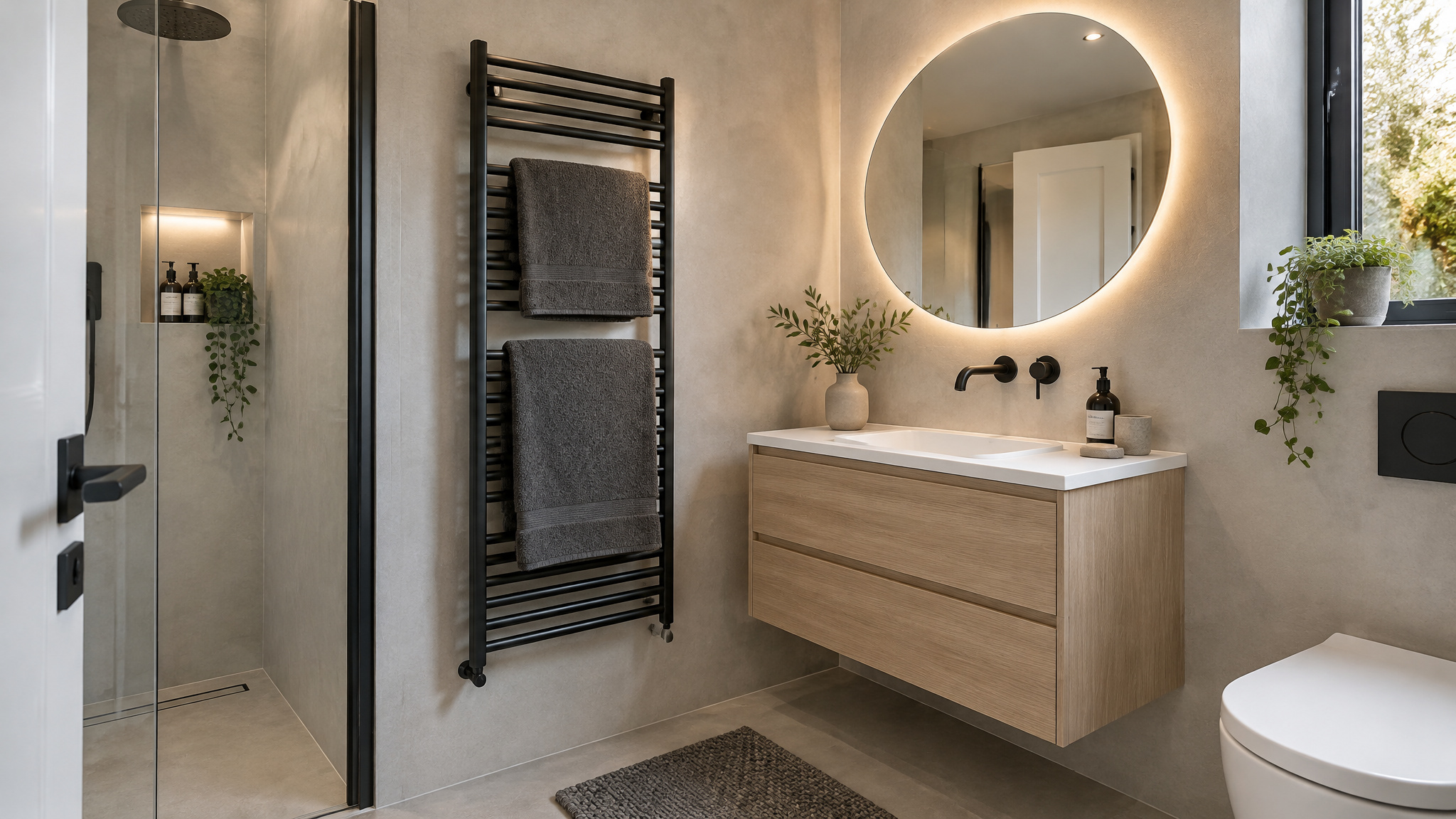
Finishes matter too: chrome is classic and bright; brushed brass and antique gold are warm and currently very fashionable; matt black is dramatic and modern; white is discreet and blends into the wall.
Placement
- Near the shower or bath, so towels are within reach when you step out.
- Away from the door, where cold draughts will undermine it.
- Not directly above the toilet, for obvious reasons.
- Consider the electrics. A dual-fuel or electric rail needs a power supply, ideally installed before tiling.
Running Costs and Efficiency
The honest answer is that heated towel rails cost money to run—but less than most people fear.
- Hydronic rails cost almost nothing extra if your heating is already on.
- Electric rails typically run at 100–500 watts. On a timer for two hours a day, that is a modest addition to your bill—particularly compared to the cost of running a tumble dryer for towels.
- Dual-fuel rails give you control: use the electric element only when the heating is off.
A thermostat and timer are essential. There is no need for a warm towel at 3am.
The Case for Warmth
There is a broader argument here, beyond towels.
Bathrooms and en-suites in British homes are often the coldest rooms in the house. They are tiled, they are small, they have windows that are frequently left open. They are rooms in which we are naked and wet—the two conditions under which cold is felt most acutely.
Warming a bathroom is not indulgence. It is basic comfort & is the difference between a room that feels hostile and a room that feels hospitable. It is the difference between rushing through a shower and enjoying one.
The heated towel rail is the simplest, most affordable way to make that difference. It warms the towel, warms the air, and warms the mood of the room.
The Point
A heated towel rail is not a luxury item. It is an everyday comfort—one that pays for itself in dry towels, lower laundry bills, and bathrooms that feel warm and welcoming in the depths of winter.
If you are renovating a bathroom, fit one. If you are not, consider a freestanding or plug-in option.
Your towels—and your feet on a January morning—will thank you.







