
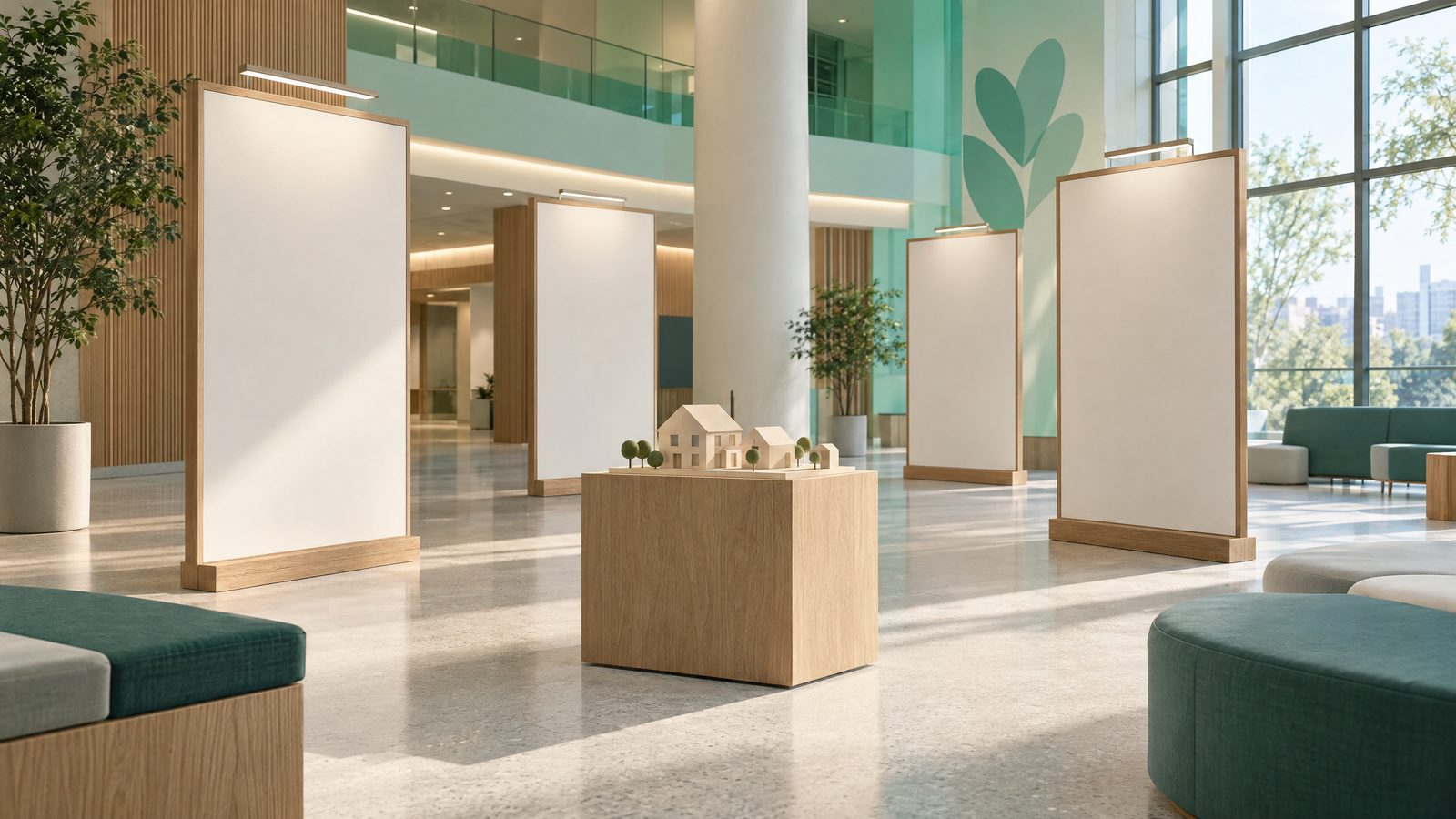

A new public art installation exploring the relationship between housing and health has opened at University College Hospital on Euston Road. Home Truths, by multimedia artist Lynn Dennison, is on display in the hospital atrium from 28 October until 24 November, with free access daily between 6am and 9pm.
The installation sits in a setting used by patients, visitors and staff throughout the day. Its purpose is not to provide housing or clinical care. Instead, it uses art to bring attention to the ways homelessness, insecure housing and poor-quality homes can shape health and wellbeing, while inviting visitors to consider what healthier, more secure homes might look like.
An artwork in a public hospital
At the centre of Home Truths is a substantial wooden-framed structure covered with cyanotype images printed on fabric. The work draws on ideas from Passivhaus housing design, which is intended to reduce energy demand through measures such as insulation, ventilation and careful control of heat. An accompanying film considers the effects of homelessness on people’s lives and prospects, alongside the case for affordable and sustainable housing.
The physical installation is designed to be encountered in passing as well as examined closely. That matters in a hospital atrium, where many people may be there for appointments, visiting or work rather than a planned gallery visit. By placing the work in a shared civic space, the commission makes housing a visible part of a wider conversation about population health.
The project has been developed with families who have experience of temporary accommodation, as well as doctors, paediatricians, local-authority housing teams, architects and planners. Those contributions give the work a broad frame: it addresses the experience of home and instability, but also the practical systems that shape the homes available to people.
Part of a wider London programme
Home Truths forms part of Healthy Homes for All, a programme bringing together architecture, public-health research and engagement around housing and homelessness. The programme also includes a discussion on housing and health inequalities, a design exhibition and other public activity in Bloomsbury.
The hospital presentation is a distinct part of that programme. It is not a new housing scheme, a clinical treatment or a change to hospital services. Its contribution is cultural and public-facing: it brings a subject often discussed through statistics, planning policy and individual hardship into an everyday London healthcare setting.
That approach also leaves room for different responses. A visitor might focus on the materials and images, while another may recognise questions about temporary accommodation, overcrowding, affordability or the energy performance of homes. The installation does not attempt to offer one simple answer to those issues. It sets out the connection between housing conditions and health as a subject for reflection and discussion.
Why the location matters
University College Hospital is on one of central London’s busiest routes, close to major rail stations, universities and residential neighbourhoods. Displaying the installation there gives the project an audience beyond a conventional arts venue and places it among the daily movement of a large public institution.
For Londoners, the exhibition offers a free opportunity to engage with the subject without booking a ticket. Its timing also coincides with a wider series of events examining how the design, cost, security and environmental performance of homes affect people and communities.
The immediate development is the opening of the installation itself. Visitors can see Home Truths in the atrium through 24 November. The work does not claim to resolve the housing pressures it addresses, but it creates a public place to consider how the condition of a home can be bound up with health, dignity and daily life.







