

Hong Kong’s government and railway operator MTR have signed an agreement for the second part of the Northern Link, clearing the way for the remaining main line works and a branch to the border with Shenzhen.
The government put the estimated capital cost of the full project at HK$86.2 billion, in July 2025 prices, and said that was 28 per cent below the original estimate. Officials and the operator are aiming to bring the main line and spur into service together by 2034 or earlier. Neither line is open.
The agreement was signed on 10 November, after the Chief Executive in Council approved the financial arrangements for the second part of the scheme. It covers financing, design and construction of the remaining works, as well as the future operation and maintenance of the Northern Link as a whole.
The signing follows a first agreement in July 2025. That allowed work on parts of the main line to proceed while detailed planning and design began for the spur. The shared target of opening both lines by 2034 was already part of that earlier agreement; Tuesday’s signing extends the contractual arrangements to the rest of the project.
Two routes planned as one railway
The main line is planned as a 10.7-kilometre underground railway between Kam Sheung Road, on the Tuen Ma Line, and Kwu Tung, on the East Rail Line. Three intermediate stations are planned at Au Tau, Ngau Tam Mei and San Tin. The operator says the new station names are working titles.
A spur of about 6.2 kilometres would branch from San Tin and run through Chau Tau and the Loop to Huanggang Port in Shenzhen. Around 1.1 kilometres of that route would be in Shenzhen. Both lines are planned to use a shared depot at Ngau Tam Mei, and the new railway sections and stations are to be underground.
The government expects the peak-hour journey between Kam Sheung Road and Kwu Tung to fall from around 60 minutes to 12 minutes once the line is operating. It estimates a journey of about 11 minutes from San Tin to Huanggang Port on the spur. Those are projections for a railway still under construction, not current journey times.
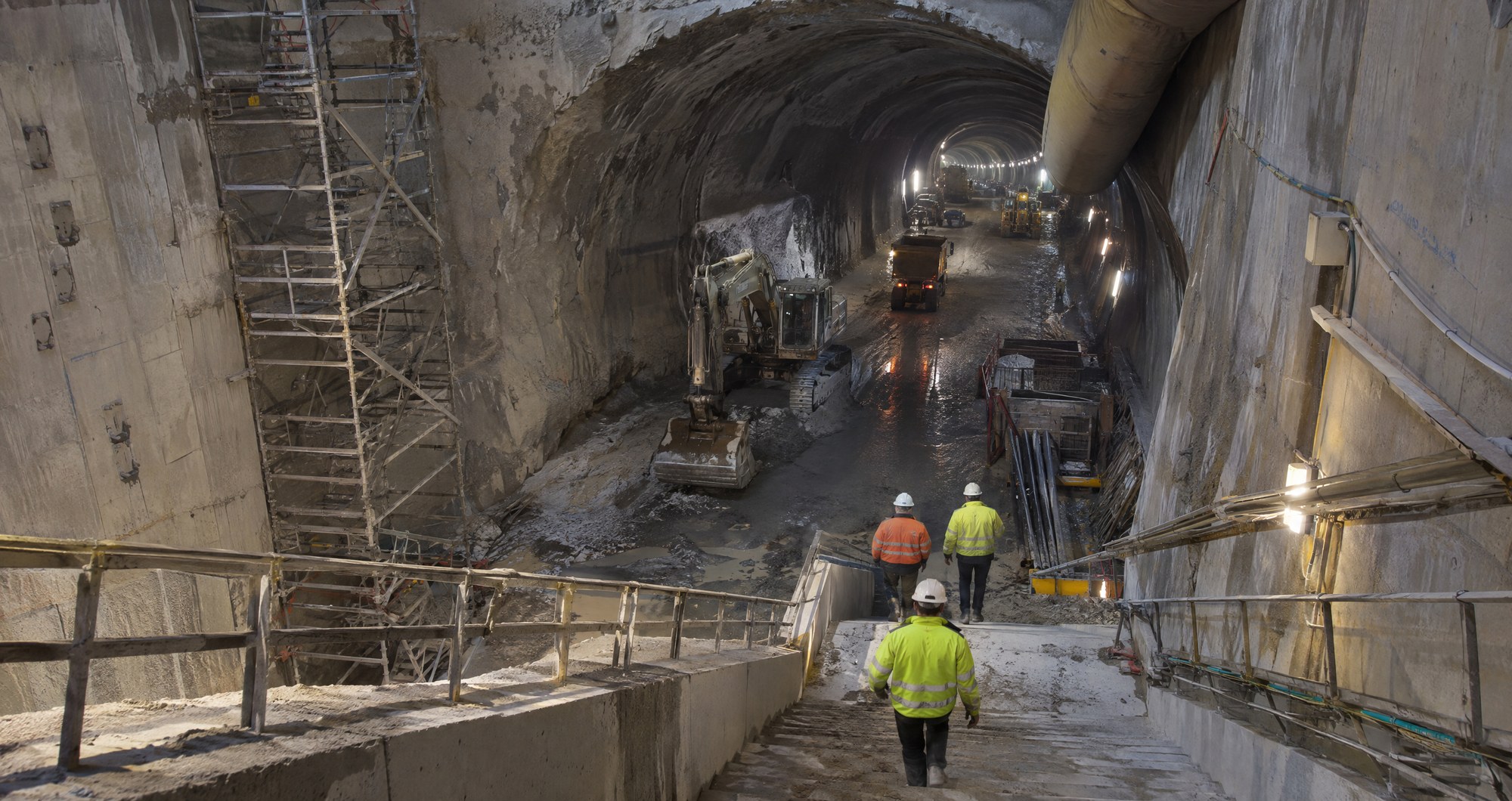
The operator said work on the main line was already progressing, including excavation for the first tunnel-boring machine launch shaft. The Hong Kong section of the spur received railway-scheme authorisation in September. The project is intended to serve development areas in the Northern Metropolis and connect existing rail routes as well as provide a cross-boundary link.
Separate arrangements are still expected for the Shenzhen section. MTR said the Hong Kong and Shenzhen governments were expected to reach an agreement, and that the company would enter agreements with the Shenzhen authorities to build, operate and maintain that section.
Estimate and funding
The government said its assessment of the second part, supported by an independent checking consultant, put its capital cost at about HK$54.8 billion in July 2025 prices. Combined with the first part, the estimate for the full railway is HK$86.2 billion. The figure covers elements including tunnels, stations, the depot and electrical and mechanical systems. It is an estimate rather than a final construction bill.
Transport and logistics secretary Mable Chan attributed the reduction against the original estimate to measures including new railway standards, streamlined procedures and delivery of the two lines as a combined project. The government also cited savings associated with a shorter construction period. The spur had previously been targeted for 2036; the 2034 joint target was announced in 2025.
MTR said it would be responsible for the full cost of the second part under the agreement, including land acquisition costs. It expects to incur that project cost over approximately ten years. The government said it had approved the grant of residential and commercial development sites in areas including Ngau Tam Mei, San Tin, Kwu Tung North and Au Tau under the rail-plus-property model.
Under that arrangement, a fixed sum would be deducted from the land premium assessed at full market value on a basis that takes the railway into account. The deduction is intended to support delivery of the second part. The operator said property development proceeds would support railway construction and long-term maintenance and renewal.
The agreement also provides for sums from railway revenue to be set aside for network improvements if commercial operation begins after the scheduled operating date. For now, the stated opening date remains a target, with substantial construction, systems work and cross-boundary arrangements still to be completed.







