


AI investments often start with a promising use case. The harder part is proving that the investment deserves more funding. A strong idea still needs a clear business case, realistic costs, and enough technical readiness to move forward.
PwC found that 20% of organisations capture 74% of AI-driven returns. The gap shows why investment alone does not create business value.
So, what should you evaluate before putting more money into an AI initiative?
- Is the business case strong enough to justify funding?
- Is the initiative ready to move beyond its current stage?
Start With the Business Case
The first step is understanding why the business needs custom AI solutions. A strong use case should connect the technology to a measurable business outcome and a clear business priority.
Start by checking the current situation. Without a baseline, it becomes difficult to prove whether AI created meaningful improvement.
Ask these questions before funding:
- Business problem: Is the problem clearly defined?
- Baseline: Do you know the current cost or performance?
- AI rationale: Is there a clear reason to use AI?
- Expected outcome: Can the expected business outcome be measured?
- Business priority: Is the initiative linked to a current business priority?
These questions keep the evaluation focused on business value rather than technology alone.
Calculate the Full Investment
The model or software price represents only one part of an AI investment. AI coding costs can also include implementation, integration, security, testing, and ongoing operations.
A realistic investment case should account for the resources needed to build, operate, govern, and maintain the solution.
Include the costs of:
- Technology: Models, platforms, and software
- Data: Preparation, access, and management
- Engineering: Development and technical resources
- Integration: APIs, systems, and workflow changes
- Infrastructure: Cloud, compute, and storage
- Security: Required controls and testing
- Training: Preparing teams to use the solution
- Operations: Monitoring, maintenance, and support
- Governance: Oversight and accountability
If the model only includes software costs, it is not the full AI investment.
Evaluate the Investment With Specific Questions
A score is useful only when the questions behind it are clear. The scorecard covers business value, financial readiness, technical readiness, scale, risk, and governance.
The AI Investment Scorecard uses:
0 = No, 1 = Partially, and 2 = Yes.
The questions to evaluate the initiative:
- Do you know the current cost or performance baseline?
- Have you included data and integration costs?
- Is there a clear reason to use AI?
- Have you included ongoing operating costs?
- Is the business problem clearly defined?
- Have you calculated the full AI investment?
- Is the expected business outcome measurable?
- Is the expected payback realistic?
- Is the initiative linked to a business priority?
- Can the expected ROI be measured?
- Are security and governance requirements clear?
- Is user adoption planned?
- Is the required data ready?
- Can the solution scale if the pilot succeeds?
- Are key risks and assumptions documented?
The total score shows the initiative’s current readiness.
- 0–10: Unclear – Key information is missing.
- 11–20: Developing – Some elements are in place.
- 21–25: Finance Ready – Ready for pilot or phased funding.
- 26–30: Scale Ready – Strong business case and technical readiness.
The score does not predict ROI. It shows how prepared the initiative is for a stronger investment decision.
Check What Happens After the Pilot
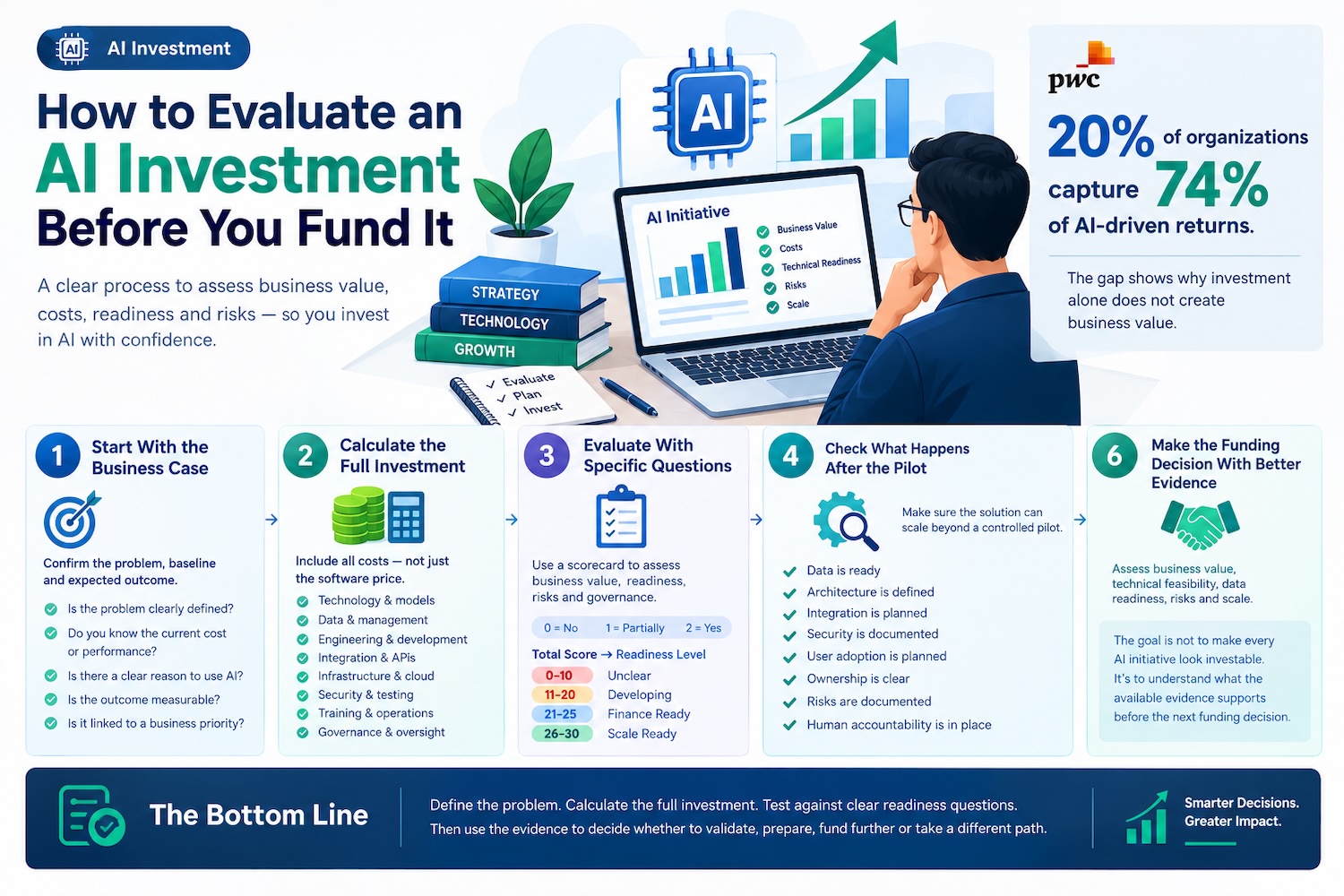
A successful pilot does not automatically justify wider investment. The next stage should depend on evidence from both the business and technology sides.
Before increasing the budget, check whether the solution can work beyond a controlled pilot.
Before funding the next stage, check whether:
- The required data is ready.
- Architecture requirements are understood.
- Integration requirements are defined.
- Security requirements are documented.
- User adoption is planned.
- The solution can scale.
- Ownership is clearly defined.
- Key risks are documented.
- Human accountability is clear.
These checks help identify gaps before they become larger investments.
Measure More Than Cost Savings
Cost savings are only one possible source of AI value. A broader evaluation can show where the initiative may create or protect business value.
The AI Investment Playbook identifies six areas for measuring value:
- Cost: What will the initiative require?
- Productivity: What valuable capacity can it create?
- Revenue: Can it create or protect revenue?
- Risk: What financial or operational risk can it reduce?
- Decision Quality: Can it improve decision speed or quality?
- Strategic Value: Can it create new capabilities, products, or business models?
Looking across these areas gives leaders a more complete view of potential value.
Make the Funding Decision With Better Evidence
At ValueCoders, we help teams assess AI investments before more capital is committed. Our approach covers business value, technical feasibility, data readiness, risks, and scale requirements.
The purpose is not to make every AI initiative look investable. It is to understand what the available evidence supports before the next funding decision.
Conclusion
A funding decision should start with more than an attractive AI use case. Define the problem, calculate the full investment, and test the initiative against clear readiness questions.
Then use the evidence to decide whether the initiative needs validation, more preparation, further funding, or a different path.







