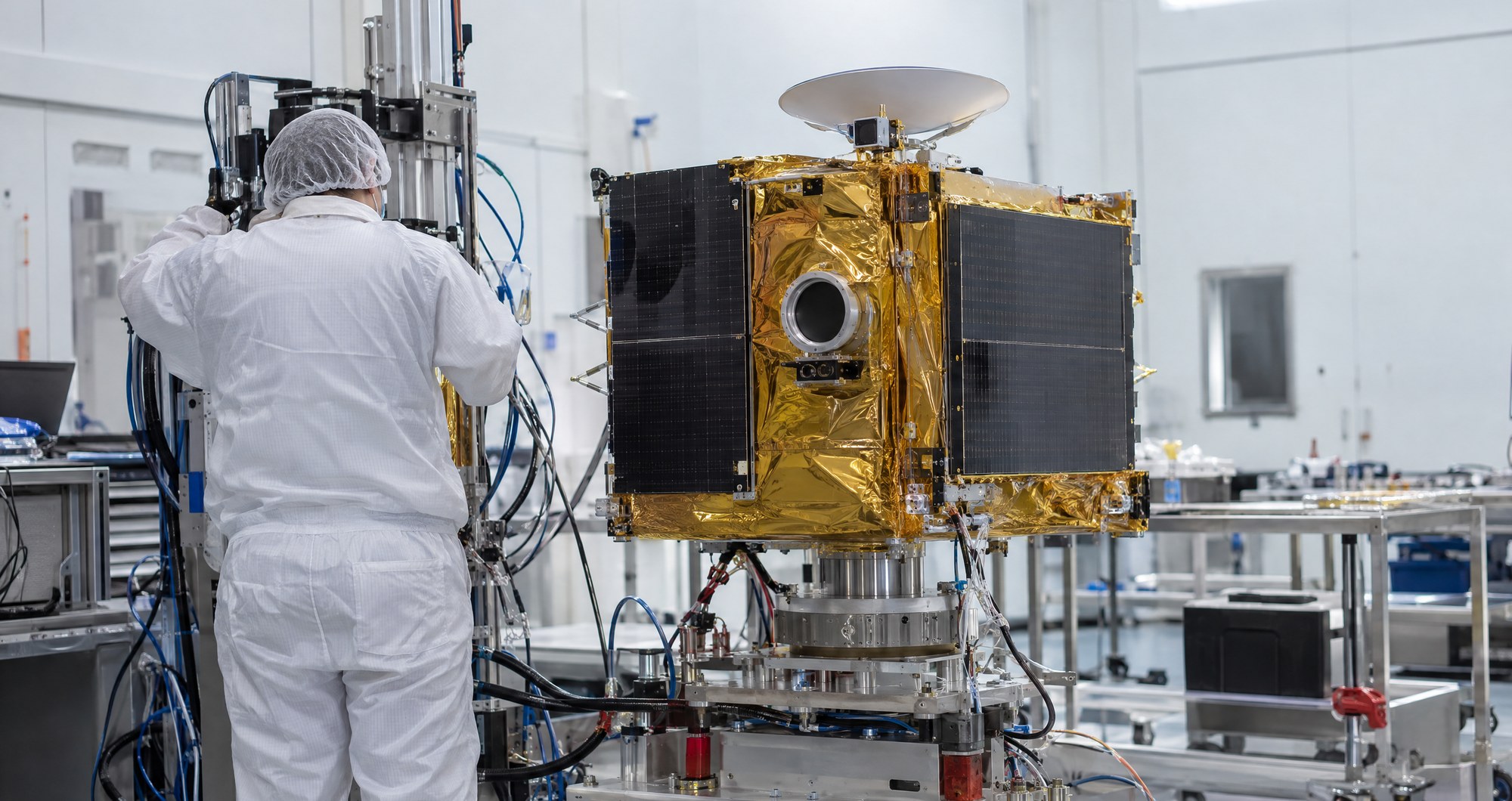

Britain’s second military observation satellite, Titania, has entered orbit and begun service alongside Tyche, the Ministry of Defence announced on 7 November. The British-built spacecraft adds to the UK’s ability to observe the Earth from space, as the department also trials a ground sensor network intended to monitor threats to British satellites.
Titania was launched in October on a SpaceX rocket from California. About the size of a washing machine and weighing roughly 100kg, it travels at about 27,000km/h and completes an orbit of the Earth every 90 minutes. Its arrival in service follows the launch of Tyche in 2024.
The satellite will be operated by UK Space Command, headquartered at RAF High Wycombe. It was designed and built in Hampshire by the Defence Science and Technology Laboratory, known as Dstl, with BAE Systems. Two further satellites, Juno and Oberon, are planned.
A second spacecraft for military observation
The announcement brings the UK’s military observation satellite programme from its first spacecraft to a pair in service. Titania joins Tyche as part of a developing space capability, with further expansion planned rather than completed. The MoD has confirmed the new satellite’s operational status, but the supplied announcement gives no timetable for Juno or Oberon.
Titania’s compact size contrasts with the scale of its journey: the spacecraft circles the planet once every hour and a half. Those figures describe its movement in orbit, rather than how frequently it can observe any particular location. The announcement does not set out the satellite’s detailed observation capabilities or identify the military activities it will monitor.
Responsibility for operating Titania sits with UK Space Command, while its design and construction were carried out in Hampshire. That separates the spacecraft’s British development and military operation from its launch, which took place in California using a SpaceX rocket.
The sequence is also important: Titania’s launch took place last month, while the 7 November announcement confirmed that it had entered orbit and begun service. It is therefore an addition to the UK’s operational military observation capability, not simply a spacecraft awaiting launch.
Ground sensors to watch threats in orbit
Alongside the satellite programme, the MoD is trialling Inaros, a network of ground sensors at three sites worldwide. Its stated purpose is to monitor threats to British satellites. The announcement describes Inaros as a trial, distinct from Titania’s confirmed entry into service.
The two projects address different parts of the UK’s space requirements. Titania provides observation from orbit, while Inaros is intended to help monitor threats to spacecraft. The ground network is therefore concerned with the environment in which British satellites operate, rather than being another observation satellite itself.
The development follows the standing up of the UK’s first space squadron and comes against a background of heightened concern about Russian activity in orbit. The supplied details do not identify a specific Russian incident connected to Titania’s launch or to the Inaros trial, and do not establish that either project was a response to a particular event.
Air Chief Marshal Sir Harv Smyth, the Chief of the Air Staff, said the ability to observe the Earth from space was “critical to both national resilience and military advantage”. His comments place the capability in a wider defence context, beyond the technical achievement of putting a second observation spacecraft into service.
British design and further satellites planned
Defence Secretary Wes Streeting said the satellites meant British forces “can see threats sooner, making the UK safer”. He also stressed that Titania and Inaros were “British-built and British-designed”, backed by more than £3bn of investment in space capabilities.
The investment figure relates to space capabilities more broadly. It is not presented as the cost of Titania alone, and the supplied announcement does not provide separate prices for the satellite, the Inaros network or the two planned spacecraft. The emphasis on British design and construction is supported by Titania’s development in Hampshire.
Juno and Oberon are the next named satellites in the programme, but both remain planned. Their inclusion shows that Titania is not intended to be the final addition, although no launch dates or operational specifications have been supplied.
For now, the confirmed change is a second military observation satellite in service alongside Tyche, with UK Space Command responsible for its operation. The next stages are further satellite development and the continuing trial of the ground sensors intended to watch for threats to Britain’s assets in orbit.