
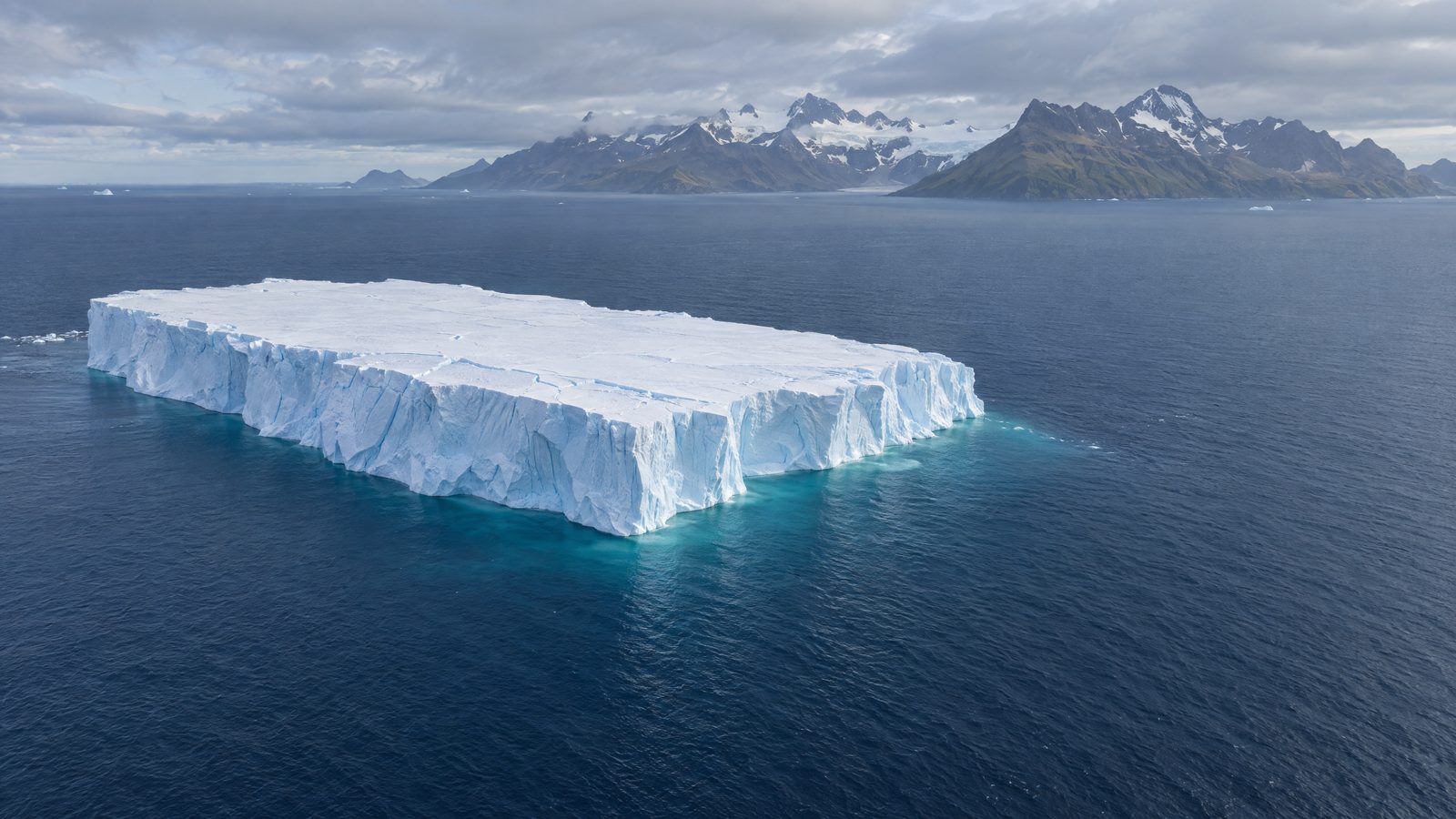

Iceberg A-81 has slowed as it nears South Georgia, where the island’s shallow underwater shelf appears to be affecting its course. A satellite image taken on 20 October shows the Antarctic iceberg close to the shelf edge after a journey of more than three years from the Weddell Sea.
The image offers a clear view of a change in pace rather than a final outcome. A-81 appears to have been moving more slowly in the days before the image was taken, with its route running along the edge of the submerged shelf around South Georgia. It is not yet established whether the iceberg has grounded, will remain in the area, break up, or continue past the island.
A long route out of the Weddell Sea
A-81 broke away from the Brunt Ice Shelf in January 2023. At the time, it measured about 28 nautical miles at its longest point and 25 nautical miles across at its widest. The iceberg then spent more than three years in the Weddell Sea, carried along the Antarctic coast by the clockwise circulation of the Weddell Gyre.
By May 2026, it had reached the tip of the Antarctic Peninsula. It then travelled north into the Scotia Sea and approached South Georgia in late October. The island lies about 2,300 kilometres north-northwest of the Brunt Ice Shelf, making the current position a notable stage in a long ocean journey rather than a sudden arrival.
Satellite observations from mid-October placed A-81 south-west of South Georgia and put its area at around 1,340 square kilometres. That scale means its progress can be followed from orbit, but a satellite image is still a snapshot. Further observations will be needed to show how the iceberg responds to local currents, water depth and weather.
Why the shelf matters
South Georgia’s underwater shelf can change the course of a drifting iceberg even though much of the feature is below the surface. Water becomes shallower around the island, so a deep-keeled iceberg can slow, pivot or, in some cases, run aground. The imagery shows A-81 near that transition, but it does not confirm that the iceberg has become fixed in place.
The area has affected large icebergs before. In 2025, iceberg A-23A ran aground on the shelf off South Georgia and later broke apart. That earlier episode illustrates why A-81’s next movements cannot be assumed from its approach alone. Each iceberg has a different shape, draft, rate of melting and exposure to winds and currents.
For the moment, the most accurate description is that A-81 has approached South Georgia and slowed near the shelf. It would be premature to describe a collision with the island, a confirmed grounding, or an effect on local wildlife, fishing or shipping. Those outcomes are not established by the available images.
Part of an active ice shelf
The break that created A-81 followed a long period of change at the Brunt Ice Shelf. One rift, known as Chasm 1, had been relatively stable for about 35 years before it began growing again around 2012. Its advance accelerated by 2019, but the final separation did not happen until January 2023.
Iceberg calving is a normal part of an ice shelf’s life cycle. A-81 is one of several large bergs released from Brunt in recent years: A-74 calved in 2021 and later broke up, while A-83 calved in 2024 and remains intact behind A-81. Their presence does not, by itself, establish a cause for any individual calving event or a particular future outcome.
The current focus is therefore on observation rather than prediction. New satellite passes can clarify whether A-81 continues to drift along the shelf, becomes temporarily held near South Georgia or begins to fragment. Until then, the evidence records a vast iceberg slowing at a consequential point in its route through the South Atlantic.







