
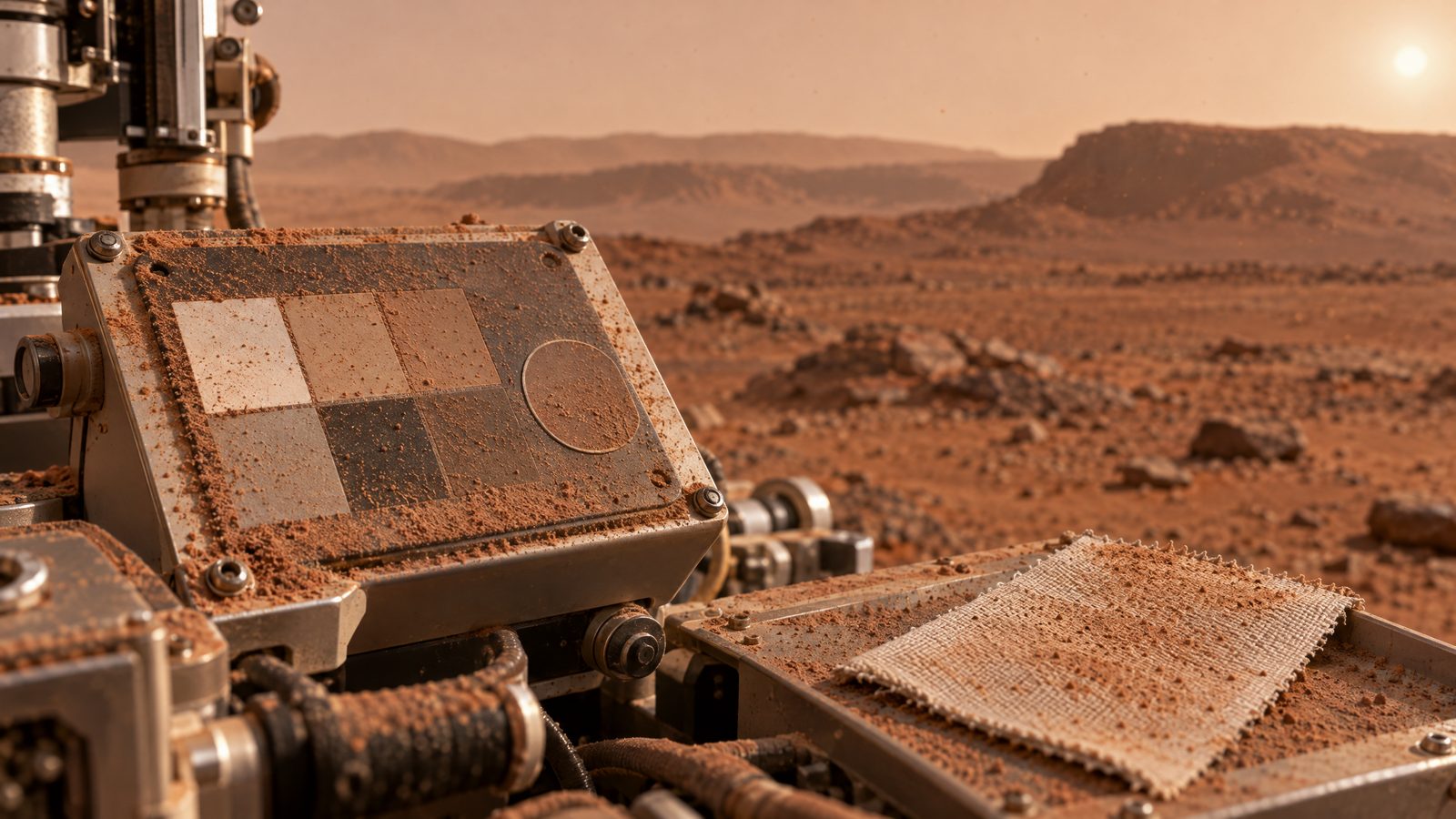

NASA’s Perseverance rover has provided a closer look at one of the practical problems that future Mars crews will have to manage: dust small enough to cling stubbornly to equipment and potentially enter living spaces.
After 1,645 Martian days on the surface, an analysis of dust resting on calibration targets and samples of spacesuit material has identified fine particles below 2.5 micrometres and ultrafine particles down to roughly 100 to 300 nanometres. The work offers direct, on-the-ground detail about a fraction of Martian dust that had previously been difficult to distinguish.
Small particles on equipment samples
Perseverance carries instruments designed to investigate the chemistry of Martian rocks. Its Planetary Instrument for X-ray Lithochemistry, known as PIXL, also examined dust that had settled on a target containing Teflon and basaltic glass. A separate target for the rover’s SHERLOC instrument includes small swatches of materials relevant to spacesuit outer layers.
The targets created an unusual opportunity. Teflon does not produce the elemental X-ray signals PIXL detects, so the signal on its sample could be used to examine dust resting on the surface. The analysis found dust in several size ranges. On one Teflon target and a Vectran fabric sample, particles averaged around two micrometres. On the basaltic glass and another Teflon sample, the estimated sizes extended down to the nanoscale.
That scale matters because a nanometre is one billionth of a metre. A particle around 100 nanometres across is far smaller than the width of a human hair. Earlier Mars measurements had generally resolved particles only to a few micrometres across, leaving the smaller fraction less clearly characterised.
Why dust is hard to manage
Mars dust is not simply loose soil that falls away when a rover moves. Grains can become electrically charged as they collide in the atmosphere. The new analysis indicates that the smallest particles can remain attached to some surfaces through years of driving, drilling and vibration. The effect appears to vary with the material, meaning that the choice of coatings and fabrics could affect how readily a surface can be cleaned.
Martian grains are generally more rounded and less abrasive than lunar dust because wind-driven movement has repeatedly knocked them together. That does not make them an insignificant engineering concern. Dust storms can recirculate material through the atmosphere, and fine particles can settle on hardware, seals and surfaces. For a crewed outpost, the challenge would be to keep material collected outside from travelling into pressurised areas.
Health questions remain open
The finding does not establish that Mars dust has harmed people. No crew has yet lived or worked on the Martian surface, and the study did not measure the dose that a future astronaut might receive. Any health effect would depend on factors including the amount of dust, the duration of exposure, its chemical form and the success of cleaning and filtration systems.
Even so, the size of the particles makes exposure an important design issue. On Earth, fine airborne particles can penetrate deeply into the lungs, while ultrafine particles may behave differently again. Martian dust contains silicate minerals and chemically reactive compounds, including perchlorates and iron-bearing material. The new measurements strengthen the case for testing Mars-relevant dust in laboratories and for developing limits that account for particle size as well as bulk composition.
Design choices before crews arrive
The results could inform choices that are still open for future missions. Possible measures include materials that retain less dust, protective surface coatings, cleaning methods that use mechanical or electrostatic effects, and airlock arrangements that limit the transfer of dust into habitats. A suitport, where a spacesuit remains attached to the outside of a habitat, is one design that could reduce the amount carried indoors. Dual-chamber airlocks may provide another layer of separation.
Those options are not a complete solution, and the rover measurements are only one part of a much larger engineering task. The samples were exposed at one Martian location and do not recreate every condition of a human mission. Further work is needed on airborne dust, surface chemistry, cleaning performance and long-term exposure before specific standards or hardware choices can be settled.
Perseverance’s primary mission is to investigate ancient environments in Jezero Crater and search for signs that could indicate past microbial life. Its instrument targets and technology demonstrations also provide information for later exploration. In this case, a set of small material samples has supplied evidence that the finest Martian dust deserves close attention well before the first crewed mission is designed in detail.







