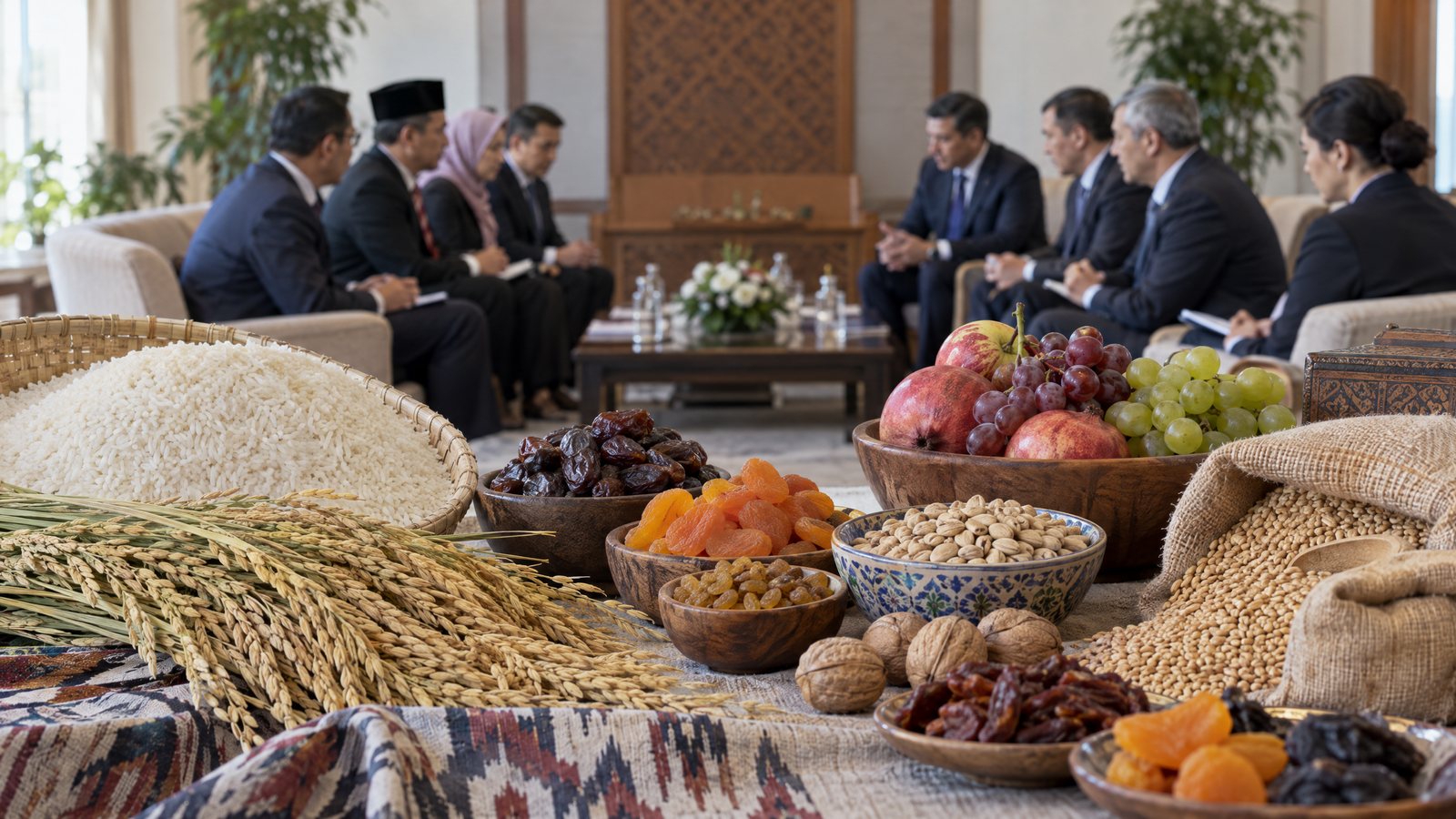

Indonesia and Uzbekistan have agreed to establish an intergovernmental joint committee to coordinate cooperation on food security, trade and investment. The planned body is intended to follow up bilateral outcomes and provide a framework for future economic cooperation between the two countries.
The agreement brings together several strands of discussion, from agricultural trade and food-safety requirements to transport connections and green investment. Although the committee has been agreed, the associated trade, aviation and environmental measures remain discussions or plans rather than completed projects.
Its intended role is coordination: following up what the two governments have agreed and organising further cooperation. That distinction matters because establishing a committee does not itself mean that new imports, direct flights or investment projects have received approval or begun operating.
Food trade and safety
Agricultural trade is a central part of the discussions. The two countries considered possible imports of Uzbek dried fruit into Indonesia, with food-safety requirements forming a condition of that potential trade. The prospect remains conditional, rather than a confirmed new flow of goods.
Food security and food safety are therefore both part of the agenda. Cooperation on agricultural supplies is being considered alongside the requirements that would apply to food entering the Indonesian market. The discussions do not establish that those requirements have already been met.
The planned committee would give the governments a means of following up these issues within their wider economic relationship. Its remit covers food security as well as trade and investment, rather than treating the agricultural discussions as a separate, finalised arrangement.
The initiative is also linked to negotiations for an Indonesia–Uzbekistan free-trade agreement, which began in March 2026. Those negotiations provide the wider trade context for the committee, but the agreement to create the body is distinct from concluding a free-trade deal.
No completed free-trade agreement is established by these developments. The position remains one of negotiations alongside a newly agreed coordination mechanism. Likewise, the discussion of dried-fruit imports should not be read as confirmation that a particular market-access arrangement is already in place.
Connectivity and green investment
The two governments have also explored direct air links between Jakarta and Tashkent. Connectivity forms part of the broader cooperation agenda, but the exploration of a route is not the same as a confirmed service. Direct flights were not presented as an implemented measure.
The distinction leaves the aviation element at the planning and discussion stage. The committee agreement does not, on its own, establish an operating timetable or the start of an air connection between the Indonesian and Uzbek capitals.
Environmental cooperation was another strand of the talks, covering sustainable agriculture, conservation and waste-to-energy investment. These areas sit alongside the food-security and trade agenda, broadening the subjects under consideration without establishing that individual projects have been finalised.
Waste-to-energy investment, in particular, remains an area of discussion rather than a completed investment commitment. The same caution applies to sustainable agriculture and conservation: the governments have explored cooperation, but the discussions should not be treated as evidence of projects already under way.
The clearest outcome is therefore the agreement to create the joint committee. Its purpose is to connect bilateral follow-up with future coordination across several economic fields. The other elements describe the scope of cooperation being considered, not a package of measures already delivered.
For now, Indonesia and Uzbekistan have agreed on a mechanism for taking their discussions forward. Possible agricultural imports remain subject to food-safety requirements, free-trade negotiations remain separate, and direct connectivity and green-investment proposals retain their exploratory status.