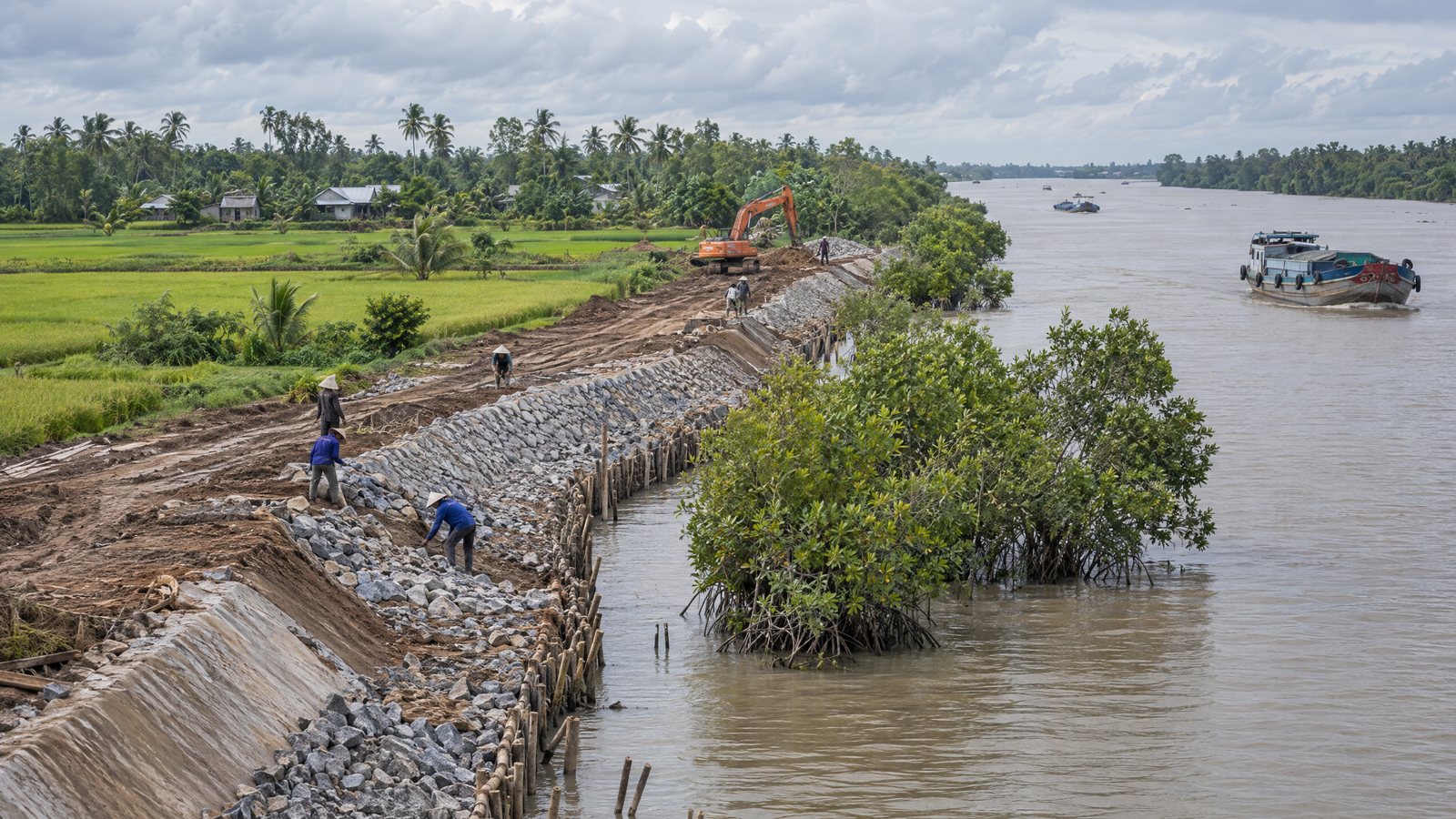

Vietnam’s agriculture and environment minister has told lawmakers that funding planned for climate adaptation and disaster prevention remains well below the country’s stated needs. His account set out a continuing gap between the capital available for protective works and the scale of demand, including in the Mekong Delta.
The minister said 23.5 trillion Vietnamese dong (VND) had been allocated for measures in the Mekong Delta over the 2026–31 period. He described that funding as comprising 15 trillion VND from a prime-ministerial allocation and 8.5 trillion VND in official development assistance.
At the national level, the minister put demand for disaster-control works at about 210 trillion VND. He said central-budget capacity was about 105 trillion VND, acknowledging that available capital did not match the assessed requirement. Those figures describe his assessment of demand and budget capacity, rather than completed spending or protection already delivered.
Regional allocation and national demand
The Mekong Delta allocation and the nationwide estimates cover different geographical scopes. The 23.5 trillion VND identified by the minister relates to measures in the delta during a specified funding period. The larger demand estimate concerns disaster-control works across Vietnam, not the delta alone.
That distinction matters when considering the size of the funding gap. The regional allocation is not a statement of the total resources available nationwide, while the national demand figure is not an estimate solely for the Mekong Delta. The minister’s remarks nevertheless placed the delta within the broader discussion of resources for adaptation and disaster prevention.
The two components of the delta allocation also identify different funding categories. One is the allocation associated with the prime minister; the other is official development assistance. Together, they make up the regional total stated by the minister, but neither the total nor its components establish how much work has already been carried out.
A range of protection needs
The minister’s nationwide demand estimate covered works addressing erosion, subsidence, drought and saltwater intrusion, as well as protection against heavy rain and flash floods. The stated requirement therefore spans several types of disaster-control work rather than a single form of flood protection.
Within that assessment, demand represents the scale of works judged to be needed. Central-budget capacity is a separate measure of the resources the minister said were available from that budget. Treating the two as interchangeable would obscure the shortfall he acknowledged.
The difference between those categories is also important for interpreting the funding announcement. An allocation sets out money assigned for measures; it does not, by itself, confirm that the measures are finished. Likewise, an estimate of need does not establish that every identified work has funding in place.
For the Mekong Delta, the minister’s figures provide a defined regional funding envelope for 2026–31. They do not amount to a statement that the delta’s adaptation and disaster-prevention requirements have been fully met. His acknowledgement of a continuing gap between capital and need remains central to the account.
The national figures show the same distinction on a wider scale: the minister’s estimate of demand is substantially above the central-budget capacity he described. Both remain attributed assessments, with the demand figure indicating a requirement rather than an approved spending total.
The minister’s remarks leave a clear picture of funding identified alongside needs that remain larger than available capital. They establish neither that the gap has been closed nor that the planned allocations have already translated into completed protective works.