
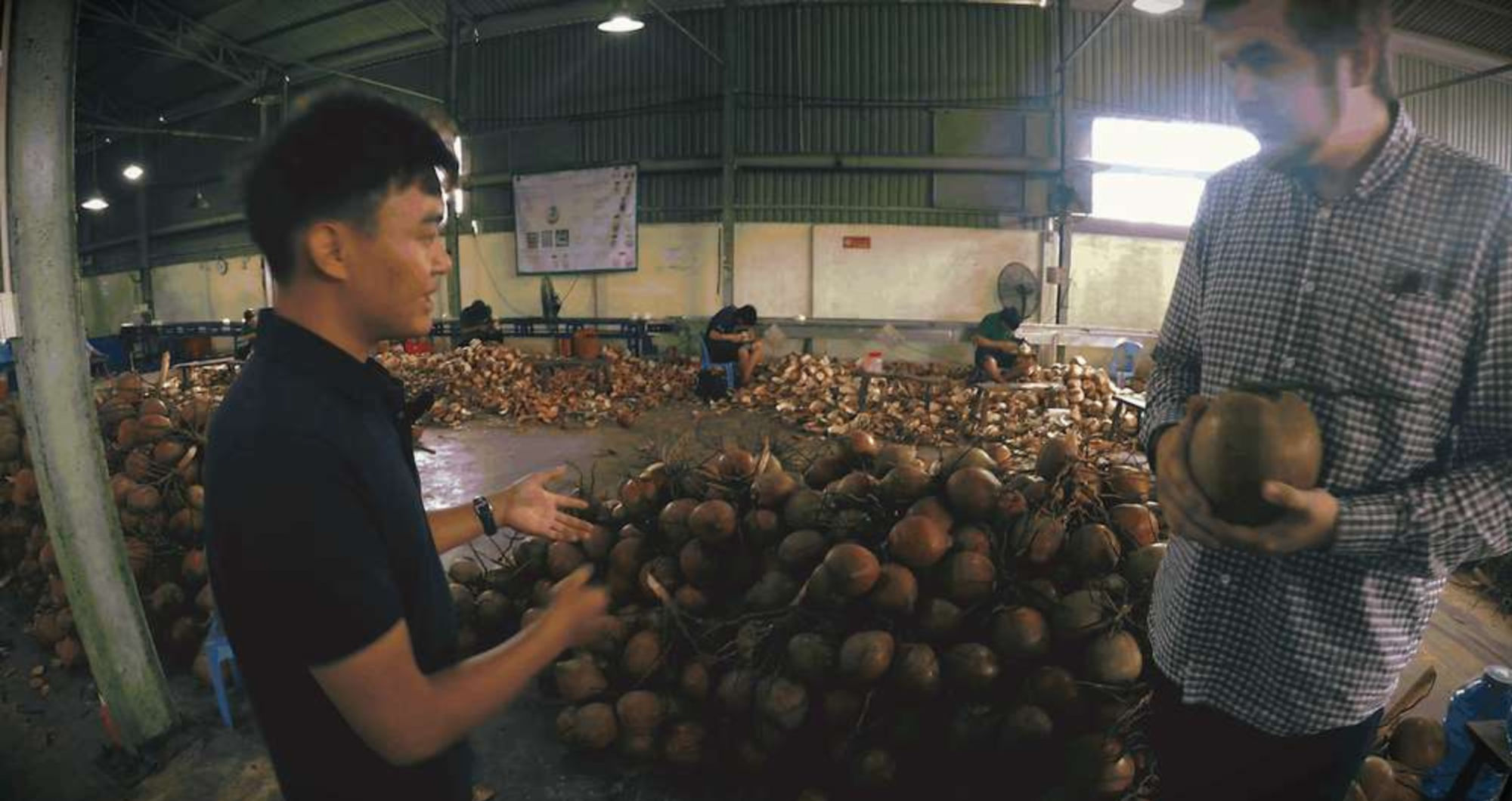

As part of an on-the-ground review of coconut exports to the UK, conducted alongside operators handling the export flow, I observed the early export stages in southern Vietnam’s Mekong Delta. The humidity in the Mekong Delta is thick, yet the market thrust is even more intense. The morning started in the heart of Ben Tre, inside a coconut plantation, tracking a gold rush most people only see in spreadsheets. What started as a regulatory shift has rapidly manifested in the ledgers; coconut exports have hit a significant stride since the UK-Vietnam Free Trade Agreement (UKVFTA) took effect in 2021. The latest Customs data suggests we’ve finally hit a tipping point. While coconut exports are the headline act, the broader agricultural numbers for 2025 are, frankly, staggering. Coffee shipments have surged by an eye-watering 218.5%, while staples like cashews and pepper—alongside fresh produce—all posted gains well north of the 50% mark.
The “VIP Pass” to British Markets and the Strategic Edge it Provides Over Regional Competitors
Think of the UKVFTA as the green light for Vietnam-UK trade. It’s essentially a “VIP pass” for Vietnamese products entering the UK. Instead of wrestling with tariffs, items like coffee and tropical fruits (everything from mango and lychee to dragon fruit and coconut) get the 0% treatment at the border. Best of all? There are no restrictive quotas or volume ceilings to worry about. You aren’t boxed in by seasonal quotas.
Exploring the Mekong’s Tactical Advantage
B2B buyers from UK often choose Vietnam, particularly Ben Tre and Tien Giang regions, for coconut sourcing because of its developed infrastructure built all around coconut farming and processing. I spent several hours moving through processing hubs in Tien Giang, where access to the facilities was arranged through the sourcing platform Vietnamia. This is one of dozens of specialised sites preparing fresh coconuts for export to the UK. Ben Tre and Tien Giang form the core of the region’s coconut supply chain. The year-round tropical heat and the maze of river systems create a natural “incubator” for tender coconuts. In the world of wholesale, this organic distribution network is a huge tactical advantage. It keeps the palms hydrated year-round, meaning we don’t see the wild swings in quality that usually plague seasonal crops.
We don’t wait around for the day to start. By 6 AM, trucks from partner farms in Ben Tre and Tien Giang are already dropping off the day’s intake in this processing unit. This is the “raw” stage where thousands of green coconuts are piled up in wholesale quantities and ready for the first round of inspections. We don’t waste a second of daylight here. Once the quality check clears the haul, the line moves into high gear. Workers strip the outer shell and shape each coconut. Husks pile up around their boots. The line doesn’t slow. Once the fruit has been scrubbed in the treatment bays with water cascading off the sides, it is moved onto trays that sit stacked chest-high across the floor.
After the drying chambers, the checks start again. Every piece gets looked at. Workers sort by the millimetre into small, medium, and large lots. If a coconut doesn’t hit the spec for our bulk buyers, it’s pulled off the line immediately. Only the survivors make it to the packing benches. To survive the trek to London, each coconut gets wrapped in three protective layers. This is followed by moving the fruit into controlled chambers where the climate is dialled in to lock in that “just-picked” freshness. Post-pack, the crates go straight into a climate-locked warehouse, fixed at 24°C. The cold hits the moment the doors close behind the line crew. This is not storage for the sake of storage. The setup holds freshness in place and keeps the fruit dormant until the containers are sealed for the 6,000-mile run to London.
Where One Man’s Trash is a Village’s Industrial Backbone
The real value is not confined to the fruit; it is realised through a full-cycle production model. As the coconuts are de-husked and de-shelled, the leftover materials are immediately funneled into a massive, eco-friendly secondary economy. What looks like waste feeds entire supply chains across multiple industries. It is the industrial backbone of the whole region. For the 200,000-plus farming households in Ben Tre and Tien Giang, the UK trade surge ties income to more than one output. Nothing sits idle. Husks go straight into coir fibre used in potting mixes. Shells head to nearby kilns, where they are turned into activated carbon. A few kilometres away, small plants press oil for cosmetics and wellness buyers. Money moves across each step. One shipment is only part of the story; as the local saying goes, “the tree feeds the village, not just the picker.” Nothing hits the scrap heap. If it’s not fiber, it’s charcoal.
Risk Compression in Global Coconut Sourcing
The run to London follows a system that holds. The river systems of Ben Tre are currently maintaining high output levels, and the infrastructure on the ground is scaling fast to meet the surge in demand. The Delta is no longer just a dot on a remote sourcing map; it’s evolved into something far more vital: a strategic “kitchen garden” servicing the UK’s growing appetite for direct supply. Luu Van Phi, Director of the Tien Giang Department of Industry and Trade, confirmed that local facilities are operating at full capacity as the province intensifies its push for export growth. Phi notes that this isn’t a flash in the pan; rather, it’s the fruit of “effective solutions” planted in early 2025 to tighten the links between supply and demand while breaking fresh ground in new territories. Putting its weight behind platforms like Vietnamia is how the province plans to stay ahead of the curve. By leaning on digital tools and e-commerce to shake up the old logistics model, Tien Giang is leveraging digital connectivity to jettison the traditional brokerage layers and bypass the bloated middleman within the supply chain.







