
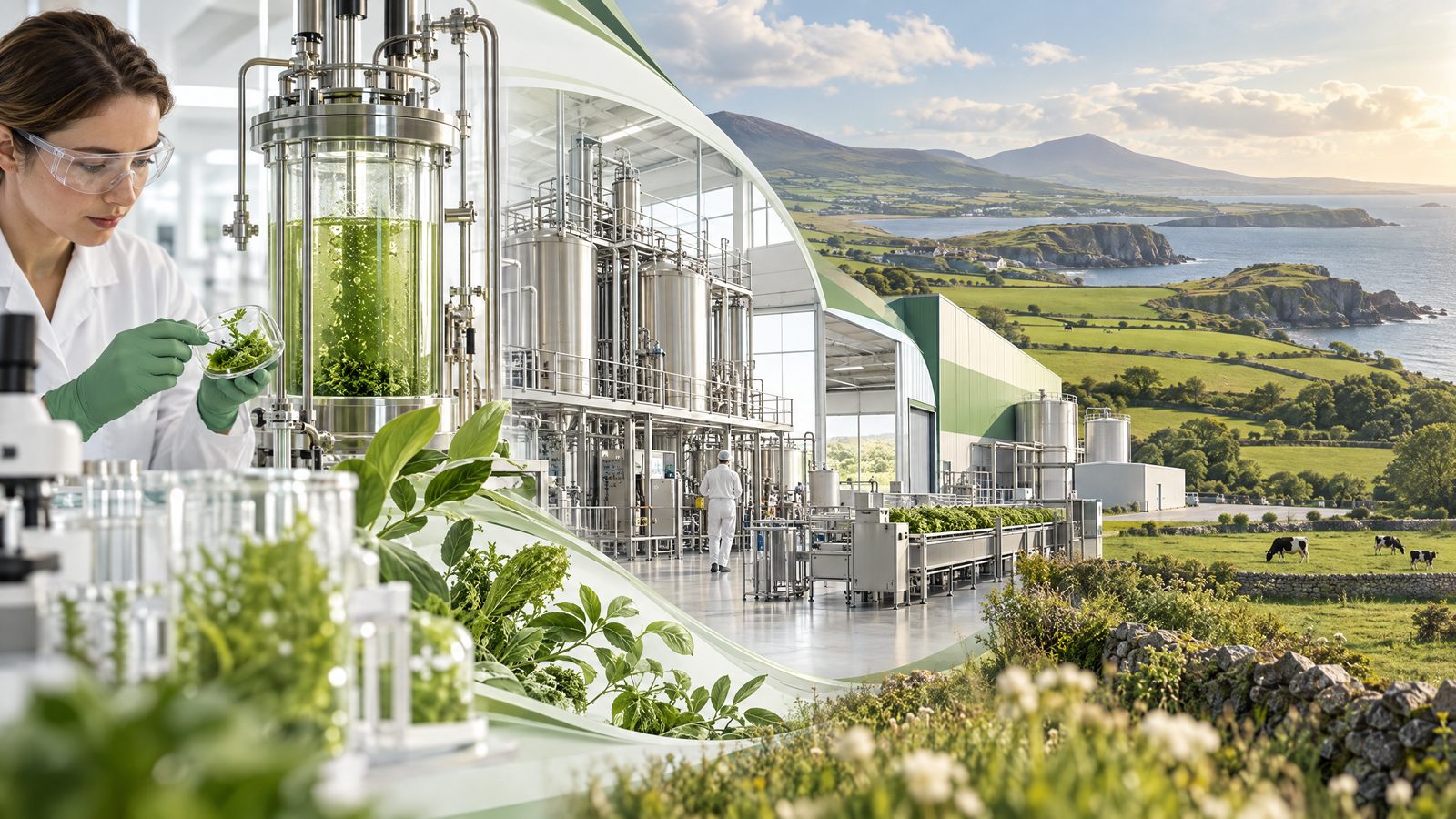

Ireland has launched its first National Bioeconomy Strategy, setting out a five-year framework intended to turn research and renewable biological resources into businesses, markets and regional economic opportunities. Called BioScale 2030, the strategy covers 2026 to 2030 and was launched in Dublin on Wednesday, 21 October.
The policy centres on a practical challenge: moving promising work beyond research and demonstration into commercial deployment. It identifies the infrastructure, finance, sustainable biomass supply, market demand, regulation and skills needed to make that transition, rather than treating innovation alone as enough to build new industries.
Five strategic objectives guide the framework. They cover scaling infrastructure, technology and investment; developing market demand; using innovation, knowledge and skills; applying the bioeconomy to climate action and circularity; and improving governance, cooperation and partnerships. The strategy also focuses on five areas where the Government sees scope to expand sustainable activity: agriculture and circular nutrients; biobased construction and retrofit; marine resources; biomanufacturing and biobased materials for industry; and food and other organic waste.
From biological resources to higher-value products
The term bioeconomy refers to economic activity that produces, processes, distributes or uses biological resources. In Ireland, that can include outputs from farming, forestry and fishing, as well as material left over from food and other processing. The strategy envisages using these resources to make products such as foods, feeds, fertilisers, construction materials and consumer goods, including biobased packaging.
That ambition is tied to a change in how resources are valued. Residues and side-streams that might otherwise be discarded could become inputs for further production. The policy argues that this can create additional value chains and potential income opportunities for farmers, foresters, fishers and other primary producers, while supporting a more circular use of materials. Such outcomes depend on viable processing, markets and sustainable sourcing; the strategy sets a direction, not proof that these benefits have already been delivered.
Ireland is building on earlier policy work, including its 2018 National Policy Statement on the Bioeconomy and a 2023–2025 action plan. The new framework is designed to coordinate public bodies, business, researchers and communities around the next stage, with implementation overseen by a Bioeconomy Development Group co-led by the departments responsible for agriculture and climate, energy and the environment.
Scale-up is the test
The strategy points to existing pilot and demonstration infrastructure as part of the bridge between research and industry. Examples include a grass-biorefinery and anaerobic-digestion demonstration plant in Cork, and a national biorefinery pilot plant and demonstration initiative in Tipperary. These facilities can help test processes and develop value chains, but pilot activity is not the same as full commercial production.
Planned action includes strengthening biomass supply chains, developing facilities for pilot work and scale-up, improving access to finance, supporting demand through standards and public procurement, and building skills. Better regulatory coordination and regional development are also identified as requirements. The strategy does not announce a single new funding pot or guarantee that individual projects will reach market; its emphasis is on creating conditions that make investment and deployment more feasible.
The launch took place during the Global Bioeconomy Summit, held at Dublin’s Convention Centre on 20 and 21 October. The meeting brought together policymakers, researchers, industry, investors and civil society to discuss the sector. The summit provided a platform for the launch, while BioScale 2030 is a national policy with a five-year implementation horizon.
Taoiseach Micheál Martin said the framework would build on recent progress and reduce reliance on fossil fuels. Agriculture Minister Martin Heydon stressed the need to connect Ireland’s natural-resource base with research and new markets so primary producers can share in value created. Climate, Energy and Environment Minister Darragh O’Brien linked sustainable use of biological resources with climate and energy challenges, while cautioning against creating new problems for future generations.
The measure of success will be whether coordination and investment convert the country’s research capacity and renewable resources into durable businesses and products, while maintaining sustainability safeguards. BioScale 2030 now gives that effort a national structure; delivery will depend on the actions, market development and infrastructure built over the years to 2030.







