


The design economy in London contributed £43.3 billion in GVA in 2023, accounting for almost a third (32%) of the entire UK design economy, according to new research from the Design Council.
Design Economy 2026, the Design Council’s flagship study into the value of design, shows the scale of design’s contribution across industries, places and jobs, and argues that strengthening design capability will be critical to delivering good growth across the UK.
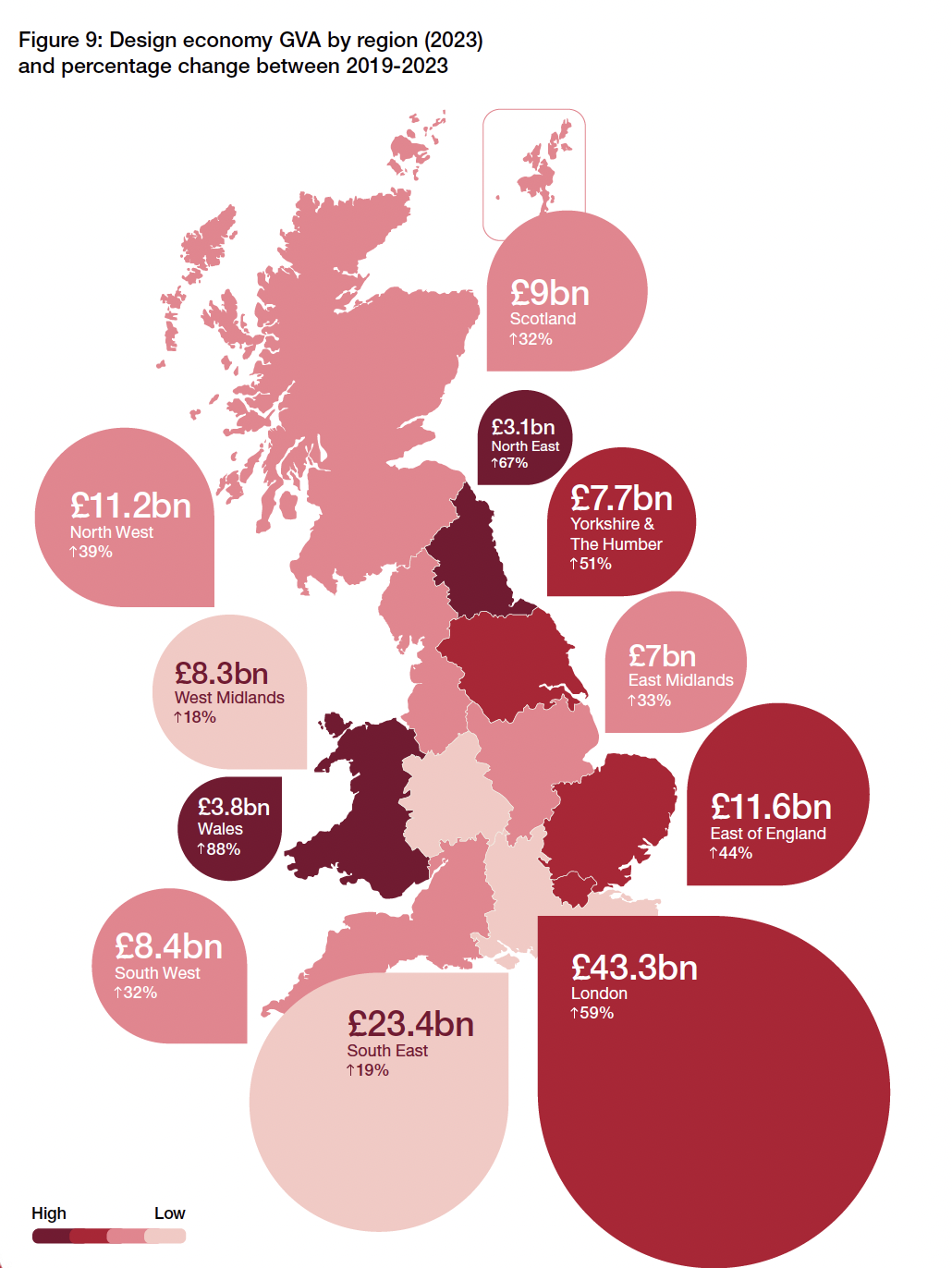
Design Economy 2026 report, which is published every three years, reveals London remains the UK powerhouse with design GVA increasing by 59% since 2019, significantly ahead of the 40% increase recorded nationally.
Design now accounts for 7.5% of the region’s overall GVA, demonstrating its growing importance to the local economy.
London also continues to be a major centre for specialist design expertise. Architecture, built environment and multidisciplinary design employment are particularly concentrated in the capital, which is home to four of the five strongest UK clusters for these design disciplines.
Together, London and the South East generated £66.7 billion in design GVA in 2023 – equivalent to 49% of the UK total. This is broadly unchanged from 48% in 2019, underlining the continued concentration of design activity in and around the capital.
However, London’s dominance in economic output has not been matched by the same pace of employment growth in the sector. Design employment in the capital has increased by just 3% since 2020, the slowest rate of any UK region, compared with a 15% increase nationally.
The findings come as London prepares to once again showcase its design credentials through London Design Festival (12 – 20 September 2026), bringing together designers, businesses and institutions from across the capital and beyond.
Professor Mariana Mazzucato, Founding Director of the UCL Institute for Innovation and Public Purpose and Design Council ambassador commented,
“Design increasingly demonstrates that it is not merely another productive sector. It is a strategic capability that shapes how products are made, services are organised, technologies are governed, institutions operate and places develop in fields including healthcare, finance, advanced manufacturing, digital technologies, and the built environment. The report therefore provides evidence not simply of economic expansion, but of design’s role in steering economic transformation.”
Alongside a positive economic growth story, the report also warns that future growth cannot be taken for granted. In the UK as a whole, entries for Design and Technology GCSEs have fallen by 68% over the decade to **2024, raising concerns about the future skills pipeline at a time when businesses need design capabilities to respond to rapid technological change, including AI. Progress on workforce diversity also remains slow: women account for only 25% of designers, while Black designers make up 2% of the design workforce compared with 5% of the wider UK working population.
Mat Hunter, Chief Executive of the Design Council said,
“These figures should change the way we think about design. It is not a niche creative activity sitting at the edge of the economy; it is a £136.7 billion capability embedded in the way organisations effectively innovate, tackle complex problems and grow. What is particularly exciting is the opportunity for growth to reach every part of the UK. Stronger design capability can help cities and regions build on their existing strengths, create higher-value jobs and turn local investment and innovation into a long-term economic advantage. The opportunity now is to make sure that capability is available everywhere – in businesses and public services, across every region and nation – and that we invest in the skills and diversity needed to sustain it for the future.”
The Design Council says the findings demonstrate the potential for design to support regional growth, place-based innovation and higher-value jobs, and is calling for government, businesses and public bodies to strengthen design capability and invest in regional design ecosystems and the skills pipeline.
Design Economy 2026 is published by the Design Council and is available to view / download: Design Economy – Design Council.







