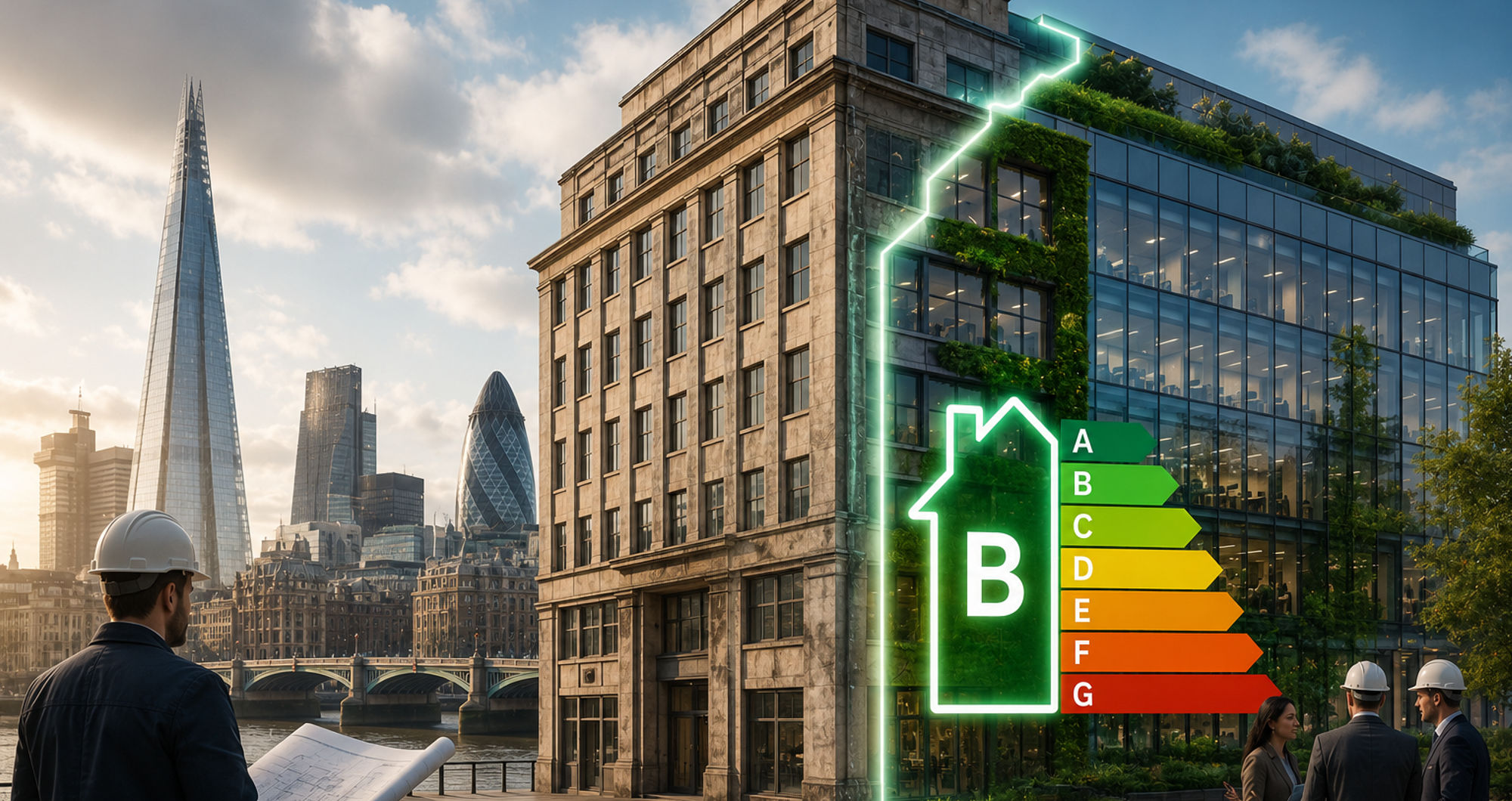

London’s commercial property owners have been given more time to improve energy performance, but the direction of travel is unchanged. In June 2026, the Government confirmed its intention to strengthen Minimum Energy Efficiency Standards for larger privately rented non-domestic buildings. Under the current proposal, rented commercial buildings over 1,000 square metres in England and Wales would need to reach EPC B from 2031, where cost-effective and subject to secondary legislation.
The previously proposed 2027 EPC C milestone will not be taken forward, giving landlords and tenants more time to plan improvements around leases, service charge cycles, finance and refurbishment programmes.
However, for London this should not be read as a pause. The capital’s office market is already moving in the same direction. Occupiers want better, greener and more efficient space. Planning policy is increasingly pushing developers to consider retrofit before demolition. Investors are looking more closely at whole-life carbon, operational performance and the risk of older assets becoming harder to let. The result is that retrofit is becoming one of the most important commercial property issues in London.
London’s retrofit pressure is already visible
London has one of the most complex property markets in the world. It also has a large stock of ageing commercial buildings, many of which were built before modern energy efficiency standards became a major consideration.
That matters because the UK’s existing buildings are central to net-zero delivery. The Parliamentary Office of Science and Technology has noted that around 80% of the UK’s national building stock will still be in use in 2050, and that the UK currently has the oldest building stock in Europe.
In London, this challenge is particularly acute. The city cannot meet future demand for sustainable commercial space through new development alone. There are planning constraints, heritage constraints, land constraints and carbon constraints.
At the same time, central London continues to see demand for high-quality office space. Savills reported that leasing across Central London reached 2.2 million sq ft across 152 transactions in Q1 2026, up 6% on Q1 2025 and slightly above the 10-year average. This creates a difficult question for landlords: how do you make older buildings competitive without defaulting to demolition and rebuild? Increasingly, the answer is retrofit.
Retrofit-first is becoming a London planning reality
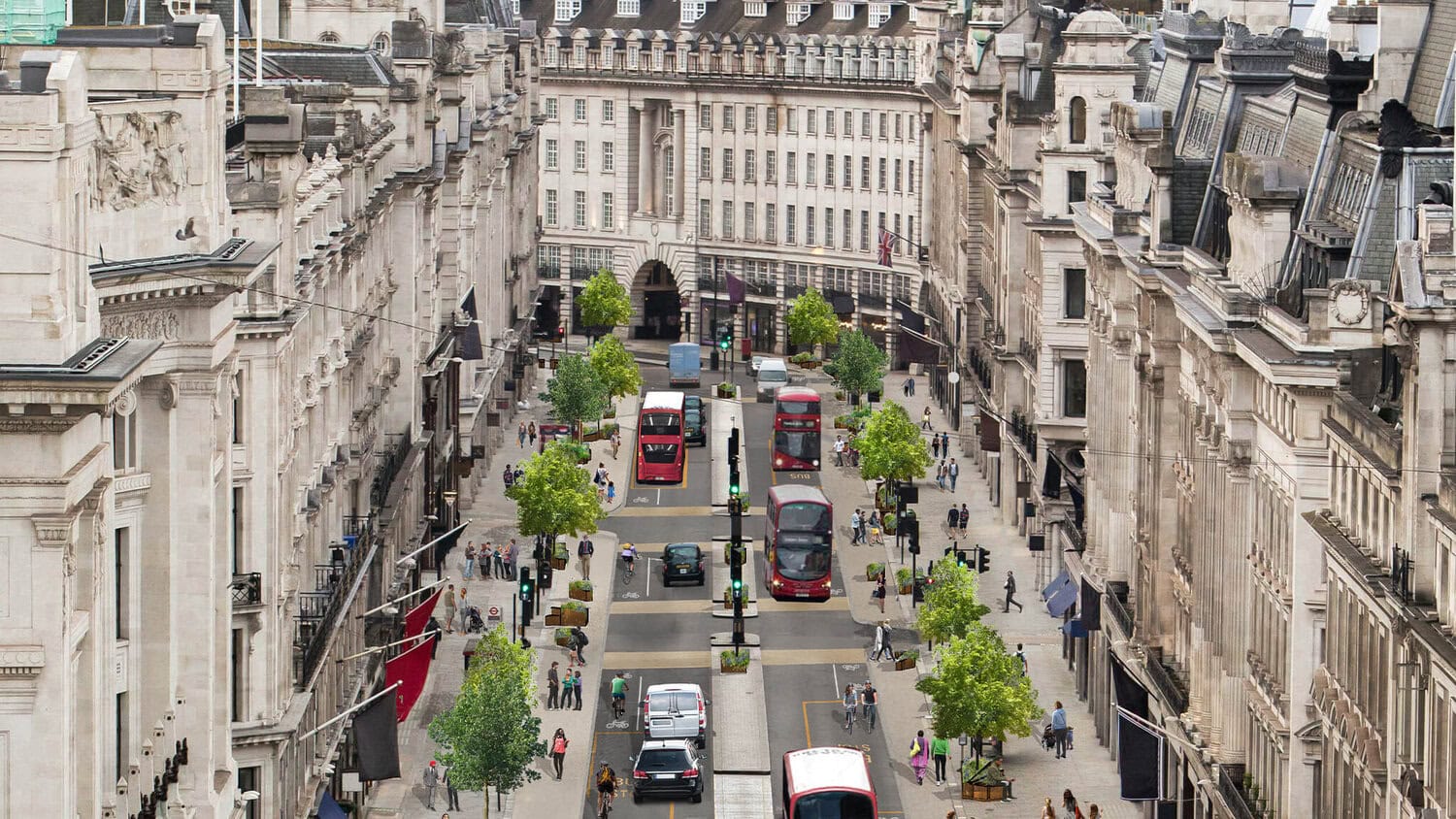
London’s planning environment is already shifting toward retention, refurbishment and reuse. The City of London Corporation’s Carbon Options Guidance makes clear that retrofit and retention of existing buildings and structures should be prioritised where feasible, partly to reduce embodied carbon emissions and demolition waste. It also requires applicants to explore options for retaining existing buildings and structures before proposing substantial demolition.
Westminster has moved in a similar direction. Its retrofit-first planning approach requires developers to explore refurbishment before demolition, with the aim of upgrading commercial and residential buildings while helping the borough reach net zero by 2040.
This is not a ban on redevelopment. Some buildings will still need major replacement where there are structural, safety or performance reasons. But the planning test is becoming more demanding. Developers increasingly need to show why demolition is necessary, not simply why a new building might be commercially attractive.
The carbon cost of replacement is becoming harder to ignore
The biggest reason retrofit has moved up the agenda is whole-life carbon. Operational carbon remains important, but it is only part of the picture. The construction industry is now paying closer attention to embodied carbon: the emissions created through manufacturing, transporting, installing, maintaining, replacing and disposing of materials.
For London’s commercial buildings, the facade is one of the clearest examples. A building exterior is not just an architectural feature. It protects the structure, affects energy performance, shapes tenant perception and contains a large amount of material already manufactured and installed.
Research by Arup and Saint-Gobain found that, across the 16 facade systems studied, embodied carbon ranged from 160 to 520 kgCO2e per square metre of facade, depending on system type and design. For a large London office building, that is a significant carbon consideration.
If a facade is removed and replaced prematurely, the building owner creates a new carbon burden through manufacturing, transport, installation and waste. If the facade can instead be cleaned, restored, repaired and maintained, much of the existing embodied carbon can be preserved.
Facade restoration is becoming part of the retrofit conversation
Retrofit is both an environmental and a financial argument. Specialist facade restoration contractor See Brilliance suggests that facade restoration should be seen as part of the wider retrofit strategy for commercial buildings, rather than only as cosmetic maintenance. Its project data suggests facade refurbishment can cost as little as 5% of full replacement, depending on the condition of the building and scope of works.
Nick Down, Director at See Brilliance, said:
“London has thousands of commercial buildings with facades that still have useful life left in them. The challenge is not always that these buildings need replacing. In many cases, they need careful cleaning, restoration and planned maintenance so the existing materials can keep doing their job for longer.
“Once you factor in cost, disruption and embodied carbon, facade restoration becomes a serious retrofit decision. If a building owner can extend the life of the existing envelope instead of replacing it prematurely, that can make a meaningful difference to both project cost and carbon impact.”
That matters in London and other major cities, where building owners are often balancing high capital costs, tenant disruption, complex access requirements and planning considerations. A full facade replacement may still be necessary in some cases, particularly where there are safety, fire, structural or systemic performance issues.
However, where deterioration is primarily visual, localised or related to surface contamination, restoration can offer a lower-cost, lower-disruption alternative. This includes specialist cleaning, localised repairs, sealant renewal, protective treatments and ongoing maintenance programmes designed to extend the life of the existing building envelope.
Retrofit is not just about heat pumps and insulation
Much of the public conversation around retrofit focuses on energy systems: heat pumps, solar panels, lighting controls, glazing and insulation. Those measures are important, but commercial retrofit is broader than that.
For a London office, hotel, retail asset or civic building, the retrofit question includes the condition of the existing fabric. A building with water ingress, deteriorating external materials, biological growth, staining or poorly maintained facades may need basic fabric improvements before deeper energy upgrades can perform properly.
This is where maintenance and restoration become part of the retrofit conversation. Keeping existing materials in service for longer reduces the likelihood of early replacement. It also helps protect the value of the asset while more substantial upgrades are planned.
In practical terms, the best retrofit strategies are often phased. They do not rely on one large intervention. They combine fabric maintenance, energy efficiency improvements, better controls, services upgrades and long-term asset planning.
London’s older offices face a choice
London’s office market is becoming increasingly divided. On one side are highly efficient, well-located buildings that meet occupier expectations around sustainability, amenity and performance. On the other are older assets that may become harder to lease unless owners invest in them.
That does not mean every older building is obsolete. In many cases, the opposite is true. Older London buildings often have strong locations, distinctive architecture and embodied carbon already locked into the structure.
The challenge is making them fit for modern use without erasing their value through unnecessary demolition. Retrofit gives owners a middle path: retain what works, upgrade what needs improvement and replace only what cannot sensibly be preserved.
The next few years matter
The proposed 2031 EPC B timetable may feel distant, but commercial property decisions move slowly. Surveys, planning, funding, procurement, tenant engagement and phased works can take years, especially on occupied buildings. Owners who wait until regulation is finalised may find that the practical window for cost-effective improvement has narrowed.
London’s landlords should use the additional time strategically. The first step is understanding the building’s current condition. That includes EPC performance, services, glazing, facade condition, maintenance history, water ingress risk, lease profile and the likely carbon impact of different options.
For some buildings, that will lead to major retrofit. For others, it may mean targeted upgrades, restoration and better maintenance. What is becoming harder to justify is inaction.
Retrofit is now central to London’s property future
London will continue to build new offices, homes, hotels and mixed-use developments. But the capital’s sustainability challenge will increasingly be won or lost in the buildings that already exist. The Government’s latest MEES update gives landlords more time, but not a different direction.
With planning policy moving toward retrofit-first thinking, occupiers demanding better-performing space and carbon assessments becoming more important, London’s commercial property owners need to treat existing buildings as assets to improve, not problems to replace. The future of London property will not only be shaped by the next tower on the skyline. It will also be shaped by how intelligently the city upgrades the buildings it already has.