

Eight new Robotics Adoption Hubs are being launched with £40 million of support to help organisations move from considering automation to putting it into practical use. The programme is aimed at the adoption of proven robotics and autonomous systems across sectors including manufacturing, agriculture, logistics, healthcare, waste and public services.
The hubs are not research projects in isolation. Their task is to give businesses and public-service organisations practical advice on benefits, costs and integration requirements; to demonstrate technology in working settings; and to connect potential users with suppliers, integrators and finance providers. That focus is important for smaller firms that may understand the potential of robotics but lack the capacity to test options or build a business case alone.
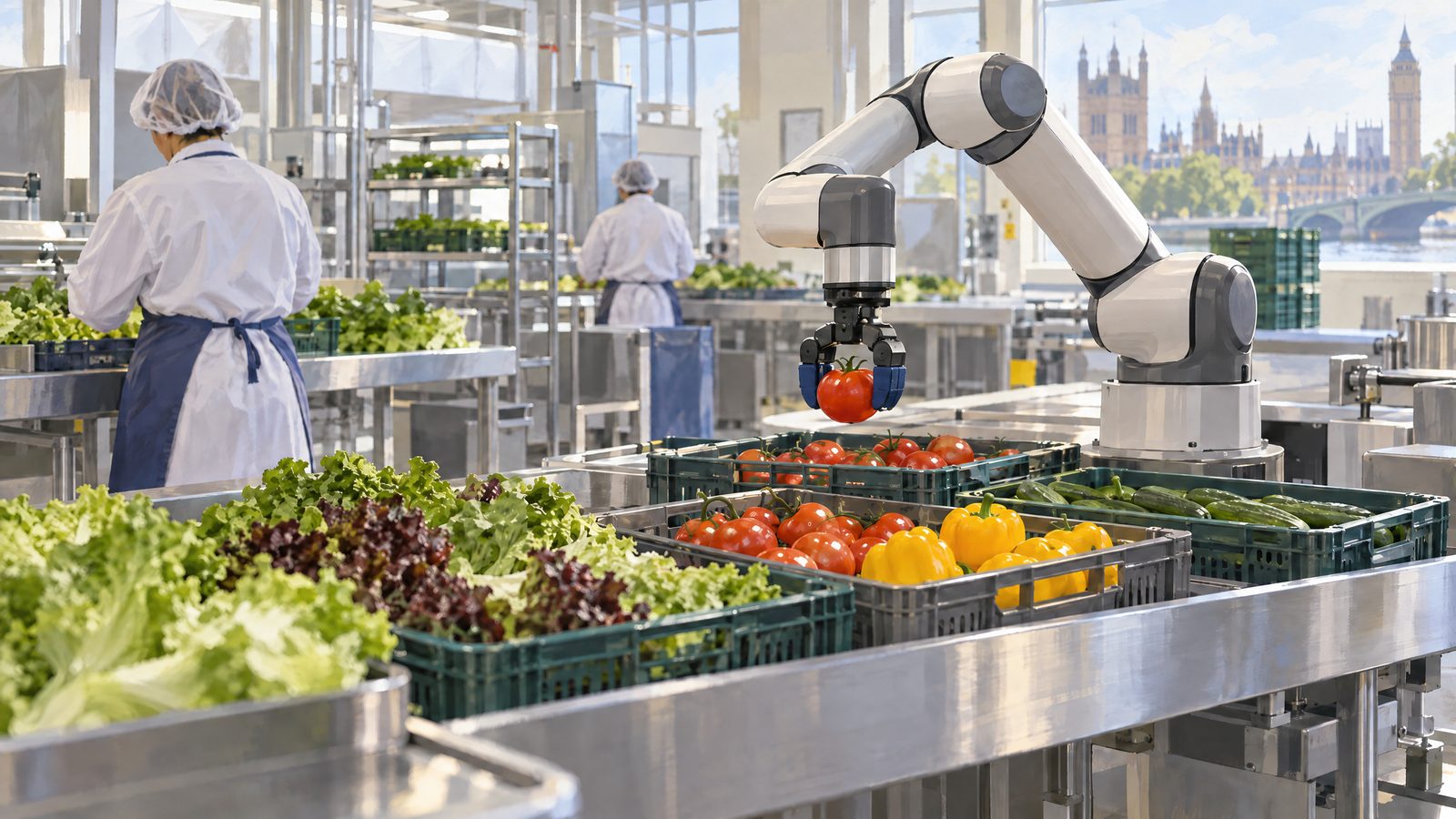
Sites are planned in the Greater South West, Lincoln, Milton Keynes, South Wales, Yorkshire and other regions. The Milton Keynes hub will examine service robots, drones and driverless vehicles in public spaces and transport settings. The HARVEST hub in Lincoln will focus on agri-food applications, including automated fruit picking and food manufacturing. A national waste and recycling hub will support sites looking to recover more material and reduce landfill.
The University of Lincoln has set out how the scheme will work at one location. It has secured £4.8 million as part of a £7.1 million investment for HARVEST, one of the eight selected hubs. The university says the hub will include a test track, industry-led living labs and a £1 million acceleration fund intended to help agri-food robotics businesses overcome adoption barriers. Its industry partners include developers and end users from across the food supply chain.
The national programme also includes £1.7 million for a convening body, delivered by The Welding Institute with Anglia Ruskin University, to share learning across the hubs. A further £2.5 million will support 12 projects for practical training, continuing professional development, apprenticeships and outreach. Those amounts are complementary elements of the programme and should not be confused with the £40 million allocated to the hub network.
Government estimates suggest that robotics and autonomous systems could add £150 billion to the economy by 2035 if adoption is maximised, compared with £6.4 billion at current adoption levels. These are projections rather than realised gains. The announcement does not guarantee productivity improvements for individual companies, and it does not direct businesses to adopt a particular technology.
For entrepreneurs, suppliers and established operators, the new network is best understood as an adoption infrastructure. It offers routes to impartial advice, demonstration, skills and connections rather than a promise that every business will receive funding or a robot. The support is intended to reduce uncertainty around technical fit, commercial integration and workforce requirements before a firm commits capital.
The programme’s success will depend on whether organisations can translate demonstrations into sustainable deployments. The hubs are explicitly geared towards use in practice, not fundamental research, and are expected to work with existing facilities where possible. That makes the new funding a commercial-development story as much as a technology announcement: the objective is to make established capabilities more usable for the businesses that need to decide whether, when and how to deploy them.







