
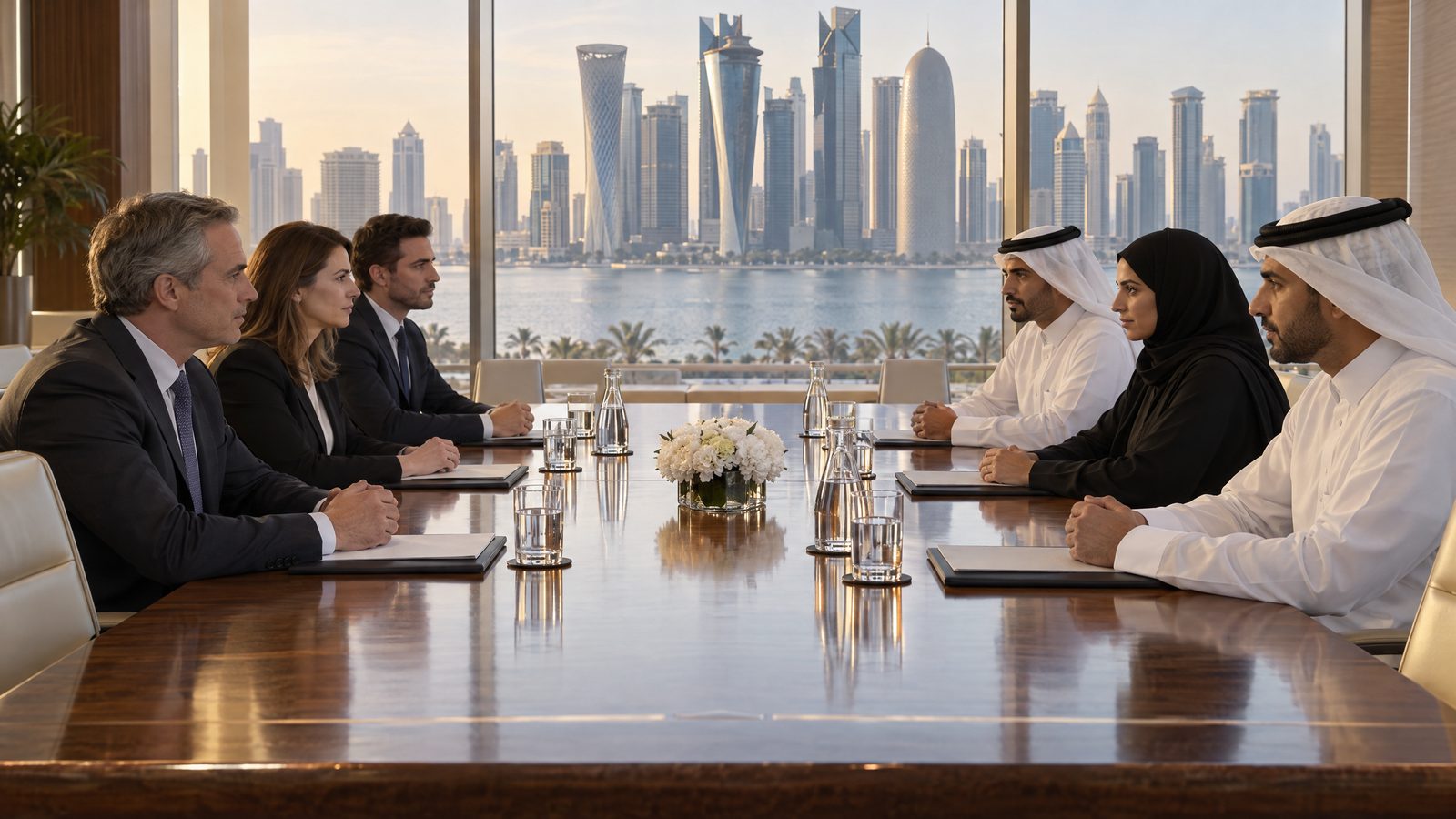

Pakistan and Qatar have used a second joint meeting on trade and investment to set out areas for further work, while leaving several of the most significant proposals subject to later approvals and follow-up.
The Pakistan–Qatar Joint Task Force on Trade and Investment met in Doha on 24 October, co-chaired by Pakistan’s Federal Minister for Commerce, Jam Kamal Khan, and Qatar’s Minister of State for Foreign Trade Affairs, Dr Ahmad bin Mohammed Al-Sayed. It was the task force’s second meeting, following its inaugural session in April.
Rather than announcing a completed investment package, the discussions focused on trade access, prospective projects and the machinery needed to take ideas forward. The two sides reviewed economic cooperation since the first meeting and considered measures intended to support trade and investment across a range of sectors.
Pakistan pressed for the early signing of a free trade agreement with the Gulf Cooperation Council. Pakistani representatives said their domestic approval process had been completed and that the approved text had been sent to the GCC Secretariat at the end of 2025. The remaining formalities have yet to be completed.
Market access for food products was also on the agenda. Pakistan raised restrictions affecting exports of bone-in meat to Qatar and sought an early resolution. It said a technical dossier dealing with animal-health and food-safety requirements had already been shared with the relevant Qatari authorities.
Food security featured in a separate proposed arrangement. A memorandum concerning supplies of Pakistani rice between the Trading Corporation of Pakistan and Qatar’s Hassad Food has been put before Pakistan’s Federal Cabinet for approval. That means the arrangement has not been finalised. Pakistan also invited Qatari participation in modern farming, grain storage, silos, cold-chain facilities and agricultural technology, alongside discussions on more sustainable food-supply arrangements.
The agenda extended to industry and infrastructure. Pakistan presented opportunities connected with new-energy and electric vehicles, including potential joint manufacturing, technology transfer and industrial partnerships. It also encouraged investment in information technology, digital infrastructure and digital services.
In maritime transport, the talks considered cooperation involving oil tankers, liquefied natural gas carriers and container vessels. Pakistan also presented a proposed Karachi–Hyderabad motorway as a possible investment opportunity, describing it as a route that could improve connections between seaports and the national road network. These projects were presented for consideration, not announced as funded commitments.
Qatar highlighted civil aviation and air-traffic cooperation. Pakistan said aviation matters could be taken forward through a technical working group on logistics and communications. The Pakistani side also presented the idea of an investment fund spanning infrastructure, agriculture, industrial development and technology.
A central practical issue is the activation of eleven technical working groups identified at the first task-force meeting. Their proposed remit covers logistics, aviation, advanced manufacturing, mining and minerals, agriculture, tourism, financial technology, healthcare, education, industrial development, information technology and start-ups. Pakistan said it had shared its proposed membership and asked Qatar to nominate its counterparts so the groups could begin work.
The two ministers signed the minutes of the task force’s first meeting at the close of the Doha session. The working groups are expected to identify opportunities, address outstanding issues and produce sector-by-sector progress reports before a third meeting, which Pakistan is due to host. For now, the outcome is a framework for continuing bilateral work rather than a list of completed deals.







