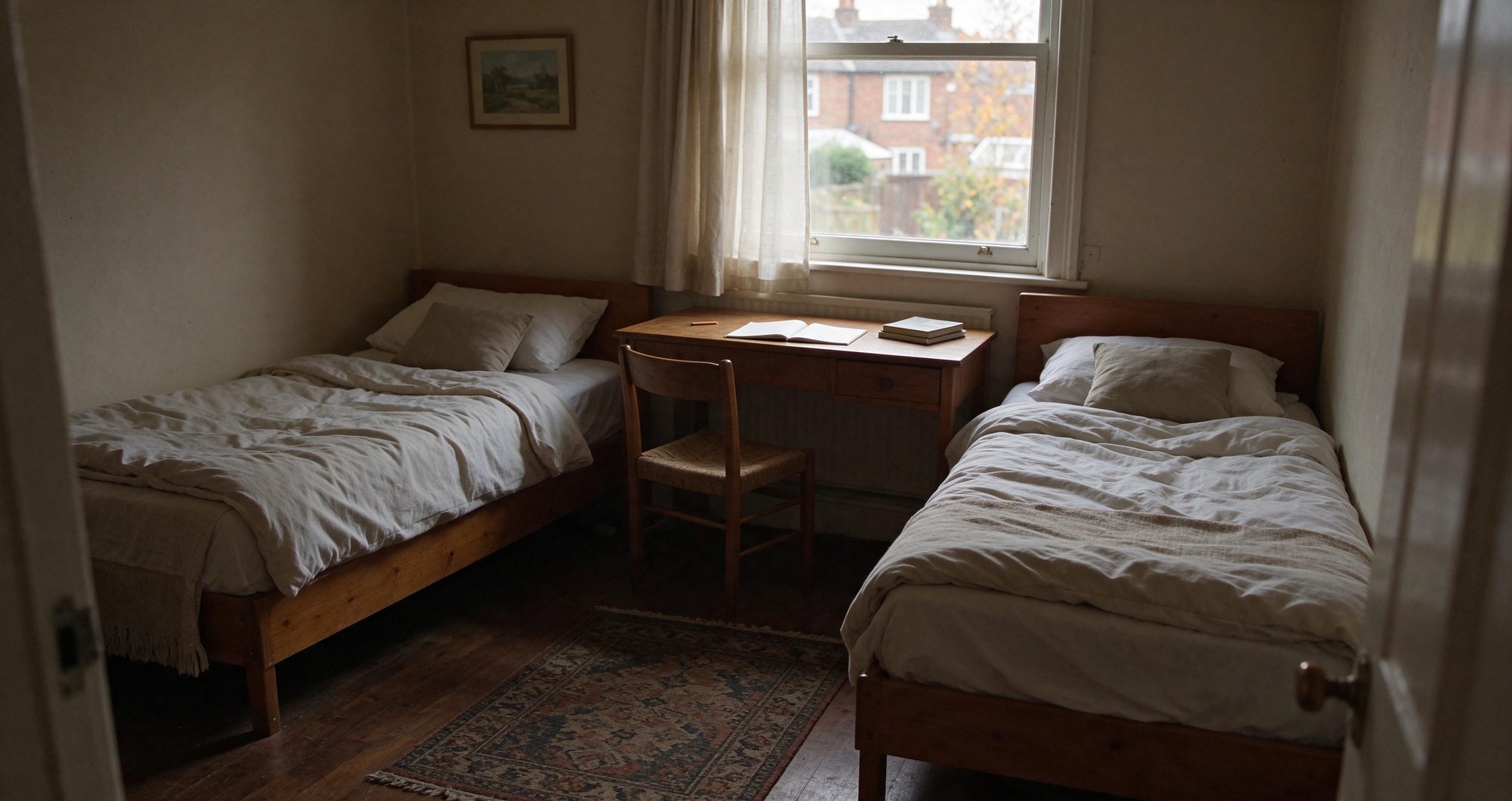

Poor-quality housing in childhood is linked to lower exam grades, reduced educational progression and worse health and wellbeing later in life. A new analysis published on 26 November examines how the space, quiet and stability available at home relate to young people’s opportunities, beyond the broader disadvantages associated with family income.
The findings bring together three UK longitudinal studies, which follow people over time. They cover educational results, adolescent health and wellbeing, and outcomes in adulthood. The comparisons show associations rather than establishing that housing conditions alone cause the differences observed.
Space to study and the attainment gap
A central measure is the physical home learning environment: whether a young person has their own bedroom and a quiet place to work, and whether their home is overcrowded or noisy. These conditions differ sharply between households at opposite ends of the income distribution.
At age 11, 52 per cent of children in the poorest fifth of families shared a bedroom, compared with 7 per cent in the richest fifth. Children from poorer families were also more likely to live in noisy homes and lack a quiet place to study.
Around 10 per cent of the link between family income and GCSE results was accounted for by housing quality. Almost all of that contribution related to differences in the space and quiet available at home, rather than to other housing characteristics.
Even when comparing young people with similar family incomes, backgrounds and measured skills earlier in childhood, home learning conditions typical of the poorest fifth were associated with scores around a sixth of a grade lower in each of their best eight GCSEs than conditions typical of the richest fifth. Poorer conditions were also linked to lower participation in A levels and higher education.
A similar pattern appeared among pupils whose schooling was disrupted by the pandemic. Those without a suitable or quiet study space in Year 12 achieved lower results across A levels and other Level 3 qualifications combined, even when their results at the end of primary school were comparable.
Homelessness findings need particular caution
Young people whose families had experienced homelessness by age 14 were 18 percentage points less likely to achieve five good GCSEs, including English and maths. They were also around 19 percentage points less likely to progress to higher education.
Those figures are unadjusted differences. They do not account for the other disadvantages faced by families experiencing homelessness. The group in the data was small, so the analysis could not reliably separate the role of homelessness itself from wider family circumstances. These gaps should not be read as the effect of homelessness alone.
Links extend into adult life
Childhood housing problems were also associated with outcomes measured between ages 26 and 44. Each additional problem experienced at ages 11 to 15 was linked to a roughly three percentage-point lower chance of having a degree or being in work, after accounting for family background and region. Earnings among those in work were around 4 per cent lower.
The problems examined included a shortage of space, street noise, condensation and vandalism or crime in the surrounding area. Poorer childhood housing was also linked to worse adult health and lower life satisfaction.
However, the education and employment associations became less clear after further accounting for housing tenure and property type. The associations with adult health and life satisfaction remained. In adolescence, damp was associated with poorer physical health, while less favourably rated neighbourhoods were linked to lower wellbeing and greater psychological distress.
Housing and education policy together
Proposals accompanying the findings include prioritising families with school-age children when tackling overcrowding, particularly near GCSE and A-level stages. Housing standards could consider room for a desk alongside warmth, safety and freedom from damp. These are recommendations, not newly implemented requirements.
Quiet study spaces in schools and libraries could provide more immediate support, although they would not replace improvements to housing. Closer coordination between housing, education and health policy, and better links between official housing and education records, are also proposed to identify needs and evaluate the consequences for children’s learning and wellbeing.