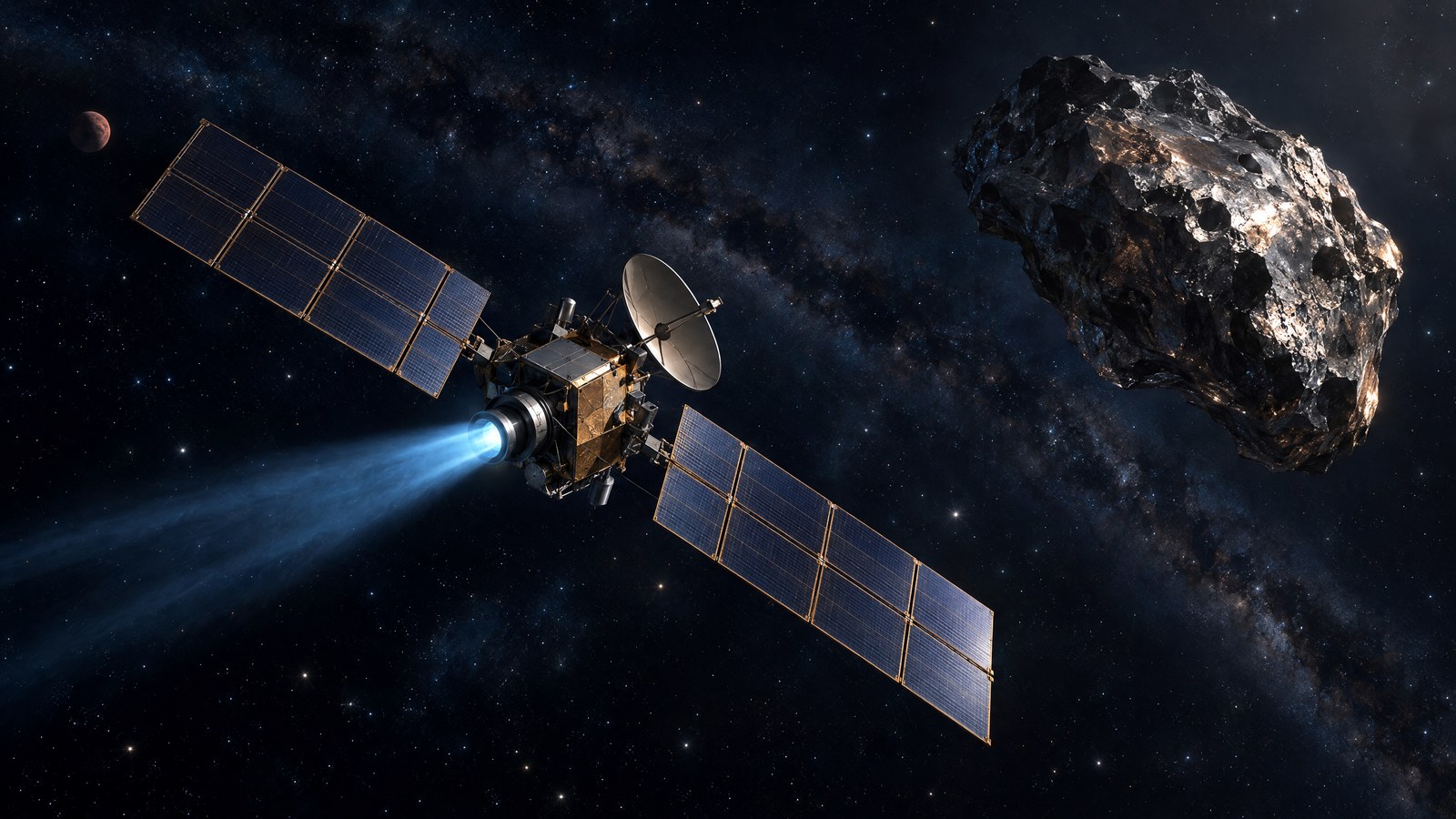

Psyche begins sustained push towards asteroid target
NASA’s Psyche spacecraft has entered a new phase of its journey, running its solar-electric propulsion system nearly continuously as it heads towards the metal-rich asteroid Psyche. The change followed the spacecraft’s successful Mars gravity assist and began on 28 September. Mission controllers expect the spacecraft to reach its destination in the main asteroid belt in summer 2029.
The thrusters are scheduled to operate at every available opportunity, with a weekly pause for the spacecraft to check in with Earth-based controllers. The mission team says propulsion will be available for nearly 90 per cent of the time on the cruise to the asteroid. This is a planned operating pattern, not a claim that the spacecraft has arrived or begun studying its target.
How solar-electric propulsion works
Psyche’s propulsion system draws electricity from sunlight and uses electromagnetic fields to expel charged xenon atoms, or ions. The resulting thrust is gentle compared with the short, powerful bursts produced by conventional chemical rocket engines. Its effect accumulates over a long journey, gradually changing the spacecraft’s speed and course.
The spacecraft carries four Hall-effect thrusters, although they operate one at a time. At maximum output, the system can deliver up to 250 millinewtons of force. Two cross-shaped solar arrays, each made up of five panels, provide power for the spacecraft’s systems. Their combined sunlight-collecting area is about 800 square feet.
Psyche launched in October 2023 with nearly 2,400 pounds of xenon stored in seven tanks. The mission team reported that around one third of this supply had been used by the time of its latest update. The remaining propellant is intended to support the cruise and the spacecraft’s planned two-year prime science mission in orbit around the asteroid.
Mars flyby marked a change in the journey
Before the Mars encounter, Psyche used its electric propulsion intermittently to position itself for the planet’s gravity assist. The flyby provided a propellant-saving boost in speed and a change to the spacecraft’s trajectory. Once that manoeuvre was complete, the mission could move into the sustained propulsion phase that began on 28 September.
The system’s operation will change as Psyche travels farther from our nearest star. Mission engineers expect it to run at full power for about three months before gradually reducing to roughly half power as the solar arrays receive less sunlight and generate less electricity. The projected 2029 arrival is a forecast and remains dependent on the mission continuing along its planned route.
Managing a small but measurable twist
Extended thruster operation also gives engineers an opportunity to monitor a small twisting force, or torque, associated with the flow of xenon ions. The ions swirl in the magnetic field inside a Hall-effect thruster. Their motion can impart angular momentum that would otherwise affect the spacecraft’s pointing.
Psyche uses reaction wheels to manage that momentum. After several hours of thrusting, engineers can switch off a thruster, rotate the spacecraft and operate another thruster briefly at low power in a different direction. That sequence helps remove momentum accumulated in the wheels while allowing the propulsion system to continue its work over the longer cruise.
The mission team says the spacecraft is measuring this torque in space across different power levels and periods of operation. The measurements are possible because the effect is too small to observe in the same way on Earth. They provide engineering information about how Hall thrusters behave during prolonged operation, alongside the propulsion needed to reach Psyche.
When the spacecraft reaches the asteroid, it is expected to enter orbit and map the object through a sequence of lower and higher orbits. Psyche is about 173 miles across at its widest point. Scientists think it may be the partial core of an early planetesimal, but that interpretation has not been established; the spacecraft’s observations are intended to help investigate the asteroid’s composition and history.
For now, the mission remains in interplanetary cruise. The operational milestone is the move to near-continuous solar-electric thrusting after Mars, while the destination, orbital science phase and summer 2029 arrival remain ahead.